Does Time Exist Everywhere the Same Way? | Bedtime Astronaut For Sleep
In the quiet expanse of your imagination, where the stars twinkle softly against the velvet night, we find ourselves together, embarking on a journey through the cosmos. Here, in this serene space, we are explorers not only of distant galaxies and mysterious planets but also of the very nature of existence. Today, we gently turn our thoughts to the nature of time itself, a concept so woven into the fabric of our daily lives that it often slips by unnoticed, like the gentle ticking of a distant clock. Yet, in the universe, time can be as elusive and intriguing as a comet streaking across the sky.
To begin our exploration, imagine time as a flowing river. In our everyday experience, this river carries us steadily forward, with each moment seamlessly following the next. We measure its passage with clocks and calendars, marking its flow in seconds, minutes, hours, and days. This orderly progression gives structure to our lives, allowing us to plan and remember, to look forward and reflect. However, this familiar rhythm of time is not a universal constant. The river of time can bend and twist, altering its pace and direction depending on where you are in the universe and how you are moving within it.
The foundation of our understanding of time's fluid nature begins with the work of Albert Einstein, whose theories of relativity transformed the way we think about both space and time. In Einstein's view, time is not a separate entity but is intertwined with the three dimensions of space, forming a four-dimensional continuum known as spacetime. This elegant fabric is not rigid but is instead shaped by the presence of mass and energy. Just as a heavy object placed on a flexible surface will cause it to curve, so too does mass cause the fabric of spacetime to warp. This curvature affects the flow of time, causing it to slow down in the presence of strong gravitational fields.
Consider, for a moment, the vastness of a massive star or a dense planet. These celestial bodies, with their immense gravity, bend spacetime around them. As a result, time runs more slowly in their vicinity compared to regions of weaker gravitational influence. This phenomenon, known as gravitational time dilation, has been confirmed through precise experiments. Atomic clocks, which are marvels of precision and reliability, tick differently when placed at varying altitudes on Earth. Those positioned at higher elevations, where the gravitational pull is slightly weaker, run faster than those located closer to sea level. This subtle variation, though imperceptible in our daily lives, has profound implications for our understanding of the universe.
Now, let us imagine traveling at speeds approaching the speed of light, the ultimate speed limit of the cosmos. According to the principles of special relativity, as you move faster, time itself begins to stretch and slow. For a traveler journeying at such extraordinary velocities, a journey that might seem to take only a few hours could equate to years passing for those left behind. This time dilation effect is not merely theoretical; it is an observable reality, confirmed by experiments involving fast-moving particles and precise measurements of time aboard swiftly orbiting satellites.
As we drift further into this contemplation, we can appreciate how these principles of relativity reveal a universe where time is not a uniform backdrop, but a dynamic participant in the cosmic dance. Each location in the universe, each speed of travel, provides its own unique experience of time. This relativity of time invites us to ponder the interconnectedness of all things and the ways in which the universe is both vast and intimately connected.
While the intricacies of relativity provide one lens through which to view the nature of time, there are other aspects to consider. On a more fundamental level, time is deeply intertwined with the laws of thermodynamics, which govern the flow of energy and the evolution of systems toward equilibrium. The second law of thermodynamics, in particular, introduces the concept of entropy, a measure of disorder. In a closed system, entropy tends to increase over time, driving processes toward a state of greater randomness. This natural tendency toward disorder provides a directionality to time, often referred to as the "arrow of time." It is this arrow that gives the universe its forward momentum, guiding the unfolding of events from past to future.
The interplay between relativity and thermodynamics paints a picture of time that is both intricate and subtle, prompting us to reflect on its role within the cosmos. It is a reminder that our understanding of time is not static, but evolves as we continue to explore the universe and uncover its secrets. As we ponder these concepts, we are invited to consider our own relationship with time, how we measure it, and how we experience its passage.
In this vast and ever-changing universe, the question arises: does time exist everywhere the same way? The answer, as we have begun to see, is a resounding no. Time, like a skilled illusionist, adapts its performance based on the stage upon which it finds itself. In the gravitational embrace of a black hole, a region where the pull of gravity is so intense that not even light can escape, time slows to such an extent that for an outside observer, it appears to stand still. In contrast, at the edges of the universe, in the vast and empty stretches of intergalactic space, time flows with a different rhythm, unburdened by the gravitational pull of massive objects.
In contemplating these cosmic scales, we are reminded of the delicate balance that governs the universe. Each star, each planet, and each galaxy is a thread in the intricate tapestry of spacetime, contributing to the symphony of existence. As you listen, you might imagine yourself as a traveler through this vast expanse, feeling the gentle pull of gravity and the subtle shifts in time as you journey from one celestial body to another. It is here, in the quietude of these thoughts, that we find a sense of connection to the cosmos, a reminder of our place within the universe.
As we bring this part of our journey to a natural pause, let us rest in the knowledge that time, in all its complexity and wonder, remains one of the most profound mysteries of our existence. It shapes our lives, our histories, and the very fabric of the cosmos. And though we may never fully unravel its secrets, the quest to understand it invites us to marvel at the beauty of the universe and the intricate dance of time and space.
Time, in its vast complexity, extends its influence beyond the immediate grasp of human perception, weaving through the lives of stars, galaxies, and the fabric of the universe itself. In this grand tapestry, time guides the evolution of cosmic structures, from the birth of stars in swirling nebulae to the majestic dance of galaxies across the vast canvas of space. The lifecycle of a star, with its phases of birth, life, and eventual death, is a testament to time's gentle yet inexorable progression. In the heart of stellar nurseries, clouds of gas and dust coalesce under the influence of gravity, igniting nuclear fusion and giving birth to new stars. These stars, in turn, live out their lives over millions or even billions of years, their fates determined by their initial masses. Some will end their days in spectacular supernovae, scattering elements forged in their cores across the cosmos, while others will quietly fade into white dwarfs, steadily cooling over eons.
As time flows, it also sculpts the grand architecture of galaxies. Galaxies, vast collections of stars, gas, and dark matter, are not static entities but dynamic systems that evolve over cosmic time scales. They interact with one another, sometimes colliding and merging in titanic events that reshape their structures and trigger waves of star formation. These galactic interactions, governed by the laws of gravity, are slow and majestic, unfolding over hundreds of millions of years. Through these processes, galaxies grow, change, and contribute to the ever-changing face of the universe. The study of galaxies and their evolution provides a window into the history of the universe itself, offering insights into the conditions that have shaped the cosmos as we see it today.
Time also plays a crucial role in the expansion of the universe. The universe has been expanding since its inception in the Big Bang, a process driven by the mysterious force known as dark energy. This expansion is not uniform but accelerates over time, causing galaxies to drift apart at ever-increasing speeds. The observation of this accelerating expansion has profound implications for our understanding of the universe's ultimate fate. Depending on the nature of dark energy, the universe may continue to expand forever, or it might eventually slow and collapse back on itself. This cosmic expansion stretches the very fabric of space-time, a phenomenon that subtly influences the passage of time on the largest scales.
While we ponder these vast cosmic scales, time manifests itself in more immediate and personal ways on Earth. The rotation of our planet on its axis gives rise to the cycle of day and night, while its orbit around the Sun defines the passing of the seasons. These rhythms of time have shaped life on Earth, influencing the behavior and evolution of countless species. From the migration patterns of birds to the blooming of flowers, time's influence is ever-present in the natural world. Human cultures, too, have been profoundly shaped by time, as societies have developed calendars and systems of timekeeping to organize daily life and mark significant events. The measurement of time has evolved from the simple observation of celestial bodies to the precise ticking of atomic clocks, which define the second with unerring accuracy. These advances have enabled a deeper understanding of the universe and our place within it, highlighting the importance of time as a fundamental aspect of existence.
In exploring time, we also encounter its intimate connection with memory and history. Time is the thread that weaves together the stories of our past, allowing us to reflect on our experiences and learn from them. Memory is a bridge across time, linking the present to the past and shaping our identity. Through the preservation of history, we gain insight into the journeys of those who came before us, their triumphs and challenges, and the legacy they left behind. This continuity of time and memory enriches our understanding of the human experience and informs our aspirations for the future.
The enigmatic nature of time also invites contemplation of its philosophical and existential dimensions. Time raises profound questions about the nature of reality and our place within it. Is time truly linear, or might it be more fluid, with past, present, and future intertwined in ways beyond our comprehension? Such questions inspire exploration not only through scientific inquiry but also through the arts and humanities, as we seek to express the subtleties of time in literature, music, and visual art. These reflections deepen our appreciation of time's beauty and complexity, reminding us of the intricate interplay between the measurable and the immeasurable aspects of existence.
As we consider time's influence, we are drawn to the notion of the present moment, a fleeting intersection of past and future. The present is where we experience life, make decisions, and create memories. It is a point of convergence where time and consciousness meet, allowing us to engage with the world around us. The present moment is both a gift and a mystery, an ever-changing now that invites us to be present, to observe, and to appreciate the unfolding of life. In the grand scheme of the universe, the present moment is but a whisper of time, yet it holds the essence of experience and the potential for growth and transformation.
In our journey through the cosmos, time beckons us to explore its mysteries with humility and wonder. Whether we gaze at the stars, contemplate the history of the universe, or reflect on the moments that shape our lives, time is a constant companion, guiding us through the vastness of space and the depths of our own consciousness. In understanding time, we embark on a journey of discovery that reveals the interconnectedness of all things, the beauty of the universe, and the richness of existence itself. Time, in its myriad forms, invites us to ponder, to learn, and to celebrate the intricate dance of life and the cosmos.
The exploration of time in the cosmos draws us further into the heart of the universe, where the mysteries of its origin and destiny beckon. Consider, if you will, the early universe, a primordial state where time and space were woven together in the fabric of the cosmos. The Big Bang, a moment of unimaginable energy and density, set the universe into motion, initiating the cosmic clock that ticks to this day. As the universe expanded, it cooled, allowing for the formation of the first particles, atoms, and eventually, the grand tapestry of galaxies and stars. Time, from this perspective, is the medium through which the universe unfolds, a silent witness to its continual evolution.
Gravitational waves, ripples in the fabric of spacetime, offer another lens through which to view the passage of time. These waves, produced by cataclysmic events like colliding black holes or neutron stars, travel across the cosmos, stretching and compressing the very dimensions through which they move. When these waves pass through Earth, they subtly alter the passage of time, demonstrating its fluid and dynamic nature. By studying gravitational waves, scientists gain insights into the most violent and energetic phenomena in the universe, unlocking secrets about the nature of gravity and the very fabric of reality.
The concept of time dilation, introduced by Einstein's theory of relativity, further illustrates the non-uniformity of time. According to this theory, time is relative, influenced by velocity and gravity. The faster an object moves or the stronger the gravitational field it experiences, the slower time passes for that object compared to a stationary observer. This is not merely a theoretical construct but a reality confirmed through experiments and observations. For instance, clocks aboard satellites orbiting Earth tick slightly faster than those on the ground, a discrepancy that must be accounted for in technologies like GPS to ensure accuracy. This phenomenon highlights the intimate relationship between time and the fundamental forces of the universe.
In the microscopic realm, the nature of time takes on a different character. Quantum mechanics, the science of the very small, challenges our classical understanding of time and causality. At this scale, particles can exist in states of superposition, where they are in multiple places or states simultaneously, until an observation collapses them into a single state. This strange behavior brings into question the linear progression of time, suggesting that at the quantum level, time may not be as straightforward as it appears in the macroscopic world. The study of quantum entanglement, where particles remain connected across vast distances, further complicates our understanding of time, hinting at a web of interconnectedness that defies classical intuition.
The arrow of time, a concept rooted in thermodynamics, provides another dimension to our understanding. This arrow points in the direction of increasing entropy, or disorder, implying that time has a preferred direction from past to future. This principle is evident in everyday phenomena, such as the melting of ice or the diffusion of gases, where systems evolve naturally towards a state of greater disorder. The arrow of time is deeply connected to the second law of thermodynamics, suggesting that the flow of time is intrinsically linked to the evolution of the universe towards equilibrium. This directionality of time provides a framework for understanding the irreversible nature of many processes in the universe.
The notion of time also permeates the field of cosmology, where it plays a crucial role in understanding the universe's ultimate fate. Theories about the end of the universe, whether through a Big Freeze, Big Crunch, or Big Rip, are inextricably linked to the concept of time and its progression. The Big Freeze, for instance, envisions a universe that continues to expand indefinitely, growing colder and darker as stars burn out and galaxies drift apart. In contrast, the Big Crunch posits a scenario where the expansion eventually reverses, leading to a collapse into a singularity, a mirror image of the Big Bang. Meanwhile, the Big Rip theorizes a future where the universe's expansion accelerates to the point where galaxies, stars, and even atomic matter are torn apart. Each of these scenarios underscores the profound influence of time on the cosmic scale.
Time, in its various manifestations, also holds sway over the biological realm. On Earth, the cycles of time are mirrored in the rhythms of life. The circadian rhythms that govern the behavior and physiology of living organisms are a testament to the influence of time. These internal clocks, synchronized with the Earth's rotation and the cycle of day and night, regulate functions such as sleep, metabolism, and hormone production. The seasonal rhythms, too, dictated by the tilt of the Earth's axis and its orbit around the Sun, influence the life cycles of plants and animals, guiding migration, reproduction, and growth.
In human society, time is a construct that shapes culture, tradition, and daily life. The invention of calendars and clocks allowed humanity to measure and organize time, facilitating agriculture, navigation, and commerce. Time zones, established to accommodate the Earth's rotation, illustrate the practical challenges of synchronizing human activity across a diverse planet. Festivals and rituals, often timed with celestial events like solstices and equinoxes, reflect the deep connection between time and human experience. In this way, time serves as a bridge between the cosmic and the cultural, linking the universal with the personal.
The psychological perception of time adds yet another layer to its complexity. Time can seem to stretch or compress, influenced by emotions, attention, and memory. Moments of joy can feel fleeting, while periods of anticipation or boredom may seem interminable. This subjective experience of time is a reminder of its dual nature, both as an objective measure and a deeply personal experience. The study of time perception touches on the fields of neuroscience, psychology, and philosophy, exploring how the brain constructs the experience of time and how this perception influences behavior and decision-making.
The concept of time travel, a staple of science fiction, invites contemplation on the possibilities and paradoxes of time. While physically traveling through time remains speculative, the exploration of time travel scenarios provides a framework for examining causality, free will, and the structure of the universe. Thought experiments such as the grandfather paradox, where a time traveler prevents their own existence, challenge our understanding of temporal logic and continuity. These musings, while theoretical, inspire scientific inquiry and philosophical debate, encouraging us to question the boundaries of what is possible.
As we ponder the vast scale of cosmic time, we are reminded of the transient nature of our own existence. The stars we see in the night sky are windows into the past, their light traveling across the void for millions or even billions of years before reaching our eyes. This celestial light, a messenger from distant epochs, connects us to the history of the universe, offering a glimpse into its ancient past. The study of starlight and the electromagnetic spectrum reveals the composition, temperature, and motion of celestial objects, providing essential clues about the life cycles of stars and the evolution of galaxies.
In this exploration of time, we find ourselves situated within a grand narrative that encompasses the birth and death of stars, the formation of planets, and the emergence of life. Time is the backdrop against which the drama of the cosmos unfolds, a constant presence that shapes the destiny of all things. Whether measured in nanoseconds or epochs, time remains an elusive yet fundamental aspect of reality, a dimension that challenges and inspires, guiding our quest for knowledge and understanding.
In contemplating time, we are invited to embrace the awe and wonder of existence, to appreciate the fleeting beauty of moments, and to seek harmony with the rhythms of the universe. Each second, a gift of the present, unfolds into the future, carrying with it the echoes of the past. As we continue our journey through life, may we find solace and inspiration in the timeless dance of the cosmos, and may the mysteries of time inspire us to explore, to learn, and to cherish the interconnectedness of all things.
In this tapestry of time, we find ourselves woven into the fabric of a universe that is as ancient as it is vast. The very stars that illuminate our night sky are both markers of a bygone era and beacons guiding us through the present. Each photon that reaches our eyes has traversed the cosmos, a silent messenger from an epoch long past, whispering tales of stellar births and cosmic upheavals. This interplay between light and time opens a window into the grand narrative of the cosmos, allowing us to gaze back billions of years to the origins of galaxies and the birth of stars.
Consider, for a moment, the journey of a single particle of light, or photon, emitted from a distant star. It travels through the vast expanse of space, passing through cosmic dust and the gravitational fields of planets and stars. As it finally enters our atmosphere and reaches the surface of Earth, it has traversed a timeline that may well exceed the entire history of human civilization. In this way, starlight is not merely illumination but a bridge connecting us to the universe's ancient past, each ray a testament to the endurance and constancy of the cosmos.
This profound connection between light and time underpins much of our understanding of the universe. Through the study of light, astronomers decipher the compositions, temperatures, motions, and distances of celestial objects. The spectral lines—those unique fingerprints of light—reveal secrets hidden within the atoms of distant stars. Through this cosmic forensics, we uncover the life cycles of stars, from their fiery births in stellar nurseries to their eventual demise, whether it be as quiet white dwarfs or cataclysmic supernovae. This continuous cycle of stellar evolution is a crucial component of the cosmic clockwork, with each generation of stars enriching the universe with heavier elements, setting the stage for new stars and planets to form.
As we delve deeper into this cosmic chronicle, we also encounter the concept of cosmic inflation, a fleeting yet pivotal moment in the universe's infancy. During this brief period, thought to have occurred mere fractions of a second after the Big Bang, the universe expanded at an exponential rate, ballooning from subatomic scales to macroscopic dimensions. This rapid expansion smoothed out any initial irregularities, setting the stage for the large-scale structure we observe today. The echoes of this inflationary epoch linger in the cosmic microwave background radiation, a faint afterglow that permeates the universe, offering a snapshot of the cosmos at a nascent stage, mere hundreds of thousands of years after its inception.
The cosmic microwave background serves as a relic of time, a whisper from the primordial universe that has survived through the eons. By studying its subtle fluctuations, scientists gain insights into the universe's early conditions, the seeds of galaxies, and the nature of the mysterious dark matter and dark energy that govern the universe's fate. These investigations form a bridge between the past and the future, helping us understand not only where we come from but also where we might be headed.
In this journey through cosmic time, we find ourselves on the shores of the present, where time is sculpted by the dance of celestial bodies. The regular motion of planets around the Sun and moons around their planets provides the rhythm by which ancient civilizations marked the passage of days, months, and years. These cycles are woven into the very fabric of our cultural and agricultural practices, guiding the planting of crops, the timing of festivals, and the navigation of seas.
Yet, as precise as these celestial clocks may seem, they are not immutable. The Earth's rotation is gradually slowing due to tidal interactions with the Moon, causing days to lengthen ever so slightly over millennia. This gradual change is imperceptible on human timescales, yet it underscores the dynamic nature of time as experienced on our planet. Similarly, the precession of Earth's axis—a slow, conical motion—alters the orientation of the sky over millennia, affecting the position of stars and constellations and demonstrating how celestial mechanics subtly influence our perception of time.
Beyond our earthly confines, time takes on a different character in the realm of black holes, those enigmatic regions of spacetime where gravity reigns supreme. At the event horizon, the boundary beyond which nothing can escape, time appears to slow to a standstill from an outside observer's perspective. The mysteries of black holes challenge our understanding of physics, pushing the limits of Einstein's general relativity and beckoning us toward a unified theory that can reconcile the macroscopic world of gravity with the microscopic realm of quantum mechanics.
In this quest for understanding, we approach the concept of quantum gravity, a theoretical framework that seeks to describe the gravitational force at quantum scales. It remains one of the great challenges of modern physics, and yet, it holds the potential to unlock a deeper comprehension of the universe's fundamental nature. As scientists explore this frontier, they hope to uncover insights that could illuminate the nature of time itself at the most fundamental level, revealing how it emerges from the quantum dance of particles.
In the pursuit of these cosmic truths, we are reminded of our place within the universe's grand tapestry. Time, in its many forms, serves as both a backdrop and a participant in the unfolding drama of existence. It shapes the stars, the galaxies, and the very atoms of which we are made. It guides the rhythms of life on Earth, from the beating of hearts to the turning of seasons. It weaves together the past, present, and future, forming the continuum on which the story of the universe is written.
And so, as we contemplate the nature of time, we find ourselves drawn into a deeper appreciation of the interconnectedness of all things. Each moment is a thread in the vast web of existence, connecting us to the cosmos and to each other. In this dance of time, we are both observers and participants, witnessing the unfolding of the universe while contributing our own chapters to its story.
As we stand at this juncture of time and space, we are invited to reflect on the mysteries that remain, the questions that beckon us to explore further. What lies beyond the limits of our current understanding? What new discoveries await in the uncharted territories of the cosmos? In this journey of exploration, we are guided by a spirit of curiosity and wonder, driven by the desire to know more about the universe and our place within it.
In the end, it is the pursuit of knowledge and the quest for understanding that bind us together, transcending the boundaries of time and space. As we continue this journey, let us carry with us the wisdom of the ages, the insights gleaned from the stars, and the promise of discoveries yet to come. In the harmony of the cosmos, may we find inspiration and guidance, and may the mysteries of time continue to illuminate our path, inviting us to explore, to learn, and to cherish the beauty and wonder of the universe that surrounds us.
In contemplating time, one cannot overlook the profound implications of Einstein's theory of relativity, which reshapes our understanding of how time operates across the universe. According to this theory, time is not a rigid, uniform entity that ticks away uniformly throughout the cosmos. Rather, it is interwoven with the fabric of space itself, forming what we know as spacetime. This intricate dance between time and space reveals that time can stretch and compress, affected by gravity and velocity. If you were to approach the speed of light, time would slow relative to someone at rest, a phenomenon known as time dilation. Similarly, the immense gravitational pull of a massive star or black hole can warp spacetime, causing time to pass more slowly in these regions compared to less massive areas. This interplay offers a humbling insight into the flexibility of time, suggesting that our experience of time on Earth is but one version of countless temporal realities throughout the universe.
Imagine, for a moment, two twins born on Earth. One decides to embark on a journey across the stars at near-light speed, while the other remains on our home planet. Upon the spacefaring twin's return, they would find their sibling aged more than themselves, a consequence of time dilation known as the twin paradox. This thought experiment, while theoretical, underscores how time's passage is not uniform but subject to the conditions of the universe. Such concepts challenge our perception of reality and invite us to ponder the possibility of time travel, not in the fantastical sense often depicted in stories, but as a natural consequence of physics.
The notion of time is further complicated when we consider the concept of simultaneity. In our everyday experience, we might assume that events occurring across the world happen simultaneously if observed at the same moment. However, relativity teaches us that simultaneity is relative, depending on the observer's frame of reference. Two events perceived as simultaneous from one vantage point may not be so from another. This realization dismantles the idea of a universal present, suggesting instead that each observer's experience of time is unique, shaped by their location in the cosmos and their state of motion.
As we delve deeper into the universe, we encounter regions where time behaves in ways that defy our intuition. The event horizon of a black hole, for instance, represents a boundary beyond which time and space as we know them cease to exist. To an outside observer, an object approaching this boundary appears to slow down, frozen in time as it is stretched and pulled by the black hole's gravity. Yet, from the perspective of the object itself, time continues as usual, illustrating the profound impact of gravity on the passage of time. This duality of experience highlights the complexity of time, urging us to question our assumptions and seek a deeper understanding of the universe's mysteries.
Beyond our immediate cosmic neighborhood, the expansion of the universe further influences time's nature. As galaxies drift apart due to cosmic expansion, the light they emit is stretched, shifting toward the red end of the spectrum in a phenomenon known as redshift. This stretching of light, in turn, reflects the stretching of spacetime itself, suggesting that the very fabric of the universe is evolving over time. This expansion paints a picture of a dynamic cosmos, where time is not a static backdrop but an ever-changing dimension intertwined with the universe's growth.
In our quest to comprehend time's essence, we turn to the realm of quantum mechanics, where the fundamental building blocks of the universe operate under rules that differ from our macroscopic experiences. At this scale, time is not continuous but quantized, flowing in discrete intervals rather than a smooth continuum. This granularity challenges our classical understanding of time and invites us to consider the possibility of a deeper, underlying structure governing its behavior. The pursuit of a unified theory that reconciles quantum mechanics with general relativity represents one of the most significant scientific endeavors of our time, holding the promise of unlocking new paradigms and enriching our understanding of the universe.
As we gaze into the night sky, the stars serve as a reminder of time's vastness, each point of light a beacon from the past. The light from distant stars takes years, centuries, even millennia to reach us, offering glimpses into the universe's history and hinting at the temporal tapestry that connects all things. These celestial time capsules inspire us to reflect on our place in the universe, to marvel at the intricate web of time and space that binds us to the cosmos, and to appreciate the fleeting nature of our existence within this grand cosmic symphony.
The exploration of time invites us to contemplate its role in the natural cycles that govern life on Earth. From the rhythmic dance of day and night to the changing seasons, time orchestrates the patterns that shape our world. These cycles, driven by Earth's rotation and orbit around the Sun, imbue our lives with a sense of continuity and change, reminding us of our connection to the cosmos and the forces that sustain life. As we observe the passage of time through the growth of a tree or the migration of animals, we are reminded of the delicate balance that governs our planet, urging us to cherish and protect the natural world.
In pondering the mysteries of time, we are drawn to the philosophical questions that have intrigued humanity for centuries. Does time have a beginning, or is it infinite? What is the nature of the present moment, and how does it relate to the past and future? These questions invite us to explore the boundaries of human understanding, to seek meaning in the cosmos, and to embrace the wonder of existence. Time, in its multifaceted complexity, serves as a canvas upon which the universe paints its story, challenging us to interpret its symbols and unlock the secrets hidden within its folds.
As we reflect on time's enigma, we are reminded of the interconnectedness of all things. Time weaves a thread through the cosmos, linking stars, galaxies, and planets in a cosmic web that transcends the limits of human perception. In this vast tapestry, we find a source of inspiration, a reminder of our shared journey through the universe and the collective quest for knowledge that unites us. The exploration of time, with its blend of science, philosophy, and wonder, invites us to look beyond the horizon, to seek answers to the questions that define our existence, and to celebrate the beauty of the cosmos that surrounds us.
In this journey of discovery, we are guided by the insights of those who came before us, pioneers who dared to ask questions and challenge the mysteries of time. From ancient astronomers who charted the heavens to modern physicists probing the depths of spacetime, each generation has contributed to our understanding, leaving a legacy of curiosity and exploration. As we continue this voyage through the cosmos, let us carry forward their spirit of inquiry, embracing the unknown and striving to unravel the mysteries of time that beckon us with their silent allure.
We stand on the precipice of discovery, poised to explore the uncharted realms of time and space. With each advance in technology and understanding, we peel back the layers of the universe, revealing new insights into the nature of time and its role in the cosmic order. From the depths of black holes to the edges of the observable universe, we seek to comprehend the forces that shape reality, guided by the light of knowledge and the promise of discovery. In this pursuit, we find not only answers but also a deeper appreciation for the wonder and majesty of the universe, a testament to the power of human curiosity and the enduring quest for truth.
As we draw this exploration to a gentle pause, let us carry with us the wisdom and wonder that time imparts. In the quiet moments of reflection, may we find solace in the knowledge that we are part of a grand cosmic narrative, a story woven through the ages by the timeless forces that shape our world. Let us cherish the fleeting moments we have, for they are part of a greater continuum that transcends the boundaries of time and space, connecting us to the universe and to each other in a shared journey of discovery and understanding.
As we embrace the interconnectedness of time and space, we find ourselves drawn into the quiet, profound dance of the celestial bodies above. Each star, planet, and galaxy tells its own story, a narrative written in the language of time. In this cosmic ballet, the rhythm of time is not always steady but varies like the subtle notes of an ever-changing symphony. Across the universe, time flows differently as it weaves through the fabric of spacetime, bending and stretching in response to the cosmic forces at play. This tapestry, woven by the gravitational fields of massive celestial objects and the vast expanse of the cosmos, offers us a glimpse into the mysterious ways in which time can diverge from our everyday experience.
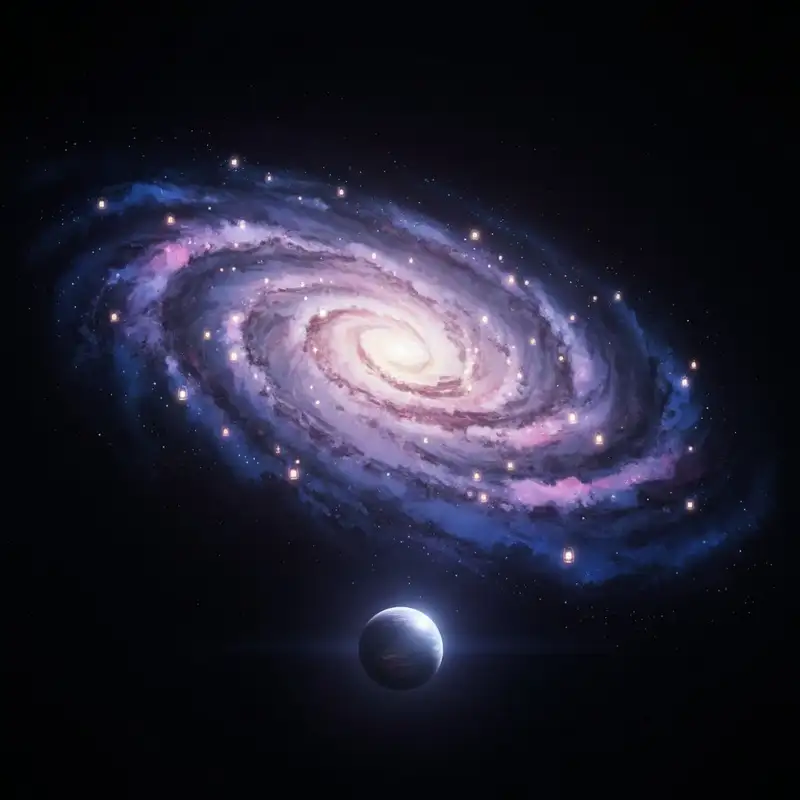
Consider the vast, silent beauty of a galaxy, its spiral arms reaching out like the graceful arms of a dancer. Within such galaxies, time takes on a unique character, influenced by the immense gravitational forces at work. Near the center, where a supermassive black hole may reside, time slows down, its passage altered in ways that defy our intuitive understanding. Here, the gravitational pull is so strong that light itself struggles to escape, and time, as experienced by an observer close to such a gravitational giant, becomes a different entity altogether. This phenomenon allows us to glimpse the profound relationship between time and gravity, a fundamental aspect of our universe that Albert Einstein captured so elegantly in his theory of general relativity.
As we shift our gaze from these cosmic giants to the delicate dance of subatomic particles, the nature of time reveals yet another layer of complexity. At the quantum level, time does not flow in a continuous stream but rather in discrete moments, like the ticking of a highly precise cosmic clock. This quantized nature of time challenges our classical perceptions and invites us to ponder the fundamental building blocks of reality. In the quantum realm, particles exist in a state of probability, their behavior influenced by the uncertainty that defines their existence. This interplay of probability and time gives rise to phenomena that are both fascinating and enigmatic, offering us a window into the underlying order of the universe.
The exploration of time at such fundamental levels beckons us to consider the possibility of a deeper, more unified understanding of the cosmos. The quest for a theory that seamlessly integrates the macroscopic world of general relativity with the microscopic domain of quantum mechanics is one of the great scientific endeavors of our age. This pursuit, driven by curiosity and the desire for knowledge, brings with it the promise of unlocking secrets that have eluded us for centuries. It is a journey that requires not only scientific insight but also a willingness to embrace the unknown, to venture into realms where time itself may be perceived in ways that challenge our deepest intuitions.
Beyond the realms of theory and observation, time invites us to reflect on our place within the universe's grand design. It encourages us to contemplate the passage of our own lives, marked by moments of joy, sorrow, and discovery. These moments, though fleeting, contribute to the rich tapestry of human experience, each one a thread in the vast narrative of existence. As we navigate our journey through time, we become part of a continuum that stretches far beyond our individual lifetimes, linking us to the past and the future in an unbroken chain of being.
In this contemplation, we may find solace in the realization that time connects us to all that has come before and all that will follow. It serves as a bridge between generations, a link that binds us to the wisdom of our ancestors and the hopes of those who will inherit the world we leave behind. As we ponder the mysteries of time, we are reminded of the enduring power of human curiosity, a force that has driven us to explore the cosmos and seek answers to questions that have long intrigued us. This curiosity, this insatiable desire to understand, is a testament to the resilience and ingenuity of the human spirit.
As we continue to unravel the mysteries of time, we find ourselves constantly challenged to expand our horizons, to look beyond the familiar and embrace the vast unknown that lies before us. The universe, with its myriad wonders and complexities, beckons us to explore its depths, to venture into the farthest reaches of space and time. In doing so, we honor the legacy of those who have come before us, the pioneers and visionaries who dared to dream of a world where the secrets of the cosmos could be unveiled.
In this spirit of exploration, we are inspired to seek new perspectives, to question the assumptions that have shaped our understanding of time and space. By embracing the unknown, we open ourselves to the possibility of new discoveries, new insights that have the potential to transform our view of the universe. This journey is not without its challenges, but it is one that promises to enrich our lives and deepen our appreciation for the intricate beauty of the cosmos.
As we reflect on the nature of time, we are reminded of its dual role as both a measure of change and a guardian of continuity. It is a force that shapes the universe, guiding the evolution of galaxies and stars, yet it is also a silent witness to the unfolding drama of life on Earth. In this duality, time offers us a profound lesson about the balance between change and constancy, a balance that is reflected in the cycles of nature and the rhythms of human life.
In moments of quiet reflection, we can take comfort in the knowledge that time is a thread that weaves through the fabric of our existence, connecting us to the universe and to each other. It is a reminder that we are part of something much larger than ourselves, a vast cosmic tapestry that stretches across the ages. As we ponder the mysteries of time, we are invited to embrace the wonder and beauty that it reveals, to celebrate the journey of discovery that it inspires, and to cherish the connections that bind us to the world around us.
In this spirit of unity and exploration, let us continue our journey through time with an open heart and a curious mind, ever mindful of the wisdom that time imparts and the possibilities that lie ahead. As we move forward, let us carry with us the knowledge that we are part of a shared journey, a journey that transcends the boundaries of time and space, connecting us to the universe and to each other in a timeless dance of discovery and understanding.
As we linger over the vast tapestry of the universe, interwoven with threads of time and space, we find ourselves pondering the intricate dance of these threads and how they shape the very fabric of reality. In this gentle reflection, we are drawn to the notion that time does not exist in a singular, uniform manner across the cosmos. Instead, it is a fluid, malleable entity, influenced by the profound forces of the universe, shaping and reshaping our perceptions and experiences.
Consider the mighty presence of a black hole, a celestial phenomenon where gravity is so intense that it warps the fabric of space-time itself. Here, in the vicinity of these enigmatic giants, time slows down in comparison to other regions of the universe. This phenomenon, known as time dilation, is a consequence of Einstein's theory of general relativity, which describes how time is affected by the strength of gravitational fields. As you imagine standing near a black hole, the passage of time for you would be markedly different from someone located far from such gravitational pull. This revelation invites us to reflect on how our understanding of time is deeply connected to the forces that govern the universe.
In our daily lives on Earth, we are accustomed to the steady march of time, a rhythm dictated by the rotation of our planet and its orbit around the sun. Yet, the cosmic perspective reveals a universe where time is not a universal constant but a variable experience, dependent on the observer's position and the gravitational forces at play. This intricate relationship between time and gravity extends beyond black holes, influencing the orbits of planets, the cycles of stars, and the evolution of galaxies. As you contemplate these celestial movements, you may feel a sense of wonder at how intimately connected time is to the very structure of the universe.
Delving deeper into the cosmic tapestry, we encounter the realm of quantum mechanics, where the nature of time becomes even more perplexing. At the subatomic level, particles behave in ways that challenge our classical understanding of time. In the quantum world, events do not unfold in a linear sequence but are governed by probabilities and uncertainties. This enigmatic behavior suggests that time, as we perceive it, may be an emergent property of a more fundamental reality, one that transcends our current understanding. The interplay between general relativity and quantum mechanics, two pillars of modern physics, continues to be a fertile ground for exploration, as scientists seek a unified framework that can reconcile these disparate views of time and space.
As we traverse the universe on this journey of discovery, we are reminded of the profound impact that time has on our own planet. The cycles of nature, the changing seasons, and the rhythms of life are all expressions of time's influence on Earth. Yet, these cycles are but a glimpse of the broader cosmic rhythms that govern the universe. The life cycles of stars, the formation and dissolution of galaxies, and the expansion of the universe itself are testaments to the dynamic and ever-changing nature of the cosmos.
The expansion of the universe, a phenomenon first observed in the early 20th century, is a testament to the dynamic nature of time and space. As galaxies drift apart, carried by the cosmic expansion, we are offered a glimpse into the universe's past. The light from distant galaxies travels across vast stretches of space and time to reach us, carrying with it stories from billions of years ago. This light, stretched and elongated by the expansion of the universe, presents itself to us in the form of redshift, a cosmic signal that reveals the universe's history and the evolution of its structures.
In contemplating these vast scales of time and space, we are invited to reflect on our place within the universe. Our lives, though fleeting in the grand scheme of things, are part of a continuum that stretches back to the dawn of the cosmos and forward into an unknown future. This continuum connects us not only to the universe but also to each other, as we share in the collective experience of time's passage. The bonds we form, the stories we tell, and the knowledge we pass down are all threads in the tapestry of human existence, woven together by the fabric of time.
As you ponder these connections, consider the possibility that our understanding of time may evolve as we continue to explore the universe. The quest to comprehend time is not merely an intellectual pursuit but a journey of the heart and mind, one that invites us to embrace the unknown and to seek understanding in the face of mystery. The universe, in all its complexity and beauty, beckons us to explore its depths, to unravel its secrets, and to find our place within its vast expanse.
In this shared journey, we are guided by the legacy of those who have come before us, pioneers who dared to question the nature of reality and to seek answers beyond the familiar. Their curiosity and determination have laid the groundwork for our own explorations, inspiring us to push the boundaries of knowledge and to forge new paths in the pursuit of understanding. As we build upon their discoveries, we carry forward a tradition of inquiry that transcends generations, connecting us to the past and the future.
The pursuit of knowledge is a testament to the enduring spirit of exploration, a reflection of our innate desire to understand the world around us. It is a journey that invites us to look beyond the surface, to delve into the depths of the cosmos, and to uncover the mysteries that lie hidden within. In this quest, we are reminded of the importance of humility and open-mindedness, qualities that enable us to approach the unknown with a sense of wonder and possibility.
As we continue to explore the nature of time and its relationship to the universe, we find ourselves drawn to the idea that time is not merely a backdrop against which events unfold, but an integral part of the cosmic dance. It is a force that shapes and is shaped by the universe, a dynamic entity that influences the course of evolution and the unfolding of the cosmos. In this understanding, we are invited to see time not as a constraint, but as a partner in the journey of discovery, a companion that guides us as we seek to unravel the mysteries of the universe.
This perspective encourages us to embrace the complexity of time, to appreciate its nuances and its role in shaping our experiences. It invites us to look beyond the surface and to consider the deeper connections that bind us to the universe and to each other. As we navigate the currents of time, we are reminded of the importance of curiosity and openness, qualities that enable us to engage with the unknown and to find meaning in the midst of uncertainty.
In this exploration, we are also reminded of the importance of imagination, a powerful tool that allows us to envision possibilities beyond the limits of our current understanding. Imagination is the wellspring of innovation and creativity, a source of inspiration that fuels our quest for knowledge and drives us to explore the boundaries of the known. It is through imagination that we are able to transcend the confines of our immediate experience and to glimpse the broader universe beyond.
As we journey through the cosmos, we are invited to cultivate a sense of wonder, a quality that opens our hearts and minds to the beauty and majesty of the universe. Wonder is a state of being that allows us to connect with the world around us, to see the extraordinary in the ordinary, and to appreciate the interconnectedness of all things. It is a reminder of the limitless possibilities that lie ahead, waiting to be discovered and explored.
In this spirit of exploration and discovery, we are encouraged to continue our journey with an open heart and a curious mind, ever mindful of the wisdom that time imparts and the possibilities that lie ahead. As we move forward, let us carry with us the knowledge that we are part of a shared journey, a journey that transcends the boundaries of time and space, connecting us to the universe and to each other in a timeless dance of discovery and understanding.
In this dance, we are invited to embrace the unknown, to seek understanding in the face of mystery, and to find our place within the cosmic tapestry. The universe, in all its complexity and beauty, beckons us to explore its depths, to unravel its secrets, and to find our place within its vast expanse. As we continue our journey, let us be guided by the light of curiosity and the spirit of exploration, knowing that the path ahead is one of boundless possibility and infinite wonder.
Within this vast expanse of the cosmos, the tapestry of time weaves its threads through every corner, shaping the story of the universe in ways both subtle and profound. As we delve deeper into the nature of time, we find ourselves contemplating its role not just as a measure of moments passing but as an intrinsic element of the universe's very fabric. The universe itself, in its ongoing expansion, offers a vivid illustration of how time interplays with space, creating a dynamic stage upon which all cosmic events unfold. In the distant reaches of space, where galaxies drift apart, time stretches and bends in accordance with the dance of celestial bodies. This ever-expanding universe invites us to ponder the origins of time itself, tracing back to the moment of the Big Bang, when time and space were born in a singular flash of creation.
As we explore deeper, we find that time, much like space, is not a static backdrop but a dynamic entity, a flowing river that carries the universe forward through the eons. Each star that flickers in the night sky is a testament to the passage of time, its light a messenger from the past, traveling across unimaginable distances to reach us. In this light, we witness the life cycles of stars, from their fiery births in nebulae to their eventual ends as white dwarfs, neutron stars, or black holes. These stellar lifecycles, dictated by the inexorable march of time, remind us of the transient nature of existence, where even the most massive stars are subject to the cosmic clock.
Time, in its relentless passage, also sculpts the grand structures of the universe, from the swirling arms of spiral galaxies to the intricate web of galaxy clusters. These cosmic structures evolve over billions of years, shaped by gravitational forces and the expansion of the universe. As galaxies collide and merge, they undergo transformations that echo through time, leaving behind trails of cosmic debris and newly formed stars. Each gravitational interaction, each cosmic dance, adds another chapter to the universe's story, a narrative written in the language of time and space.
Turning our gaze closer to home, we recognize time's influence on our own planet, where it governs the rhythms of life and the cycles of nature. The Earth, in its orbit around the Sun, experiences the changing seasons, a testament to the passage of time as it marks the progression of life on our planet. The cycles of day and night, the waxing and waning of the Moon, all serve as reminders of time's presence in our daily lives. These cycles, deeply woven into the fabric of life on Earth, have guided human civilizations for millennia, shaping cultures and calendars, influencing agriculture and rituals.
In the quiet moments of reflection, we find ourselves contemplating time's role in the evolution of life itself. From the earliest single-celled organisms to the complex ecosystems that thrive today, life has adapted and evolved, driven by the pressures and opportunities presented by time. The fossil record, a chronicle etched in stone, provides glimpses into the long history of life on Earth, revealing the gradual and often tumultuous changes that have occurred over millions of years. As species rise and fall, as ecosystems flourish and fade, time remains the steady backdrop against which the drama of life unfolds.
Yet, in the midst of all this, we are drawn to consider time's more elusive aspects, those that challenge our understanding and invite us to explore the boundaries of our knowledge. In the realm of theoretical physics, time becomes a subject of intense scrutiny, where scientists seek to unravel its mysteries and reconcile its nature with the fundamental forces of the universe. The quest to understand time is not merely an academic pursuit but a journey into the heart of reality itself, where the boundaries of science and philosophy often blur. This pursuit invites us to question our assumptions, to look beyond the familiar, and to consider the possibility that time, as we experience it, may be but one aspect of a deeper, more intricate reality.
As we stand at the frontier of human understanding, we are reminded that time is not merely a measurement but a profound aspect of our existence, interwoven with the very essence of the universe. The exploration of time, in all its dimensions, is a journey that calls upon our greatest faculties of imagination, curiosity, and inquiry. It beckons us to look outward, to the stars and galaxies, and inward, to the very nature of our being. In this exploration, we find not just answers but a tapestry of questions that enrich our understanding and inspire our quest for knowledge.
So, as we continue to ponder the mysteries of time, let us remember that we are part of this cosmic journey, a journey that spans the ages and connects us to the distant stars. In this connection, there is a profound sense of belonging, a realization that we are part of a greater whole, a universe that is both vast and intimate. Time, in its boundless reach, offers us the opportunity to explore, to discover, and to dream, guiding us toward a future filled with potential and wonder. As we navigate the currents of time, let us do so with a spirit of openness and wonder, embracing the journey with all its challenges and revelations. The universe, in its timeless elegance, awaits our exploration, inviting us to become both observers and participants in its grand narrative.
In this reflection, we find a quiet assurance, a gentle reminder that time is not an adversary but a companion on our journey through the cosmos. It is a partner in our quest for understanding, a guide in our exploration of the unknown. As we move forward, let us carry with us the wisdom of the past, the curiosity of the present, and the hope for the future, knowing that each moment is a step along the path of discovery. The universe, in its infinite expanse, offers us the gift of time, a gift that invites us to explore, to learn, and to grow. In this journey, let us find joy in the unfolding of time, a joy that transcends the fleeting moments and connects us to the eternal dance of the cosmos.
In this vast and intricate tapestry, where time weaves the threads of existence, let us consider the remarkable phenomenon of time dilation. This intriguing concept, born from the mind of Albert Einstein, introduces us to a realm where time is not a constant, but rather a variable, influenced by the fabric of space itself. As we ponder this, we find that time, much like a river, can flow at different speeds depending on the conditions it encounters. In the presence of a massive object, such as a planet or a star, the flow of time can be altered, slowed by the gravitational forces that bend the space around it. This is a gentle reminder of the interconnectedness of time and space, a relationship that shapes the universe in ways both subtle and profound.
Imagine, if you will, the experience of an astronaut traveling close to the speed of light. For them, time would pass differently compared to those of us anchored to the Earth. This relativistic effect, known as time dilation, means that what feels like mere moments for the traveler could translate into years for those left behind. This thought experiment invites us to contemplate the relativity of our own experiences and how the passage of time is relative to our motion and the gravitational fields we traverse. It is a humbling notion, one that reminds us of our place within an ever-expanding universe, where time is as much a part of the cosmic dance as the stars themselves.
As we drift further into this exploration, let us turn our gaze to the enigmatic entities known as black holes. These celestial phenomena, with their immense gravitational pull, represent a place where time behaves in ways that challenge our comprehension. At the event horizon, the boundary beyond which nothing can escape, time appears to come to a halt. For an observer watching from a safe distance, anything approaching a black hole seems to slow down, frozen in time at the brink of this cosmic abyss. Yet, the reality for the object itself is quite different, as it continues its inexorable journey into the unknown. Within these mysterious regions, time and space are warped to such an extent that they merge into a single entity, a singularity where the laws of physics as we know them cease to hold sway.
It is in these moments of contemplation that we find ourselves drawn to the wonder of the universe and the mysteries it holds. The interplay between time and gravity, the bending of space, and the relativistic effects of motion all serve as a testament to the complexity and beauty of our cosmos. As we ponder these phenomena, we are reminded that time is not merely a backdrop against which events unfold, but an active participant in the grand narrative of existence.
Turning our attention back to our own celestial neighborhood, let us consider the subtle rhythms of our planet, which are deeply tied to the passage of time. The Earth's rotation gives rise to the cycles of day and night, while its orbit around the Sun defines the changing seasons. These natural cycles have been a constant in human history, shaping the rhythms of life and the patterns of culture. From the ancient practice of agriculture to the modern understanding of ecology, the temporal cycles of Earth have guided our development and continue to influence our understanding of the natural world.
Yet within these familiar patterns, there lies a deeper connection to the cosmic order. The gravitational pull of the Moon, for instance, influences the tides, creating a rhythmic ebb and flow that has been a source of fascination and inspiration for countless generations. This celestial dance between Earth and its lunar companion serves as a reminder of the intricate connections that bind us to the universe, a web of influences that shape our existence in ways both seen and unseen.
As we journey onward, let us pause to reflect on the notion of time as an agent of change. In the vastness of the universe, time is the force that drives evolution, guiding the transformation of stars and galaxies, shaping the formation of planets, and influencing the emergence of life. It is a process that unfolds over eons, a slow, deliberate progression that nonetheless holds within it the seeds of wonder. The stars themselves are born, live, and die, scattering their elements across the cosmos, sowing the potential for new worlds and new beginnings.
In this cosmic symphony, we too are participants, each of us a note in the grand composition of life. Our own evolution, both biological and cultural, is a testament to the power of time to foster growth and adaptation. From the earliest forms of life that emerged in primordial seas to the complex societies we have built today, time has been our constant companion, guiding us on a journey of discovery and understanding.
And so, as we stand at the threshold of the unknown, let us embrace the mysteries that time presents. It is a journey that requires patience and curiosity, a willingness to explore the boundaries of our knowledge and to venture into the realms of possibility. For in doing so, we honor the legacy of those who came before us, and we pave the way for those who will follow. Together, we are participants in a timeless quest, one that invites us to seek out the truths of our existence and to find our place within the cosmos.
In this exploration, we are reminded of the delicate balance that exists between the known and the unknown, the seen and the unseen. Just as the stars light the night sky, guiding travelers across vast distances, so too does time illuminate the path of discovery. It is a beacon that calls us forward, inviting us to delve deeper into the mysteries of the universe and to uncover the secrets that lie beyond the horizon.
As we conclude this journey of contemplation, let us carry with us the knowledge that time, in all its complexity and wonder, is a gift. It is an invitation to explore, to learn, and to grow, to find joy in the unfolding narrative of existence. In the quiet moments of reflection, may we find solace in the understanding that we are part of something greater, a cosmic dance that stretches across the ages, connecting us to the infinite possibilities of the universe. And as we look to the future, let us do so with a heart full of hope and a spirit of curiosity, ready to embrace the adventures that time has yet to reveal.
As we linger in the gentle embrace of time’s mysteries, let us turn our gaze to the celestial wonders that adorn the night sky, each a testament to the enduring dance of time and space. The stars, those distant suns scattered across the cosmos, serve as timeless sentinels, their light journeying across the vast expanse to reach our eyes. Each twinkle is a whisper from the past, an echo of moments long gone, yet still alive in the present. The light of a star can take millions, even billions of years to travel from its source to us, carrying with it a story written in the language of the universe. This light, a messenger from distant epochs, reminds us of the astonishing scale of cosmic history and our place within it.
Consider the lifecycle of a star, a process woven intricately with the fabric of time. From the swirling clouds of gas and dust, stars are born, igniting in a brilliant blaze of nuclear fusion. They live their lives in cycles of stability and change, gradually exhausting their fuel and evolving into new forms. Some stars may end their days in a gentle shedding of their outer layers, becoming serene white dwarfs, while others may explode in cataclysmic supernovae, their remnants seeding the cosmos with elements that become the building blocks of new stars, planets, and even life. This stellar alchemy is a testament to the transformative power of time, shaping and reshaping the universe in an endless cycle of birth, death, and rebirth.
The planets and moons, too, bear the mark of time’s influence. Their surfaces tell stories of ancient impacts and volcanic upheavals, of shifting continents and evolving atmospheres. On Earth, time has carved majestic canyons, raised towering mountains, and nurtured the delicate balance of ecosystems teeming with life. The Moon, our constant companion, is a silent witness to these changes, its surface pockmarked by the passage of time and the relentless bombardment of meteoroids. Each crater and plain on the Moon is a chapter in a story that spans billions of years, inviting us to ponder the forces that have shaped our celestial neighbor.
Beyond our solar system, time continues its inexorable march, weaving the tapestry of galaxies that populate the universe. These vast collections of stars, gas, and dust are bound together by the gravitational ties that have held them in a cosmic embrace for eons. Within galaxies, stars are born and die, their light illuminating the cosmic landscape and revealing the intricate structures formed by the interplay of time and gravity. The majestic spiral arms of a galaxy, the luminous heart of a starburst region, and the enigmatic core of an active galactic nucleus all bear witness to the ceaseless dance of creation and destruction that defines the universe.
Time’s influence extends even to the smallest scales, where the fundamental particles that make up matter dance to the tune of quantum mechanics. Here, time takes on a different character, one that is less intuitive but no less profound. The interactions and transformations of particles occur on timescales so brief that they are beyond our direct perception, yet they are crucial to the functioning of the universe. These fleeting moments, governed by probabilities and uncertainties, contribute to the rich tapestry of reality, reminding us that time is as much a part of the microcosm as it is of the macrocosm.
In the grand scheme of the cosmos, time is both a river and a tapestry. It flows relentlessly forward, carrying with it the stories of all that has been and all that will be. It is a tapestry woven with the threads of countless moments, each one contributing to the intricate pattern of existence. As we ponder the nature of time, we are invited to reflect on the connections that bind us to the universe and to one another. Each heartbeat, each breath, is a reminder of the rhythms that govern our lives, echoing the rhythms of the stars and galaxies.
The concept of time also challenges us to consider the nature of memory and anticipation. Our memories are the echoes of moments past, shaping our identities and informing our understanding of the present. They are the repositories of experience, allowing us to learn and grow as we navigate the journey of life. Anticipation, on the other hand, is the bridge to the future, a canvas upon which we paint our hopes and dreams. It is the promise of what is yet to come, a reminder that time is not only a record of the past but a guide to the future, inviting us to imagine new possibilities and embrace the unknown.
In this way, time is a bridge connecting all things. It links the past, present, and future in a continuous flow, reminding us that we are part of a much larger story. It is a story that spans the universe, from the fiery birth of stars to the quiet whispers of atoms. It is a story that includes the grand and the humble, the ordinary and the extraordinary. And within this vast narrative, each of us plays a part, contributing to the unfolding drama of existence.
As we contemplate the nature of time, let us also consider the role of time in our understanding of the cosmos. The study of time has led to profound insights into the nature of reality, from the realization that the universe is expanding to the discovery of gravitational waves, ripples in the fabric of spacetime caused by the movement of massive objects. These discoveries have expanded our understanding of the universe and our place within it, offering glimpses into the fundamental workings of nature.
The exploration of time is not merely an academic pursuit; it is a journey of discovery that touches on the deepest questions of existence. It invites us to ponder the origins of the universe, the nature of consciousness, and the ultimate fate of all things. It encourages us to seek out new horizons, to explore the unknown, and to embrace the mysteries that lie beyond our current understanding.
In this journey, we are guided by the light of knowledge and the spirit of curiosity. We are inspired by the discoveries of those who came before us, and we are driven by the desire to contribute to the unfolding narrative of exploration and understanding. Each new insight, each new discovery, adds to the rich tapestry of human knowledge, expanding our horizons and deepening our appreciation for the wonder of the universe.
As we continue to explore the mysteries of time, let us do so with a sense of wonder and humility. Let us be mindful of the connections that bind us to the cosmos and to one another, recognizing that we are part of a larger whole. And as we look to the stars, let us remember that we are not merely observers of the universe but participants in its ongoing story.
Time is a gift, an invitation to explore the wonders of the cosmos and to engage with the mysteries of existence. It is a reminder of our connection to the universe and to one another, an affirmation of our place in the grand tapestry of creation. As we reflect on the nature of time, let us do so with gratitude and curiosity, embracing the journey of discovery that lies before us. And as we navigate the currents of time, let us find joy in the unfolding narrative of life, a story that continues to inspire and amaze, connecting us to the infinite possibilities of the universe.
In this vast cosmos, where time weaves its intricate dance, we find ourselves pondering the nature of time's passage across the expanse of space. The question naturally arises: does time exist everywhere in the same way? The universe, with its majestic galaxies swirling in the cosmic ocean, offers a stage where time plays out its role with both subtlety and grandeur. Yet, time, as we understand it, is not a constant companion; it is a variable, a dimension that bends and shifts according to the rules of the universe. This variability is elegantly demonstrated through the principles of Einstein's theory of relativity, which teaches us that time is influenced by the fabric of space itself, bending and warping under the influence of gravity. In regions where gravity is intense, such as near a massive star or a black hole, time appears to slow down compared to a region where gravity is weaker. This profound realization invites us to imagine the universe as a dynamic tapestry, where time and space are threads woven together, each affecting the other in a complex interdependence.
Picture, if you will, the event horizon of a black hole, a boundary beyond which time and space merge into an enigmatic singularity. At this threshold, time stretches to infinity, creating a place where the conventional understanding of past, present, and future dissolves into a singular moment. For an observer falling into a black hole, time itself would seem to draw out, while to an outside observer, it would appear as though the descent into the abyss takes an eternity. This curious interplay between time and gravity challenges our perception, reminding us that our experience of time is deeply rooted in our position in the universe.
As we journey further into this cosmic contemplation, we encounter the phenomenon of time dilation, a concept that reveals itself when considering the relative motion of objects. According to relativity, time moves differently for objects in motion relative to one another. An astronaut traveling at a significant fraction of the speed of light would experience time differently than someone remaining stationary on Earth. For the traveler, seconds would stretch and minutes would elongate, experiencing less passage of time than their counterpart. This effect, though imperceptible at everyday speeds, becomes profoundly significant when approaching the velocities of light, hinting at the universe's deeper layers of reality.
Furthermore, the vast distances between celestial bodies introduce another intriguing aspect of time's nature. Light, the fastest traveler in the universe, carries with it the stories of distant stars and galaxies, yet it takes time to traverse these great expanses. When we gaze upon a starry sky, we are in fact looking back in time, seeing these celestial objects as they were when their light began its journey to us. This time delay creates a universe where the past is perpetually present, a cosmic archive written across the night sky. In this way, time becomes a bridge, connecting us to the distant reaches of space and the epochs that have unfolded over the eons.
The dance of time also plays out in the life cycles of stars, those luminous beacons that dot the universe. Stars are born, live, and die over vast stretches of time, their lifespans a testament to the universe's grandeur. A star's youth is marked by the fusion of hydrogen, a process that sustains it for millions to billions of years, depending on its mass. As the star ages, it expands into a red giant, eventually shedding its outer layers to leave behind a dense core, a white dwarf, a neutron star, or, for the most massive, a black hole. These transformations are driven by physics, yet they are orchestrated on a timescale that dwarfs human experience, reminding us of our fleeting presence in the cosmic theater.
On a grander scale, galaxies themselves are subject to the inexorable march of time. These vast collections of stars, gas, and dust evolve through gravitational interactions, merging and colliding in cosmic ballets that stretch over billions of years. The Milky Way, our galactic home, is on a collision course with the Andromeda galaxy, a meeting predicted to occur in several billion years. This future cosmic dance is but one chapter in the ever-evolving story of the universe, a narrative that unfolds on a timeline far beyond the scope of human history.
As we delve deeper into the mysteries of time, we also encounter the realm of quantum mechanics, where time's nature becomes even more enigmatic. At this microscopic scale, particles exist in a state of uncertainty, their positions and velocities described by probabilities rather than certainties. Here, time does not flow smoothly but appears to be discrete, a series of moments that defy our classical understanding. This intersection of quantum mechanics and relativity presents a frontier of scientific inquiry, a puzzle that continues to elude complete understanding, yet it tantalizes with the promise of insights into the fundamental workings of the universe.
Beyond the scientific understanding, time also holds a philosophical dimension, prompting us to reflect on its passage in our own lives. We measure time in seconds, minutes, and hours, yet our perception of its flow is deeply personal, shaped by our experiences and memories. Moments of joy seem to pass swiftly, while periods of anticipation or uncertainty stretch time's fabric. This subjective experience of time invites introspection, a reminder that, while we are bound by the cosmic clock, we also possess the ability to shape our own narrative within its confines.
In contemplating time's nature across the universe, we are drawn into a dialogue between science and wonder. We find ourselves participants in a grand cosmic symphony, where time serves as both conductor and composition. Each moment, from the fleeting to the eternal, is a note in this universal melody, inviting us to listen, to learn, and to find our place within its vastness. As we peer into the depths of space and the intricacies of time, we are reminded of the delicate balance between understanding and mystery, knowledge and awe. It is a balance that encourages us to continue our exploration, to seek answers while embracing the unknown, and to cherish the time we have as part of the universe's unfolding story.
In this vast and intricate universe, time remains a profound enigma, a dimension that shapes and is shaped by the cosmos. It connects us to the past, guides us through the present, and invites us to imagine the future. As we reflect on its nature, we find ourselves drawn into a narrative that transcends our individual lives, a story that is at once personal and universal. And so, as we journey through the universe and its mysteries, let us carry with us a sense of wonder and humility, recognizing the gift of time as an invitation to explore, to discover, and to marvel at the infinite possibilities that lie within and beyond our reach.
Amidst the vast tapestry of the cosmos, the concept of time weaves an intricate narrative that intertwines with the fundamental structure of the universe. As we ponder the essence of time, we might ask ourselves whether it exists uniformly across the vast stretches of space or if it bends and twists, adapting to the cosmic ballet in which it plays an essential role. While we are accustomed to perceiving time as a steady, unyielding flow, the universe reveals to us a more complex, nuanced picture. Imagine, if you will, the serene expanse of the cosmic ocean, where time ebbs and flows like gentle waves caressing a distant shore.
In this majestic setting, the role of time extends beyond mere measurement. It becomes a key player in the grand symphony of the cosmos, stretching and compressing in response to the profound forces at play. As we delve deeper into this enigmatic realm, we encounter the concept of spacetime, a fusion of time and space into a single, interconnected fabric. This elegant construct, introduced by Einstein's general theory of relativity, suggests that the presence of mass and energy can curve spacetime itself. Thus, time is not an independent entity but is influenced by the cosmic landscape, much like a flowing river that adapts to the contours of the land.
Consider the phenomenon of gravitational time dilation, where time ticks more slowly in the presence of strong gravitational fields. Near massive celestial bodies, such as neutron stars or the enigmatic black holes, time itself seems to slow to a languid pace, whispering secrets of the universe that are beyond our immediate comprehension. This gentle warping of time, though imperceptible in the everyday experiences of our terrestrial lives, becomes a profound reality in the cosmic theater. It invites us to ponder the delicate balance between the forces that shape our universe and the dimensions in which we exist.
As we venture further into the mysteries of time, we encounter the concept of cosmic time, a universal clock that ticks at a rate independent of the local gravitational influences. This notion serves as a reference frame for the expansion of the universe itself, allowing us to trace the evolution of galaxies and the birth of stars. Yet, even this cosmic time is not immune to the vastness of the universe's scale. It stretches with the expansion, a reminder that the universe itself is dynamic and ever-changing.
In the silent embrace of the cosmos, the arrow of time points inexorably forward, aligning with the second law of thermodynamics, which dictates that entropy, or disorder, must always increase. This principle, woven into the very fabric of reality, gives direction to time's flow, leading us from the orderly conditions of the past toward the complexity of the present and beyond. It is this irreversible march towards entropy that distinguishes the past from the future, embedding time with a sense of directionality, even as the universe teeters on the brink of chaos and order.
The quantum realm, with its myriad mysteries, offers yet another perspective on time's nature. Here, at the tiniest scales of existence, time behaves in ways that challenge our classical intuitions. Particles exist in a state of superposition, where possibilities coexist until an observation collapses them into a definite state. In this dance of probabilities, time seems to take on a more fluid and flexible character, allowing multiple paths to unfurl simultaneously until the moment of observation. This quantum uncertainty, while confounding, hints at the possibility that time, like space, may be quantized, existing in discrete rather than continuous intervals.
The exploration of time's mysteries extends beyond the boundaries of physical theory into the realms of philosophy and metaphysics, where questions arise about the very nature of existence and our place within it. What does it mean for time to exist? Is it merely a construct of human perception, an artifact of consciousness that orders our experiences, or is it a fundamental aspect of reality, existing independently of us? These contemplations invite us to consider the deep connection between time and consciousness, as our awareness of the passage of time shapes our understanding of the world and our place within it.
In the quiet solitude of the cosmos, time serves as both a backdrop and a protagonist in the stories that unfold across the universe. It is the silent witness to the birth and death of stars, the formation of galaxies, and the intricate dance of celestial bodies. Time's passage is recorded in the light that travels across the vast distances of space, carrying with it the tales of distant pasts, allowing us to peer into epochs long gone yet still present in the shimmering starlight that graces our night skies.
As the universe continues its majestic expansion, we are left to ponder what the future holds for time itself. Will the universe continue to stretch indefinitely, leading to a cold and dark future where time itself loses its meaning? Or will it culminate in a cosmic rebirth, a cycle of renewal that echoes the ancient rhythms of life and death? These speculative musings, though far removed from our immediate reality, remind us of the profound connection between time and destiny, as we navigate the uncertain waters of existence.
In this cosmic dance, where time and space intertwine, we find ourselves both observers and participants, connected to the universe in ways that transcend our earthly existence. The passage of time, with its gentle, unyielding flow, encourages us to reflect on our own journey, to embrace the moments that define our lives, and to cherish the connections that bind us to each other and to the cosmos. It is a journey that invites us to explore not only the outer reaches of the universe but also the inner landscapes of our own being, where the mysteries of time reflect the mysteries of the self.
As we draw this contemplation to a gentle close, let us carry with us the awareness that time, in all its complexity and beauty, is a gift that allows us to explore, to wonder, and to find meaning in the vastness of the cosmos. The universe, with its infinite possibilities, invites us to embark on a journey of discovery, to seek understanding and connection amidst the stars. In this shared quest, we find a kinship with the universe and with each other, a reminder that time's passage is a thread that weaves the fabric of existence, connecting the past, present, and future in a tapestry of wonder and awe.
Within the quiet embrace of the cosmos, where time and space intertwine, we find ourselves drawn to the notion that even as we ponder the vastness beyond, there exists a delicate dance between the known and the unknown. The universe, in its silent, expansive grandeur, extends an invitation to delve deeper into the mysteries that it holds, much like a vast library, each star a book, each galaxy a chapter. As we turn the pages of this celestial narrative, we encounter the concept of relativity, a profound understanding that reshapes our perception of time as not a solitary entity but a dynamic partner with space itself. This partnership reveals that time can warp and bend, a graceful fluidity that echoes the curves of the cosmic ballet.
In the fabric of spacetime, massive celestial bodies like stars and planets exert a gentle influence, their gravity molding the very path that time takes. This notion, though complex, is a reminder of the interconnectedness that pervades the universe, where even the silent pull of gravity whispers secrets of the cosmos. It is within these whispers that we find the subtle variations of time’s passage, where the ticking of a clock near a massive star slows, a testament to the universe’s gentle power to shape reality. Such phenomena encourage us to reflect on the relativity of our own experiences, where the passage of time can feel swift or languid, dictated by the moments that fill our days.
Yet, as we ponder the vastness above, we must also turn our gaze inward, to the quantum realm, where time’s flow becomes even more enigmatic. In this microscopic world, time seems to flicker with an unpredictability that defies our classical intuition. The quantum realm introduces us to a dance of particles and waves, a realm where probabilities reign, and time is but a shadow that flickers and fades. It is here that time’s nature becomes a riddle, a puzzle that invites us to explore the very foundations of reality itself, challenging our perceptions and expanding our understanding of what it means to exist.
Amidst this exploration, we find ourselves contemplating the potential of a universe that is both finite and infinite, one that may stretch endlessly or fold back upon itself in a cosmic cycle. Such contemplation is a reminder of our own impermanence and the beauty of existence, where each moment is a fleeting brushstroke in the masterpiece of time. This cosmic masterpiece is painted across the skies, with each celestial body a vibrant hue, each moment a stroke that adds depth and meaning to the tapestry of life.
As we drift through this narrative, we encounter the notion of multiverses, a theoretical expansion of our universe into a myriad of possibilities, each with its own version of time. These multiverses, though speculative, present a tantalizing possibility of parallel realities where time’s rules may differ, where the constants of our universe might not hold sway. Such ideas stretch the boundaries of our understanding, inviting us to ponder a cosmos teeming with infinite variations, each a unique expression of the fundamental forces that govern existence.
In this exploration, the boundary between science and philosophy blurs, as we find ourselves pondering questions that reach beyond the empirical, touching upon the nature of consciousness and existence itself. How do we, as conscious beings, perceive the flow of time, and how does this perception shape our understanding of the universe around us? These questions echo in the halls of philosophical thought, where time has long been a subject of contemplation, a river that flows through the landscape of the mind.
This river of time, as it flows through the cosmos and within us, carries with it the echoes of the past, the potential of the future, and the reality of the present. It is a journey without a definitive destination, an exploration that invites us to embrace the mystery and wonder of existence. In the quiet moments between the stars, we find a sense of connection, a kinship with the universe that transcends the boundaries of time and space.
As we navigate this cosmic landscape, we are reminded of the delicate balance between knowledge and mystery, where each discovery leads to new questions, and each answer uncovers new realms of exploration. It is a dance of curiosity and wonder, a testament to the human spirit’s desire to seek and to understand. In this dance, time serves as both a guide and a companion, a constant presence that shapes our journey and connects us to the universe.
In the stillness of this moment, as we contemplate the vastness beyond, we find a sense of peace in the knowledge that we are part of something greater than ourselves. The universe, with its infinite possibilities and timeless beauty, invites us to dream, to explore, and to wonder. And as we continue this journey, we carry with us the knowledge that time, in all its complexity and beauty, is a gift that allows us to explore, to wonder, and to find meaning in the vastness of the cosmos.
This exploration of time, a journey through the cosmic tapestry, is a reminder that we are both observers and participants in the universe’s unfolding story. We are, in essence, stardust contemplating the stars, a part of the very fabric we seek to understand. And in this contemplation, we find a profound connection to the cosmos, a reminder that, even in the vastness of space, we are never truly alone. The universe, with its infinite possibilities, invites us to embark on a journey of discovery, to seek understanding and connection amidst the stars.
In this shared quest, we find a kinship with the universe and with each other, a reminder that time’s passage is a thread that weaves the fabric of existence, connecting the past, present, and future in a tapestry of wonder and awe. As we continue on this journey, we are guided by the light of the stars, a beacon of hope and inspiration in the vastness of space. And with each step we take, we are reminded of the beauty and mystery that surrounds us, a testament to the boundless possibilities that await us in the universe.
In the gentle embrace of the cosmos, we find solace in the knowledge that we are part of something greater than ourselves, a part of a universe that is ever-expanding, ever-evolving, and ever-inviting. It is a universe that beckons us to explore, to seek, and to dream, a universe that holds the promise of discovery and the potential for understanding. And as we journey through this cosmic landscape, we carry with us the knowledge that time, in all its complexity and beauty, is a gift that allows us to explore, to wonder, and to find meaning in the vastness of the cosmos.
As the universe unfolds before us, we are reminded of the beauty and mystery that lies within and beyond, a testament to the boundless possibilities that await us in the cosmos. And in this exploration, we find a sense of connection to the universe and to each other, a reminder that we are part of something greater than ourselves, a part of a universe that is ever-expanding, ever-evolving, and ever-inviting. The universe, with its infinite possibilities, invites us to embark on a journey of discovery, to seek understanding and connection amidst the stars.
In this shared quest, we find a kinship with the universe and with each other, a reminder that time’s passage is a thread that weaves the fabric of existence, connecting the past, present, and future in a tapestry of wonder and awe. As we continue on this journey, we are guided by the light of the stars, a beacon of hope and inspiration in the vastness of space. And with each step we take, we are reminded of the beauty and mystery that surrounds us, a testament to the boundless possibilities that await us in the universe.
In the gentle embrace of the cosmos, we find solace in the knowledge that we are part of something greater than ourselves, a part of a universe that is ever-expanding, ever-evolving, and ever-inviting. It is a universe that beckons us to explore, to seek, and to dream, a universe that holds the promise of discovery and the potential for understanding. And as we journey through this cosmic landscape, we carry with us the knowledge that time, in all its complexity and beauty, is a gift that allows us to explore, to wonder, and to find meaning in the vastness of the cosmos.
In the stillness of the night, as we ponder our place in the universe, we find ourselves contemplating not only the mysteries of time and space but also the ways in which these concepts intersect with the phenomena of light and darkness. Light, that ever-present companion of time, travels across the cosmos at the ultimate speed limit defined by the universe. It is a messenger, bringing us glimpses of distant stars and galaxies, each one a beacon of history, telling stories of what once was. The light we perceive from a star might have embarked on its journey millions or even billions of years ago, traversing the vast expanse of space to reach our eyes. This light serves as a bridge across time, connecting us with the past and allowing us to witness the universe as it once was, even as it continues its relentless march toward the future.
Darkness, too, holds its own significance in our understanding of the universe. It is not merely the absence of light but a canvas upon which the cosmos paints its grand design. In the darkness, we find the space between stars, the voids where galaxies drift. This darkness is a reminder of the universe's vastness, of the infinite possibilities that lie beyond our perception. It invites us to consider what might exist in the unseen, the unknown. Within these voids, mysteries abound, waiting to be uncovered by those who dare to look deeper, to question what lies beyond the reach of light.
As we navigate this interplay between light and darkness, we are reminded of the fundamental forces that govern the cosmos, shaping its structure and evolution. Among these forces, gravity stands as a powerful architect, drawing matter together to form stars, planets, and galaxies. Yet, it is a force that also stretches and warps the fabric of space and time itself. It is through gravity that matter influences the very nature of time, creating a dance that binds them together in an eternal embrace. In the presence of a black hole, the most extreme manifestation of gravity, time slows to a crawl, revealing the profound interconnectedness of the universe's forces.
Beyond these tangible phenomena, we find ourselves contemplating the nature of existence itself. The universe is not merely a collection of stars and planets but a dynamic, ever-changing entity that evolves over time. It is a tapestry woven from the threads of matter and energy, each piece contributing to the whole. Within this tapestry, life emerges as a fleeting but significant phenomenon, a complex interplay of chemistry and physics resulting in consciousness and self-awareness. Life, in all its diversity and wonder, represents a unique means by which the universe comes to know itself.
This self-awareness brings us to the concept of perception, the lens through which we interpret the universe. Our senses, though limited, provide us with the tools to explore our surroundings, to make sense of the world. Yet, they are but a small window into the vast cosmos, limited by our biology and the constraints of our environment. Through science and technology, we extend our senses, peering deeper into the universe, uncovering truths that were once beyond our reach. This pursuit of knowledge is a testament to our innate curiosity, our desire to understand the nature of reality and our place within it.
In our quest for understanding, we also encounter the concept of entropy, a measure of disorder and randomness within a system. Entropy is a fundamental aspect of thermodynamics, governing the flow of energy and the direction of time. It is a force that drives the universe toward greater complexity, a process that gives rise to stars, galaxies, and eventually life itself. Yet, it is also a reminder of the impermanence of all things, as systems inevitably tend toward equilibrium and decay. Entropy, in its inexorable march, shapes the universe's destiny, guiding the dance of creation and destruction that unfolds across the cosmos.
As we ponder these profound concepts, we are drawn to the idea of cycles, the rhythmic patterns that echo throughout the universe. From the orbits of planets around stars to the life cycles of stars themselves, the universe is a symphony of cycles, each one contributing to the grand orchestration of existence. These cycles reflect the balance of creation and destruction, of birth and death, that defines the cosmos. They remind us of the interconnectedness of all things, the ways in which the universe is a continuous loop of energy and matter, ever-renewing and ever-evolving.
In contemplating the universe's vastness, we are reminded of our own insignificance in the grand scheme of things, yet simultaneously, our unique ability to question and explore. We are the cosmos made conscious, a part of the universe that is aware and capable of reflection. Our journey through time and space is one of discovery and wonder, an exploration of the infinite possibilities that lie before us. It is a journey that invites us to embrace both the known and the unknown, to seek out the truths that lie hidden in the shadows and to celebrate the light that illuminates our path.
As we stand on the precipice of discovery, we are guided by the principles of science, a method of inquiry that seeks to unravel the mysteries of the universe through observation and experimentation. Science is a tool that enables us to explore the cosmos, to test our theories and refine our understanding of reality. It is a process of continual learning and adaptation, a journey that mirrors the universe's own evolution. Through science, we gain insights into the fundamental laws that govern existence, from the smallest particles to the largest cosmic structures.
Yet, as we delve deeper into the fabric of reality, we also encounter the limits of our knowledge, the boundaries of what we can perceive and comprehend. These boundaries challenge us to think beyond our current understanding, to expand our horizons and explore new paradigms. They remind us that the universe is a place of endless mystery, a realm where questions lead to more questions, and answers are but stepping stones on the path to greater enlightenment.
In this pursuit, we are not alone. We are part of a greater community, a collective of minds that spans cultures, languages, and generations. Together, we share the journey of exploration, each discovery building upon the last, each insight contributing to the tapestry of human knowledge. We are united by a common quest, a shared desire to understand the universe and our place within it.
As we reflect on these ideas, we are drawn to the notion of harmony, the balance between the forces that shape the cosmos. Harmony is an essential aspect of the universe, a guiding principle that informs the interactions of matter and energy. It is a concept that resonates with us on a fundamental level, reflecting the interconnectedness of all things. In the dance of the cosmos, harmony is the thread that weaves together the disparate elements of existence, creating a cohesive and unified whole.
In the quiet moments of contemplation, we find solace in the beauty of the universe, in the elegance of its design and the simplicity of its truths. We are reminded of the wonder that lies in the stars, the awe-inspiring majesty of the cosmos that beckons us to explore its depths. It is a beauty that transcends the physical, a reflection of the universe's inherent order and symmetry.
As we continue on our journey, we carry with us the knowledge that the universe is a place of infinite potential, a realm of endless possibilities. It is a place where time and space converge, where light and darkness coexist, and where the forces of nature shape the destiny of all things. In this cosmic dance, we find our place, a small but significant part of the grand tapestry of existence.
In the end, it is the journey itself that holds the greatest reward, the exploration of the unknown and the pursuit of understanding. It is a journey that invites us to seek out the mysteries of the universe, to embrace the complexity and beauty of the cosmos, and to find meaning in the vastness of it all. As we gaze into the night sky, we are reminded that the universe is a place of wonder and discovery, a place where the boundaries of time and space are but invitations to explore further. It is a universe that calls to us, inviting us to embark on a voyage of exploration, to seek out the truths that lie hidden in the stars, and to celebrate the beauty and mystery of the cosmos.
In this vast and intricate tapestry of the universe, time itself weaves through every corner, every particle, and every moment. Yet, it does so in ways that challenge our understanding, inviting us to ponder the very nature of existence. The concept of time, while familiar, is not as straightforward as it might seem. It is a dimension intertwined with space, forming the very fabric of our cosmos. This space-time continuum is subject to the influences of gravity and motion, creating a reality where time can stretch, compress, and even seemingly pause.
Imagine standing on the surface of a massive planet, where the pull of gravity is significantly stronger than on Earth. Here, time passes differently, subtly slower when compared to a less gravitationally intense environment. This phenomenon, predicted by the theory of general relativity, is known as gravitational time dilation. It is not just a theoretical construct, but a reality proven by the precise measurements of clocks placed at different altitudes on Earth. Clocks, ticking away in the lower gravitational field of a mountain, run ever so slightly faster than those at sea level. This subtle difference, though imperceptible in daily life, becomes crucial in the realm of satellites and global positioning systems, where precision is key.
Beyond the influence of gravity, motion too has a profound effect on time. As one moves faster, approaching the speed of light, time begins to slow relative to those at rest. This is time dilation due to relative velocity, a remarkable consequence of Einstein's special relativity. In this strange and fascinating aspect of our universe, an astronaut traveling at significant fractions of the speed of light would age more slowly than those who remain on Earth. This effect, though minuscule at the speeds we currently achieve, opens up a realm of possibilities and philosophical musings about journeys among the stars.
Yet, despite these intriguing facets of time, it remains a deeply personal experience. Each moment we experience is shaped by the context of our own existence, our place in the universe, and the forces acting upon us. This personal nature of time is a reflection of our unique interaction with the cosmos, a dance of perception and reality. As we explore further, we find that time is not a constant, unchanging river flowing uniformly throughout the universe, but rather a tapestry woven with the threads of gravity, motion, and energy.
In the realm of theoretical physics, time continues to be a subject of exploration and wonder. The quest to unify general relativity with quantum mechanics, two pillars of modern physics, has led scientists to consider new dimensions and possibilities. String theory, a candidate for such a unifying theory, suggests that the universe may contain additional dimensions beyond the familiar four of space and time. These extra dimensions, compactified and hidden from direct observation, could offer new insights into the nature of time and its role in the universe.
The contemplation of time extends beyond the physical sciences into realms of philosophy and human experience. It is a concept that challenges our understanding of beginnings and endings, of continuity and change. Time, in its mysterious flow, shapes our lives and our legacies, leaving traces in the memories we cherish and the histories we record. It is a thread that connects us to the past and guides us into the future, a presence that is both constant and ever-changing.
As we navigate the cosmos, we are reminded of the importance of time in our exploration. It is a guide, a measure of progress, and a reminder of our place in the vast expanse. Our spacecraft travel through the void, their journeys marked by the passage of time, each moment an opportunity to gather knowledge and insight. The study of distant stars and galaxies, whose light has traveled for millions or even billions of years to reach us, offers glimpses into the history of the universe. Each photon that reaches our telescopes carries with it a story from the past, a snapshot of a moment long gone, yet preserved in the light that has journeyed across the cosmos.
In this grand exploration, we are also reminded of the importance of patience and perseverance. The universe unfolds its secrets slowly, revealing its mysteries one discovery at a time. It is a journey that requires us to embrace the unknown and to find joy in the process of learning. As we continue to explore the cosmos, we do so with the awareness that time is both a challenge and an opportunity. It is a dimension that shapes our understanding and our experience, a presence that invites us to look beyond the immediate and to contemplate the eternal.
Our journey through the cosmos is a testament to the human spirit, to our innate curiosity and desire to understand the world around us. It is a journey that transcends generations, building upon the knowledge and discoveries of those who came before us. As we stand on the shoulders of giants, we are inspired to push the boundaries of what is known, to seek out new horizons and to explore the frontiers of science and technology.
In this quest for knowledge, we are guided by the light of understanding, a beacon that illuminates our path and encourages us to look beyond the confines of our own experience. It is a light that shines brightly in the darkness of the unknown, offering hope and inspiration as we venture into the cosmos. This journey is not one of isolation, but of community and collaboration. It is a shared endeavor, a collective effort to explore the universe and to uncover the truths that lie hidden among the stars.
As we gaze into the night sky, we are reminded of the beauty and wonder of the universe, a place where time and space converge to create a tapestry of infinite possibilities. It is a universe that invites us to dream, to imagine, and to explore, a universe that challenges us to reach beyond our limitations and to embrace the journey of discovery. In this grand adventure, we are not merely observers, but participants in the unfolding story of the cosmos, a story that continues to captivate and inspire.
Time, in all its complexity and wonder, remains a central theme in our exploration of the universe. It is a dimension that shapes our understanding and our experience, a presence that invites us to look beyond the immediate and to contemplate the eternal. As we continue our journey, we do so with the knowledge that time is both a challenge and an opportunity, a dimension that offers new insights and perspectives as we seek to understand the cosmos and our place within it.
In the vast tapestry of the cosmos, time serves as both a thread and a loom, weaving together the intricate patterns of existence. It allows us to glimpse the dance of celestial bodies, to witness the birth and death of stars, and to trace the evolution of galaxies across unimaginable spans. This eternal march of time, persistent and unyielding, guides the rhythm of the universe itself. Yet, despite its omnipresence, time holds within it mysteries that continue to elude our complete understanding, mysteries that beckon us to ponder and explore with a gentle curiosity.
The universe, in its grandeur, offers us a canvas upon which the passage of time is etched in light and shadow. The light from distant stars, traveling across the vastness of space, carries with it ancient stories, tales from epochs long past. As we observe these distant beacons, we are not merely looking across space, but into the depths of time itself, peering into a past that is both foreign and familiar. This light, aged and weathered by the journey, arrives to us as a messenger from another era, a reminder that the universe is not static, but ever-changing, ever-evolving.
Within this cosmic theater, black holes stand as enigmatic sentinels, guardians of some of the most profound mysteries of time. These regions of space, where gravity reigns supreme, challenge the very fabric of spacetime. In their vicinity, time behaves in ways that defy our everyday experiences, slowing down as one approaches the event horizon. For an observer falling into a black hole, time seems to stretch and elongate, a curious effect that underscores the interconnectedness of time and gravity. This phenomenon, both awe-inspiring and humbling, invites us to reflect on the nature of time itself, to consider how it can be both a constant companion and a variable force.
As we ponder these cosmic phenomena, we are reminded of the role that time plays in shaping not just the universe, but our understanding of it. The pursuit of knowledge, driven by an insatiable curiosity, is inextricably linked to the passage of time. Each discovery builds upon the last, a cumulative process that unfolds across generations. Our understanding of the cosmos, enriched by the efforts of countless explorers and thinkers, is a testament to the enduring quest to decipher the language of the universe. And yet, for all our progress, there remains a sense of humility, a recognition that time itself is a vast frontier, one that we are only beginning to explore.
In the realm of the very small, time reveals yet another facet of its complex nature. Within the quantum world, where particles dance to their own rhythm, time seems to lose its linear progression, becoming a fluid and uncertain dimension. In this microscopic domain, the future and the past can intermingle, and events may not unfold in a predetermined sequence. This quantum ambiguity challenges our traditional notions of cause and effect, inviting us to reimagine what it means to exist within time. The interplay of quantum mechanics and time presents a profound puzzle, one that continues to captivate the minds of scientists and philosophers alike.
As we expand our gaze, time also serves as a bridge to the future, a pathway to potential discoveries yet to come. The endeavor of space exploration, with its inherent risks and rewards, is a journey undertaken not just across distances, but through time itself. Each mission, each probe sent into the void, represents a step into the unknown, a foray into a future yet to be written. The data collected from these ventures, like stardust, enriches our understanding of the universe, providing clues and insights that guide our path forward. As we chart new courses among the stars, we are reminded that time is both a companion and a guide, a presence that shapes our exploration of the cosmos.
Beyond the scientific, time holds a special place in the human experience, an intimate and personal dimension that touches our lives in countless ways. It is the backdrop against which our stories unfold, the measure by which we mark the moments of joy and sorrow, growth and change. Time allows us to reflect on our past, to celebrate our achievements, and to learn from our mistakes. It is a canvas upon which we paint the narrative of our lives, a medium through which we connect with those who have come before us and those who will follow in our footsteps.
In the gentle flow of time, we find solace and inspiration, a reminder of the continuity of life and the interconnectedness of all things. The cycles of nature, the changing of the seasons, the rhythm of the tides—all echo the passage of time, a symphony that resonates through the fabric of the universe. These natural rhythms remind us of our place within the grand scheme, a part of a larger whole, a thread in the vast tapestry of existence.
As we contemplate the nature of time, we are invited to embrace its duality, to recognize its role as both a constant and a variable, a force that shapes and is shaped by the cosmos. Time challenges us to question, to seek, and to discover, urging us to explore the depths of the universe and the intricacies of our own existence. It is a call to wonder, to appreciate the beauty of the cosmos and the journey of discovery that lies before us.
In this journey, we find that time is not merely a dimension to be measured, but a companion to be cherished. It is a reminder of the fleeting nature of existence, a prompt to savor each moment, to treasure the present even as we look to the future. For in the end, time offers us the gift of perspective, a lens through which we can view the universe and our place within it with a sense of awe and gratitude.
As we continue to explore the mysteries of time, we are guided by the knowledge that the universe is vast and full of wonders yet to be discovered. Each question answered leads to new inquiries, each discovery a springboard for further exploration. In this endless pursuit, we are united by a shared curiosity, a desire to understand the cosmos and our role in its story. Time, in all its complexity and beauty, remains a central theme in this grand narrative, a testament to the enduring spirit of exploration that drives us ever onward.
As we draw our thoughts to a close for now, we can rest in the understanding that time is both a challenge and an opportunity, a dimension that offers new insights and perspectives. It invites us to look beyond the horizon, to contemplate the eternal, and to embrace the journey of discovery that lies ahead. In the quiet moments, let us hold onto the wonder of time, a gentle reminder of the universe’s vast potential and our place within it.
Time, that ethereal thread weaving through the cosmos, carries with it the gentle whisper of the universe's stories. It unfolds in the dance of celestial bodies, where stars are born in clouds of gas and dust and eventually fade, returning their material to the cosmic sea, ready to seed new generations of starlight. This cycle, both eternal and fleeting, reminds us of the rhythm that governs the universe, a rhythm that is echoed in the beating of our hearts and the passage of days. In the vastness of space, time becomes a silent witness to the grand ballet of the galaxies, each spinning gracefully in the solitude of the night sky. The light from these distant stars, traveling over unimaginable distances, brings with it a history written in the language of photons. It tells tales of a universe that has seen more than we can fathom, a universe that invites us to listen and learn, to be patient in our quest for understanding.
As we drift through this cosmic ocean, we find that time is not merely a backdrop against which events unfold. It is an active participant, shaping the very fabric of reality. In the delicate interplay of gravity and time, we find the universe's own poetry—a language of arcs and curves, where the path of light bends and twists through the spacetime continuum. The deeper we delve into this dance, the more we realize that time is not a constant companion, but rather a fluid entity, flowing at different speeds and in different ways, depending on where we find ourselves in the universe. This fluidity invites us to ponder the strange and beautiful interplay between time and space, a relationship that defies simple explanations and yet offers profound insights.
And so, as we contemplate our place in this grand tapestry, we find that time is not just a measure of moments but a dimension that connects us to the cosmos. It is an invitation to explore, to seek out the unknown paths that lead us to new understandings. In this journey, we are not alone. We are part of a continuum that stretches back to the dawn of time and extends into the infinite future. Our shared curiosity and desire to understand bind us together, as we look up at the stars and wonder about the mysteries that lie beyond our current reach.
In the quietude of our reflections, we might consider time as a gentle river, carrying us ever forward. It asks us to appreciate the delicate balance between knowing and not knowing, urging us to embrace uncertainty as a friend rather than a foe. For it is in the unknown that discovery lies, in the spaces between what is and what might be, that we find the seeds of innovation and imagination. And so, we continue our gentle voyage, guided by the starlight that has traveled through eons to reach us, carrying with it the wisdom of the ages.
Let us allow ourselves to drift with the currents of time, feeling the subtle shifts and turns, acknowledging the vastness of the universe and our small but significant place within it. For in this grand scheme, we are both observers and participants, witnesses to the unfolding story of the cosmos. As we quietly ponder the mysteries that time presents, we can find solace in the knowledge that we are part of something much larger than ourselves, a universe that is both our home and our horizon. And so, with hearts open to the wonder of it all, we gently release our thoughts to the stars, knowing that they will carry our dreams and questions into the infinite expanse, where new stories await to be discovered and shared among those who come after us.