How Do Black Holes Form? | Bedtime Astronaut For Sleep
As you settle into a moment of calm, imagine yourself gently floating amidst the stars, where time seems to slow and the universe stretches out infinitely around you. Welcome, dear traveler, to the serene realms of Bedtime Astronaut, where tonight we embark on a tranquil journey to understand the enigmatic nature of black holes. Let us begin by casting our minds back to the fundamentals of the cosmos, where we can explore the delicate dance of matter and energy that gives rise to these mysterious entities.
In the vast expanse of the universe, stars are born in swirling clouds of gas and dust, regions known as stellar nurseries. These nurseries, faint and ethereal, are the cradles of new suns. Over immense stretches of time, under the gentle influence of gravity, these clouds begin to contract. As the particles draw closer together, they start to coalesce, forming a dense core. This process continues, and the core becomes hot and dense enough to ignite nuclear fusion – the very process that lights up the stars. It is this fusion, a serene and perpetual reaction at the heart of a star, that converts hydrogen into helium, releasing energy that we perceive as starlight.
Stars, in their celestial grace, spend the majority of their lives in this steady state, a delicate balance between the outward pressure of fusion and the inward pull of gravity. But like all things, stars too have life cycles. The journey of a star depends on its mass, with more massive stars living shorter, more tumultuous lives. As they exhaust their nuclear fuel, a profound transformation awaits them.
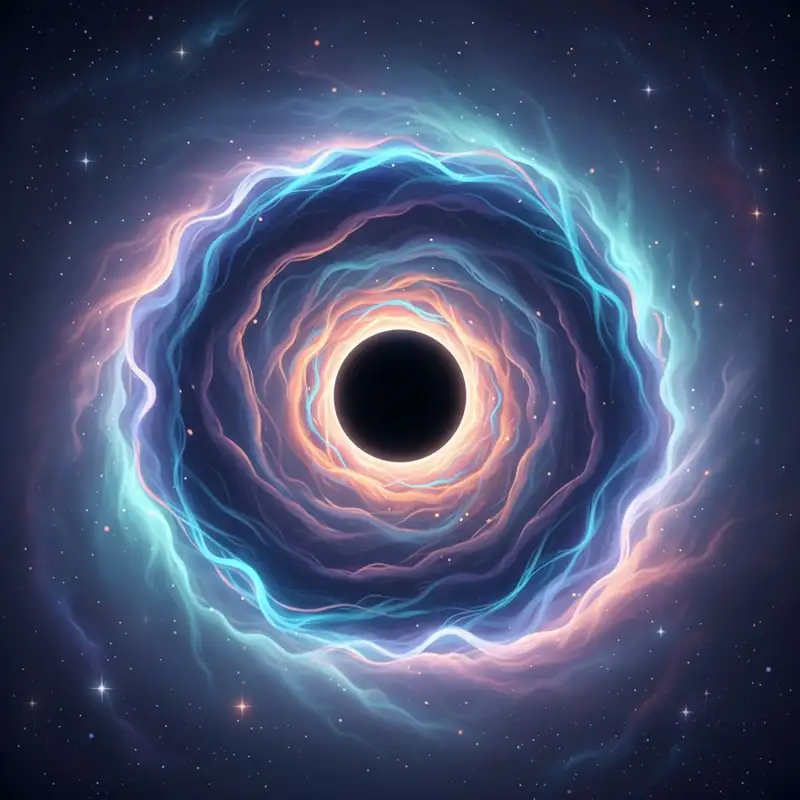
For stars that are significantly more massive than our Sun, the end of their life cycle is marked by a spectacular event known as a supernova. In this cataclysmic episode, the core of the star collapses under its own gravity, while the outer layers are expelled into space, creating a brilliant explosion. In the heart of this explosion, if the core is sufficiently massive, it continues to collapse into an infinitely dense point – a singularity – surrounded by an event horizon, beyond which nothing can escape. This, dear listener, is the birth of a black hole.
Imagine, if you will, the concept of a singularity. It is a point where the laws of physics as we know them cease to function in conventional ways. The gravitational pull becomes so intense that not even light, the fastest traveler in the universe, can escape its grasp. This is why black holes appear as inky voids against the backdrop of space, absorbing all light and matter that ventures too close.
The event horizon, often described as the point of no return, marks the boundary surrounding a black hole. Once an object crosses this threshold, it is inexorably drawn towards the singularity. It is important to understand that, from a safe distance, black holes exert gravitational forces just like any other celestial object of similar mass. It is only when one ventures too close that the dramatic effects manifest.
As we drift further into the tranquil mystery of black holes, let us consider the concept of stellar mass black holes, which form from the remnants of massive stars. These black holes typically contain between three to ten times the mass of our Sun, compressed into an incomprehensibly small space. They are scattered throughout galaxies, often invisible unless they interact with nearby matter. When such interactions occur, they can reveal themselves through powerful emissions of X-rays, as the matter spiraling into the black hole heats up to extreme temperatures.
In the calm of this exploration, we also find supermassive black holes, which reside at the centers of most galaxies, including our own Milky Way. These cosmic giants boast masses ranging from millions to billions of times that of our Sun. The origin of supermassive black holes remains one of the great mysteries of modern astrophysics. Some theories suggest they formed from the collapse of massive gas clouds in the early universe, or perhaps through the merging of many smaller black holes and stars over cosmic time. What remains clear, however, is their profound influence on the structure and evolution of galaxies.
The presence of a supermassive black hole at a galaxy's heart can be a tranquil anchor around which stars and cosmic dust dance in graceful orbits. Yet, when these giants feed, drawing in vast quantities of gas and dust, they can become the most luminous objects in the universe, known as quasars. The energy released during these feeding frenzies can outshine entire galaxies, a testament to the immense power held within these enigmatic objects.
As our gentle voyage through the universe continues, let us pause to consider the wonder of these cosmic phenomena. Black holes, in their silent majesty, challenge our understanding of physics and the nature of space and time. They beckon us to ponder the fundamental workings of the universe, urging us to explore the limits of human knowledge with quiet curiosity.
Imagine the space surrounding a black hole, where time itself seems to stretch and warp. To an observer far from its pull, a clock near a black hole would appear to tick slower, a consequence of the warping of spacetime predicted by Einstein's theory of general relativity. This time dilation effect, while imperceptible in everyday life, becomes significant in the extreme environments near black holes, offering a glimpse into the complex interplay between gravity and time.
In contemplating black holes, we also encounter the concept of Hawking radiation, a theoretical prediction that adds a gentle whisper to the conversation about these cosmic entities. Proposed by physicist Stephen Hawking, this radiation suggests that black holes may not be entirely black but instead emit faint radiation due to quantum effects near the event horizon. Over vast stretches of time, this radiation could lead to the slow evaporation of black holes, a thought-provoking idea that bridges the realms of quantum mechanics and general relativity.
Let us linger for a moment on the idea of black hole mergers, a cosmic ballet where two black holes spiral inward, eventually coalescing into a single, more massive black hole. This dance releases gravitational waves, ripples in the fabric of spacetime that travel across the universe. These waves, faint and elusive, were first directly detected in 2015, opening a new window for observing the cosmos and enhancing our understanding of these enigmatic objects.
As we conclude this segment of our journey, let the serene tapestry of the universe envelop your thoughts. Black holes, with their silent allure, invite us to ponder the beauty and complexity of the cosmos, reminding us of the unending mysteries that await our discovery. In the quietude of space, where the light of distant stars flickers softly, we find solace in the knowledge that the universe, in all its grandeur, continues to inspire wonder and contemplation.
In this moment of reflection, consider the interconnectedness of all cosmic elements, from the smallest particles to the vast structures of galaxies. Each plays a role in the grand symphony of the universe, a gentle reminder of the intricate beauty that lies within the dark and silent depths of space. As we prepare to continue our exploration, let us carry with us the quiet fascination and gentle curiosity that black holes inspire, always seeking to uncover the secrets of the cosmos with patience and reverence.
In the vast tapestry of the universe, black holes stand as enigmatic sentinels, their presence both mysterious and profound. As we delve deeper into their nature, we find that black holes, far from being mere cosmic curiosities, play pivotal roles in the dynamics of galaxies and the evolution of the cosmos itself. The gravitational influence of black holes can shape the orbits of stars and even govern the formation of new stellar systems. In regions where black holes reside, the gravitational dance between them and their stellar companions can result in fascinating phenomena such as X-ray binaries, where material from a star is drawn toward the black hole, releasing intense bursts of X-rays as it spirals inward.
Moreover, black holes are not simply isolated entities but are often found at the heart of galaxies, acting as the core around which galactic matter orbits in a cosmic ballet. These supermassive black holes can be millions or even billions of times the mass of our Sun, exerting a gravitational pull that influences the motion of stars and gas within their host galaxies. This interplay affects the rate of star formation, as well as the distribution of matter, ensuring that galaxies evolve in a complex and interwoven manner. The presence of a supermassive black hole can also affect the shape and structure of a galaxy, playing a crucial role in determining whether it forms as a spiral, elliptical, or irregular galaxy.
As we observe these celestial phenomena, we gain insight into the interconnected nature of the universe. The study of black holes and their interactions with their surroundings has led to advancements in our understanding of fundamental physics, particularly in the realms of general relativity and quantum mechanics. Black holes serve as natural laboratories where the extreme conditions of gravity and density test the limits of our current theories. Scientists continue to probe these mysteries, seeking a unified theory that can reconcile the large-scale forces of gravity with the microcosmic intricacies of quantum mechanics.
In recent years, the observation of gravitational waves has opened a new window into the universe, allowing us to detect the ripples in spacetime caused by the cataclysmic merging of black holes. These gravitational waves, first predicted by Einstein, provide us with a means to observe the universe in a way that is not limited by the constraints of electromagnetic radiation, such as light. Through gravitational wave astronomy, we can now listen to the symphony of the cosmos, detecting the subtle vibrations that echo through the fabric of space.
This burgeoning field of study has already yielded remarkable discoveries, enhancing our understanding of the frequency and scale of black hole mergers, as well as providing new insights into the population of stellar-mass black holes throughout the universe. The detection of these waves also allows us to infer properties about the merging black holes, such as their masses and spins, offering clues about their origins and the environments in which they formed.
As we contemplate the universe from the vastness of interstellar space, we are reminded of the delicate balance that sustains cosmic harmony. Black holes, with their formidable gravitational pull, are powerful agents of change, yet they also contribute to the cyclic nature of stellar life and death. Beyond their roles as cosmic engines of transformation, black holes challenge our understanding of space and time, prompting us to ask profound questions about the nature of reality and the limits of human knowledge.
While black holes are often shrouded in darkness, they illuminate our understanding of the universe, guiding us toward a deeper comprehension of the cosmic order. They remind us that the universe is a dynamic and evolving entity, with forces at play that are both familiar and yet to be fully understood. In our pursuit of knowledge, black holes serve as beacons of curiosity, urging us to explore the unknown and to embrace the mysteries that lie beyond the horizon.
As we journey further into the depths of space, let us take a moment to reflect on the remarkable journey of discovery that has brought us here. From the early observations of starlit skies to the cutting-edge technologies that allow us to peer into the heart of black holes, our quest to understand the cosmos is a testament to the spirit of human inquiry. Each new discovery builds upon the last, forming a tapestry of knowledge that enriches our understanding of the universe and our place within it.
In this ongoing exploration, we find that black holes are not just cosmic endpoints but rather integral components of a vast and interconnected universe. They offer us a glimpse into the extremes of physical reality and challenge us to expand our horizons, both literally and figuratively. As we continue to explore the universe, may we do so with a sense of wonder and humility, ever mindful of the profound mysteries that await our discovery. In the silent depths of space, where black holes hold sway, we find not only the echoes of distant stars but also the whispers of a universe that invites us to explore, to learn, and to marvel at the infinite possibilities that lie beyond our current understanding.
With each passing moment, the universe unfolds before us in a dance of light and shadow, governed by the principles of physics yet imbued with an ineffable beauty that transcends our comprehension. It is in this delicate interplay that black holes find their place, serving as both the guardians of cosmic secrets and the catalysts for new realms of discovery. As we ponder their nature, we are drawn into a deeper appreciation of the universe, recognizing the intricate web of forces that sustain its grandeur.
The study of black holes is a journey that takes us to the very edge of scientific understanding, where the known and the unknown converge in a symphony of possibility. As we continue this journey, let us remain open to the lessons that these cosmic phenomena have to teach us, embracing the mysteries with a sense of awe and a commitment to uncovering the truths that lie just beyond our reach. In the quiet contemplation of the cosmos, may we find inspiration and solace, guided by the gentle curiosity that has always driven us to explore the universe and our place within its vast expanse.
In the embrace of the cosmos, there exists a process of birth and transformation that defies the ordinary, yet is intrinsic to the universe's evolution. Black holes, enigmatic and profound, emerge from the life cycle of stars, particularly those of immense mass. When such a star reaches the end of its lifecycle, it undergoes a dramatic collapse under the weight of its own gravity. This collapse is so intense that it compresses the core of the star into an infinitely dense point known as a singularity, enveloped by an event horizon beyond which nothing can escape, not even light. This boundary delineates the black hole and marks the point of no return. It is a cosmic veil, defining a region of space where the rules we know cease to operate in familiar ways.
The journey to becoming a black hole begins in the heart of a massive star, where nuclear fusion has long provided the outward pressure necessary to counterbalance the inward pull of gravity. This fusion process, which fused lighter elements into heavier ones, sustained the star's brilliance for millions of years. However, as the star exhausts its nuclear fuel, it can no longer support itself against gravitational collapse. In the final moments, the core contracts, temperatures soar, and the outer layers are expelled into space, often resulting in a spectacular supernova explosion. For stars of sufficient mass, this cataclysmic event is but the precursor to the formation of a black hole.
In the aftermath of the supernova, the remnants of the stellar core undergo further collapse. If the core's mass exceeds approximately three times that of our sun, no known force can counteract the gravitational pull, leading to the formation of a black hole. This threshold is known as the Tolman-Oppenheimer-Volkoff limit, beyond which the degeneracy pressure of neutrons cannot halt the collapse. It is as though the core implodes into a point of infinite density, where our understanding of physics as dictated by Einstein's theory of general relativity reaches its limits, and the singularity is born.
The event horizon, the defining surface of a black hole, is not a physical barrier but a mathematical boundary. It is a region where the escape velocity exceeds the speed of light, rendering it the ultimate one-way door. Inside this horizon lies the singularity, a point where spacetime is warped to its extremes, and gravitational forces are incomprehensibly strong. The laws of physics as we know them cannot describe conditions at the singularity, presenting a frontier of science where quantum mechanics and general relativity must someday converge.
Black holes vary in size and mass, from stellar-mass black holes, formed from individual stars, to supermassive black holes found at the centers of galaxies. These cosmic giants hold masses equivalent to millions or even billions of suns, and their formation is a subject of ongoing research and curiosity. It is hypothesized that supermassive black holes could arise from the merger of smaller black holes, from the direct collapse of massive gas clouds in the early universe, or through the accretion of matter over cosmic timescales. Yet, despite their immense size, the event horizons of these black holes are minuscule compared to the vastness of space they dominate, a testament to the extraordinary density that defines them.
As we ponder the mechanisms by which black holes form, we are drawn to the concept of Hawking radiation, a theoretical prediction that suggests black holes are not entirely black. According to physicist Stephen Hawking, quantum effects near the event horizon allow for the possibility of particle-antiparticle pairs forming spontaneously. One of these particles may escape, while the other falls into the black hole, leading to a gradual loss of mass over eons. This process, though slow and theoretical, implies that black holes could eventually evaporate, releasing their stored energy back into the universe, thereby transforming the way we perceive these cosmic enigmas.
In our quest to understand black holes, we find ourselves contemplating the very nature of space and time. The warping of spacetime around a black hole creates phenomena such as gravitational lensing, where light from distant stars is bent around the massive object, providing a natural telescope that magnifies and distorts the view of the universe beyond. This warping effect, predicted by general relativity, allows astronomers to study the regions near black holes and offers a glimpse into the profound interactions between gravity and light.
Moreover, the study of black holes has profound implications for our understanding of the universe's fate. In a cosmos where these objects play a critical role, questions arise about their ultimate destiny. Will they continue to merge and grow, becoming ever larger and more dominant? Or will the universe's expansion lead to a scenario where they become isolated, eventually evaporating and leaving behind a sea of radiation? These questions, while speculative, inspire a deeper inquiry into the nature of reality and the limits of human knowledge.
As you contemplate these mysteries, consider the delicate balance that defines our universe, where the forces of gravity and quantum mechanics weave the fabric of existence. Black holes are not merely cosmic curiosities; they are integral to the narratives of galaxies, stars, and the very structure of spacetime. Their study invites us to explore the boundaries of scientific thought and the profound connections between the macroscopic and the quantum worlds.
In this exploration, we are reminded of the importance of curiosity and the pursuit of knowledge. The universe, vast and enigmatic, beckons us to understand its secrets, urging us to reflect on our place within it. Black holes, with their paradoxical nature, challenge us to expand our horizons and embrace the unknown with humility and wonder. In doing so, we find ourselves participants in a grand cosmic journey, one that transcends the confines of our everyday experience and invites us to dream of worlds far beyond the reach of our senses.
Even as we observe from afar, we are touched by the gentle influence of these distant phenomena. The ripples of their existence reach us across the vastness of space and time, whispering stories of creation, destruction, and rebirth. In the silence of the cosmos, we listen and learn, finding meaning and inspiration in the dance of the stars and the mysteries that lie within the darkened voids.
May this contemplation of black holes and their formation lead you to new insights and a deeper appreciation for the universe that surrounds us. As we venture into the unknown, let us carry with us a spirit of exploration and a sense of awe, ever mindful of the beauty and complexity that define our cosmic home. In this shared endeavor, we discover not only the nature of the universe but also the essence of our own humanity, bound together by the desire to understand, to explore, and to marvel at the wonders of existence.
In contemplating the vastness of the universe and the intricate dance of celestial bodies, we find ourselves drawn to the silent depths where black holes reside, enigmatic entities that challenge our understanding of reality itself. These cosmic phenomena, while seemingly distant and abstract, are woven into the very fabric of the universe, influencing the orbits of stars, the formation of galaxies, and the flow of time. Their presence, often heralded by the absence of light, offers a paradoxical glimpse into the nature of existence—a gateway to realms where conventional laws of physics yield to the profound mysteries of spacetime.
Imagine the delicate balance within galaxies, where stars swirl in graceful orbits, held in place by the gravitational embrace of their galactic core. At the heart of many galaxies, including our own Milky Way, lurks a supermassive black hole, a gravitational anchor around which stars and matter revolve. These colossal entities, millions or even billions of times the mass of our Sun, shape the dynamics of their galactic neighborhoods. Yet, despite their immense influence, they remain shrouded in darkness, detectable only through the effects they have on the matter and light surrounding them.
The formation of such supermassive black holes is a puzzle that continues to intrigue astronomers. As we peer into the depths of space, we witness galaxies in various stages of evolution, each telling a story of growth and transformation. Some theories suggest that these black holes began as smaller seed black holes, born in the early universe, that grew over billions of years by consuming gas and merging with other black holes. This process of accretion and merger paints a picture of a universe in constant motion, where the interplay of forces shapes the destiny of celestial objects.
In the quiet solitude of a black hole's vicinity, the laws of physics are pushed to their limits. Here, the bending of spacetime becomes extreme, and the concept of time itself takes on new dimensions. As matter spirals inward, drawn inexorably towards the event horizon, it heats up and emits radiation, creating spectacular displays of light known as accretion disks. These luminous rings, though visible from vast distances, are but a fleeting glimpse of the forces at play in the shadows beyond.
As we turn our gaze towards the cosmic horizon, we ponder the role of black holes in the grand tapestry of the universe. Their formation and evolution are not just isolated events but are intrinsically linked to the fate of galaxies and the stars within them. Through gravitational interactions, black holes can trigger the birth of new stars, setting off chains of creation and destruction that echo across the cosmos. In this way, they act as both destroyers and creators, engines of change that drive the cycle of matter and energy.
The study of black holes also offers insights into the fundamental nature of reality. At their cores, where density becomes infinite, lies a singularity—a point where the known laws of physics break down. Here, the unification of gravity and quantum mechanics, a goal yet to be fully realized, beckons us to explore the boundaries of our scientific understanding. The pursuit of this knowledge, though fraught with challenges, holds the promise of unlocking secrets that could reshape our perception of the universe.
In the unfolding narrative of black holes, we find a reflection of our own journey through the cosmos. The curiosity that propels us to seek answers mirrors the processes of exploration and discovery inherent in the universe itself. As we unravel the complexities of black holes, we are reminded of the interconnectedness of all things, from the smallest particles to the vast structures that span the heavens.
The dance of creation and annihilation, played out in the shadows of black holes, invites us to contemplate the impermanence and resilience of existence. It is a reminder that, like the stars, we are part of a larger continuum, connected by the same fundamental forces that govern the universe. In this shared experience, we find a sense of kinship with the cosmos, a bond that transcends the boundaries of time and space.
As you ponder these celestial wonders, consider the legacy of knowledge passed down through generations, each discovery building upon the last. The quest to understand black holes is a testament to the enduring spirit of inquiry that defines humanity, a pursuit that spans cultures and epochs. It is a journey that challenges us to look beyond the horizon, to seek answers to questions that have yet to be fully formed.
In the quiet moments of reflection, let the mysteries of black holes inspire a sense of wonder and curiosity. Allow these cosmic enigmas to guide your thoughts to new realms of possibility, where the boundaries of knowledge are ever-expanding. In contemplating the unknown, we find not only answers but also a deeper connection to the universe and to each other.
As you continue to explore the vastness of space, remember that the story of black holes is but one of the countless narratives woven into the fabric of the cosmos. Each star, each galaxy, each particle of matter holds its own tale, contributing to the grand saga of existence. In this shared journey, we are united by a common purpose—to uncover the secrets of the universe and to celebrate the beauty and complexity that lie within.
Let this reflection on black holes serve as a reminder of the power of exploration and the boundless potential of human ingenuity. Together, as we venture into the unknown, we carry with us the legacy of those who came before, guided by their insights and inspired by their discoveries. In this timeless endeavor, we are part of a continuum that stretches across the ages, bound by a shared desire to understand the universe and our place within it.
Embrace the wonder of the cosmos, and allow it to illuminate the path ahead, guiding you toward new horizons and new discoveries. In the dance of stars and the silence of black holes, we find a reflection of our own journey—a journey of exploration, discovery, and connection with the universe that is our home.
In contemplating the vastness of the cosmos and the enigmatic presence of black holes, one finds a sense of humility and awe. The universe, with its seemingly infinite expanse, is a tapestry woven with the threads of time and space, and black holes are among its most intriguing elements. These celestial phenomena, formed from the remnants of massive stars, represent the ultimate triumph of gravity over matter. When a star reaches the end of its life cycle, it may undergo a supernova explosion, shedding its outer layers and leaving behind a core. If this core is sufficiently massive—typically more than three times the mass of our Sun—it can collapse under its own gravitational pull, leading to the formation of a black hole. This process is a testament to the delicate balance of forces that governs the universe, where the interplay of gravity and nuclear pressure determines the fate of stars.
The concept of the event horizon, the boundary surrounding a black hole, is a profound one. It marks the point beyond which nothing, not even light, can escape the gravitational pull of the black hole. As you imagine this boundary, consider its role as a veil shrouding the mysteries that lie within. The event horizon is not a physical surface but rather a region of space-time where the escape velocity exceeds the speed of light. Crossing this threshold signifies a point of no return, where the familiar laws of physics cease to apply in the way we understand them. This boundary challenges our comprehension of reality, inviting us to ponder what exists within—a singularity where density becomes infinite, and our current understanding of physics breaks down.
Yet, black holes are not merely cosmic voids. They are dynamic entities, influencing their surroundings in profound ways. As matter spirals into a black hole, it forms an accretion disk, a swirling maelstrom of gas and dust heated to extreme temperatures. This process emits powerful radiation across the electromagnetic spectrum, making some black holes the most luminous objects in the universe. Quasars, powered by supermassive black holes at the centers of distant galaxies, shine with the brilliance of billions of suns, revealing the intense energy unleashed as matter is consumed. It is a paradox of sorts—an object defined by its inescapable darkness can, through the act of consumption, illuminate the cosmos.
The study of black holes also provides insights into the fundamental nature of gravity. Albert Einstein's general theory of relativity, formulated over a century ago, predicts the existence of black holes and describes gravity as the warping of space-time by mass. In this framework, a black hole is a region where space and time are so severely curved that they form a deep well from which nothing can emerge. Observations such as the bending of light around massive objects, known as gravitational lensing, offer tangible evidence of these predictions. Indeed, the confirmation of such phenomena stands as a testament to the power of theoretical physics to describe the unseen.
In recent years, the detection of gravitational waves has opened a new window onto the universe, allowing us to listen to the cosmic symphony of merging black holes. These ripples in the fabric of space-time, first predicted by Einstein, are generated by the collision and coalescence of massive objects like black holes and neutron stars. The discovery of gravitational waves has ushered in an era of multi-messenger astronomy, where scientists combine data from different sources to gain a more comprehensive understanding of cosmic events. Through this synergy, we can probe the most cataclysmic occurrences in the universe, gaining insights into the extreme conditions that give rise to black holes.
The evolutionary journey of black holes extends beyond their formation. Over time, a black hole can grow by accreting matter from its surroundings, merging with other black holes, or capturing gas clouds and stars. This growth plays a pivotal role in the formation and evolution of galaxies. Supermassive black holes, residing at the centers of most galaxies, including our own Milky Way, exert influence over their host galaxies. The interplay between these black holes and surrounding matter can regulate star formation, shape galactic structures, and even drive the ejection of matter into intergalactic space. This cosmic feedback loop underscores the interconnectedness of galaxies and the role of black holes as cosmic architects.
The presence of a supermassive black hole at the heart of a galaxy raises intriguing questions about their origins. How did these colossal entities form so early in the universe's history? Theories abound, suggesting that they may have grown from the remnants of the first generation of stars, known as Population III stars, or through the direct collapse of massive gas clouds. As you ponder these possibilities, consider the mysteries that remain, reminding us that the universe still holds many secrets waiting to be uncovered.
Black holes also invite us to explore the nature of information and the fundamental principles of quantum mechanics. The so-called information paradox, raised by Stephen Hawking, questions whether information that falls into a black hole is lost forever, challenging the principle that information is conserved in the universe. This paradox has sparked intense debate and research, leading to new insights into the quantum characteristics of black holes. The resolution of this paradox remains one of the most profound challenges in theoretical physics, hinting at a deeper understanding of quantum gravity—a theory that would reconcile the principles of quantum mechanics with those of general relativity.
In this journey through the cosmos, you may find yourself drawn to the beauty of mathematical equations and theoretical constructs that seek to describe the indescribable. These abstract representations are the language through which we attempt to grasp the universe's intricacies. They offer a glimpse into the elegance of the cosmos, where simplicity and complexity coexist in harmony. The pursuit of such knowledge is a testament to the human spirit's resilience and creativity, as we endeavor to decode the universe's secrets.
As you reflect on the enigmatic nature of black holes, consider the profound questions they pose about time itself. Near a black hole, the warping of space-time leads to time dilation, where time passes more slowly in strong gravitational fields than in weaker ones. This effect, predicted by general relativity, has been confirmed by experiments and observations. In the vicinity of a black hole, the flow of time is altered, inviting contemplation of the nature of time as a dimension. It serves as a reminder that our perceptions of past, present, and future are intricately linked to the fabric of the cosmos.
The exploration of black holes and their mysteries is a journey that transcends the boundaries of science, philosophy, and imagination. It invites us to consider our place in the universe, to reflect on the nature of existence, and to embrace the unknown with curiosity and wonder. In this ever-expanding quest for understanding, we are reminded that the universe is not a distant realm but a part of us, woven into the fabric of our being.
As you continue to ponder the mysteries of black holes, let your thoughts drift through the vastness of the cosmos, where each discovery illuminates a new facet of the universe, guiding us on a journey of exploration and connection. In the silence of the night sky, the stars above whisper stories of ancient processes and cosmic events, inviting you to listen, to learn, and to marvel at the wonders that lie beyond. The universe is a grand tapestry, and we are part of its intricate design, forever bound to its mysteries and its beauty.
In the ever-expanding canvas of the universe, black holes stand as profound enigmas that challenge the very fabric of our understanding. Their formation, as remnants of colossal stars, is but the beginning of a journey that extends far beyond their immediate surroundings. These cosmic entities, shrouded in mystery, beckon us to ponder their role within the tapestry of the universe. As we delve deeper, we find that black holes are not isolated phenomena but rather integral components of the cosmic dance that dictates the rhythm of galaxies and star systems alike.
The gravitational influence of black holes reaches far beyond their event horizons, shaping the orbits of stars and sculpting the very structure of galaxies. In the heart of many galaxies, including our own Milky Way, resides a supermassive black hole, millions or even billions of times the mass of our Sun. These titanic entities serve as anchors, holding together the swirling maelstrom of stars and gas that form the galactic core. Observing these supermassive black holes provides insight into the dynamics of galaxies, revealing how matter congregates and evolves over cosmic time scales.
The process through which material spirals into a black hole is often accompanied by the formation of powerful jets, streams of particles accelerated to nearly the speed of light. These jets can extend vast distances into space, influencing star formation and the interstellar medium in their wake. They act as cosmic engines, driving the circulation of energy and matter throughout their host galaxies. The interplay between black holes, their accretion disks, and these relativistic jets underscores the complex feedback mechanisms that regulate the growth and evolution of galaxies.
Furthermore, black holes serve as natural laboratories for testing the laws of physics under extreme conditions. At the event horizon, where gravity is immensely strong, the predictions of general relativity are put to the test. The bending of light around black holes, known as gravitational lensing, provides a unique opportunity to observe the warping of spacetime. This phenomenon allows astronomers to peer into regions of the universe that would otherwise remain hidden, offering a glimpse into the vast networks of galaxies that populate the cosmos.
Beyond their gravitational allure, black holes offer a window into the quantum realm. The interplay between gravity and quantum mechanics at the singularity—a point where density becomes infinite—prompts questions about the nature of space, time, and information. Stephen Hawking's proposal of Hawking radiation suggests that black holes are not entirely black but emit radiation due to quantum effects near the event horizon. This concept, though theoretical, hints at the possibility of black holes gradually evaporating over immense time scales, challenging our understanding of their permanence.
The enigmatic nature of black holes also raises profound philosophical questions about the nature of reality and our place within it. As we contemplate the possibility of information being lost or preserved within these cosmic vaults, we are led to reflect on the broader implications for the universe and the continuity of knowledge. The potential resolution of the information paradox could unlock new insights into the fundamental laws governing the cosmos, bridging the gap between relativity and quantum mechanics.
As our understanding of black holes deepens, so too does our appreciation for the interconnectedness of the universe. These celestial phenomena remind us that the universe is a dynamic, ever-evolving entity, where each component plays a vital role in the grand cosmic symphony. The study of black holes not only enriches our knowledge of the cosmos but also inspires a sense of wonder and curiosity about the mysteries that remain.
The relentless pursuit of understanding drives astronomers and physicists to develop innovative techniques for observing black holes. The Event Horizon Telescope, a global network of radio telescopes, has provided the first direct image of a black hole's event horizon, offering a glimpse into the heart of one of the universe's most elusive objects. This remarkable achievement exemplifies the power of collaboration and technology in unraveling the mysteries of the cosmos.
In the quietude of the night sky, as you gaze upon the stars, consider the forces at play, unseen yet profoundly influential. Black holes, though hidden from direct view, illuminate the path to discovery, guiding us toward a deeper comprehension of the universe's intricacies. They invite us to ponder the boundaries of knowledge and the potential for new revelations that lie beyond our current understanding.
As we continue to explore the cosmos, the questions posed by black holes serve as a testament to the enduring quest for knowledge that defines the human spirit. They remind us that the universe is not merely a collection of celestial bodies but a living entity, imbued with mystery and wonder, calling us to explore its depths and uncover its secrets. In this journey of discovery, we find ourselves not only learning about the universe but also reflecting on our place within it, as observers and participants in the grand narrative of existence.
In this vast, interconnected cosmos, we stand on the precipice of discovery, peering into the unknown with a sense of awe and reverence. The study of black holes, with all its challenges and mysteries, enriches our understanding of the universe and our place within it. As we unravel the secrets of these cosmic enigmas, we are reminded of the beauty and complexity of the universe, inviting us to embrace the wonder and curiosity that propel us forward on this endless journey of exploration.
The narrative of black holes, as we delve deeper, transitions from the realm of their cosmic roles to the intricacies of their formation, a process as fascinating as it is formidable. At the heart of this enigmatic process lies the life and death of stars. Stars, those brilliant beacons of light scattered throughout the universe, are born in vast clouds of gas and dust. Over millions of years, gravity pulls these particles together, igniting nuclear fusion in their cores—a process that powers them for the majority of their lifespans. The grandeur of a star's life is not eternal, however, and it is in their eventual demise that we find the seeds of black holes.
A star's fate, and whether it will give rise to a black hole, hinges largely on its mass. Imagine a star much more massive than our sun—perhaps twenty times its size or even greater. As these massive stars exhaust their nuclear fuel, they undergo a spectacular transformation. The core, no longer supported by the outward pressure of fusion, succumbs to the relentless pull of gravity. This core collapse is a rapid and cataclysmic event, leading to a supernova explosion. The outer layers of the star are violently expelled into space, enriching the cosmos with heavy elements, while the core contracts under its own gravity.
In some cases, the remnant core is so dense and compact that no known force can prevent its collapse into a singularity—a point of infinite density where the laws of physics as we understand them cease to be fully applicable. This singularity is shrouded by an event horizon, a boundary beyond which nothing, not even light, can escape. Thus, a black hole is born. This process, although it occurs on an unimaginable scale, is a natural consequence of the fundamental forces that govern our universe.
The formation of black holes is not uniform and can vary significantly based on the initial conditions of the star. Some stars, depending on their mass and composition, might instead form neutron stars or even white dwarfs, which are fascinating in their own right but do not possess the all-consuming gravitational pull of black holes. The formation of a black hole from a stellar collapse is a testament to the interplay between gravity and quantum mechanics, where the vastness of space is condensed into a point of infinite density.
In the grand tapestry of the universe, black holes are not only birthed from the remnants of dying stars but also through the merging of smaller black holes. Imagine two black holes spiraling towards each other in an intricate cosmic dance, their gravitational waves rippling through the fabric of spacetime. As they draw closer, the energy of their motion is emitted as gravitational waves, and eventually, they merge into a larger black hole. This process, observed by gravitational wave detectors like LIGO and Virgo, provides a glimpse into the dynamic and ever-changing nature of the universe, where even the most stable of celestial objects are subject to transformation and growth.
Black holes can also form in the early universe, during a time when conditions were vastly different from today. These primordial black holes are hypothetical and have not yet been observed directly, but they offer tantalizing possibilities for understanding the universe's infancy. Theoretically, they could have formed from high-density fluctuations in the early universe, providing a window into the conditions that existed just moments after the Big Bang. If they exist, these ancient black holes could be scattered throughout the cosmos, offering clues to the evolution of the universe on both grand and minute scales.
As we ponder these processes, it is important to recognize the subtle interplay between theory and observation. Our understanding of black hole formation is constantly evolving, shaped by the data gathered from telescopes and instruments that peer into the depths of space. The insights gleaned from observing supernovae, the gravitational waves from merging black holes, and the cosmic microwave background radiation all contribute to a more comprehensive picture of how black holes form and evolve.
The study of black hole formation also invites us to reflect on the broader implications for our understanding of the universe. Black holes challenge our perceptions of space and time, offering a unique perspective on the nature of reality. Their existence compels us to question the very fabric of the cosmos, inviting us to explore the boundaries of human knowledge and the possibilities that lie beyond. As we continue to study these enigmatic objects, we are reminded of the vastness of the universe and the intricate dance of matter and energy that shapes it.
In contemplating black holes, we find ourselves at the intersection of the known and the unknown. They are a testament to the power of nature's forces and the beauty of the cosmos, inviting us to explore the mysteries that lie beyond the event horizon. As we journey through the universe, guided by curiosity and wonder, black holes serve as beacons, illuminating the path to discovery and reminding us of the infinite possibilities that await in the vast expanse of space.
This exploration does not occur in isolation but is a collaborative endeavor, drawing on the insights of scientists from diverse disciplines. Astrophysicists, cosmologists, and mathematicians all contribute to our understanding, using a combination of theoretical models and empirical data to unravel the complexities of black hole formation. Their work is a testament to the power of human ingenuity and the relentless pursuit of knowledge, a journey that transcends borders and unites us in a shared quest to understand the universe.
As you contemplate the formation of black holes, consider the profound implications of these celestial phenomena. They are not merely objects of scientific inquiry but symbols of the universe's grandeur and mystery. Their existence challenges us to look beyond the surface of the world we know and to embrace the vastness of the cosmos. In doing so, we come to appreciate the interconnectedness of all things, from the smallest particle to the largest galaxy.
In the end, the story of black holes is one of transformation and continuity, a reminder that even in the face of immense gravity and seemingly insurmountable forces, the universe is a dynamic and ever-changing entity. As we continue to explore the mysteries of black holes, we are reminded of the beauty and complexity of the cosmos, urging us to look beyond the horizon and into the infinite possibilities that lie beyond. In this journey of discovery, we find ourselves not just as observers but as participants in the grand symphony of the universe, each note a reflection of the endless dance of energy and matter that shapes our cosmic home.
And so, we continue to gaze into the night sky, our minds filled with wonder and our hearts open to the mysteries that await. Black holes, with all their complexity and intrigue, invite us to ponder the nature of existence and the boundless potential of the universe. As we move forward, guided by the light of discovery and the spirit of exploration, we remain ever curious, ever inspired by the beauty and majesty of the cosmos.
In the vast tapestry of the universe, each celestial body plays its part in a grand cosmic symphony, with black holes emerging as some of the most enigmatic and compelling performers. As we deepen our understanding of these cosmic phenomena, it is fascinating to consider their impact on the galactic environments in which they reside. Black holes, despite their reputation as devourers of light and matter, are also key players in the universe's ongoing evolution. Their gravitational pull can influence the formation and dynamics of galaxies, acting as both destroyers and creators within this delicate cosmic balance.
At the heart of most large galaxies, including our own Milky Way, lies a supermassive black hole, often millions or even billions of times the mass of our Sun. These behemoths exert a profound influence on their galactic neighborhoods. As matter spirals into the event horizon of a supermassive black hole, it forms an accretion disk. This swirling disk of gas and dust is heated to extreme temperatures, emitting powerful radiation that can outshine entire galaxies. This radiant energy can trigger star formation in some regions while halting it in others, sculpting the very structure of the galaxy itself. The interaction between black holes and their host galaxies showcases the complex interplay of gravitational forces and energetic processes that drive the evolution of the cosmos.
Beyond their galactic roles, black holes also contribute significantly to our understanding of fundamental physics. They are natural laboratories where the laws of physics are pushed to their limits. The intense gravitational fields surrounding black holes provide a unique environment to test theories of gravity, including Einstein's theory of general relativity. The curvature of space-time around a black hole is so extreme that light itself bends in dramatic ways, offering astronomers a rare opportunity to study the warping of the universe's fabric. These insights not only enhance our comprehension of gravity but also guide the quest for a unified theory that can reconcile general relativity with quantum mechanics, the two pillars of modern physics.
The study of black holes also opens a window into the early universe, shedding light on the processes that governed the cosmos shortly after the Big Bang. Primordial black holes, if they exist, are thought to have formed from the high-density fluctuations in the universe's infancy. Although their existence remains speculative, these ancient relics could offer clues about the conditions that prevailed in the first moments of cosmic history. By exploring these primordial entities, scientists hope to unravel the mysteries of dark matter and the universe's initial state, providing a deeper understanding of the cosmos's origins.
As our observational techniques continue to advance, we are poised to uncover even more secrets hidden within black holes. Telescopes with the capability to capture the faintest signals from the farthest reaches of space are being developed, allowing us to peer deeper into the universe than ever before. Instruments like the Event Horizon Telescope have already provided the first direct images of a black hole's shadow, a groundbreaking achievement that confirms long-standing theoretical predictions. These observations offer a glimpse into the heart of these mysterious objects, revealing the intricate dance of matter and energy as they interact with the event horizon.
In parallel with observational advances, theoretical work continues to expand our understanding of black holes. New mathematical models and simulations are being developed to predict the behavior of matter in extreme gravitational fields. These models help scientists to interpret the vast amounts of data collected by telescopes and gravitational wave detectors, providing insights into the complex dynamics of black hole mergers and the nature of the singularities that lie at their cores. As our theoretical frameworks evolve, so too does our ability to appreciate the elegance and complexity of these cosmic giants.
The study of black holes also inspires technological innovation, as the challenges of observing such distant and elusive objects drive the development of cutting-edge instrumentation and computational techniques. From adaptive optics systems that compensate for the Earth's atmospheric distortions to supercomputers capable of processing vast datasets, the technological advancements spurred by black hole research have far-reaching applications beyond astronomy. These innovations contribute to a broader understanding of the universe and exemplify the symbiotic relationship between scientific exploration and technological progress.
In contemplating the role of black holes within the cosmic landscape, it is important to recognize their function as cosmic recyclers. Elements forged in the hearts of stars are eventually consumed by black holes, only to be re-released into the universe through energetic jets and winds. This process of matter being drawn in and expelled plays a crucial role in the cycling of material throughout the cosmos, enriching interstellar space with the building blocks necessary for the formation of new stars and planets. In this way, black holes contribute to the cosmic lifecycle, perpetuating the cycle of creation and destruction that defines the universe.
As we ponder these celestial phenomena, we are reminded of the interconnectedness of all things in the universe. Black holes, in their enigmatic complexity, serve as a reminder of the universe's vastness and our place within it. They challenge us to expand our horizons, to push the boundaries of our knowledge, and to embrace the mysteries that lie beyond the edge of our understanding. In doing so, we affirm our role as explorers, ever eager to uncover the secrets that the cosmos holds.
While our journey of discovery continues, the allure of black holes remains undiminished. These enigmatic objects, once the stuff of science fiction, now stand as testaments to the power of human curiosity and the pursuit of knowledge. They beckon us to venture further, to seek deeper truths, and to marvel at the infinite possibilities that the universe offers. As we turn our gaze to the stars, we carry with us the spirit of exploration and the hope that one day we will unravel the full extent of the mysteries that surround us.
In the quiet moments of reflection, as we contemplate the vastness of the cosmos, we find solace in the knowledge that there is much left to discover. Each new insight, each revelation about black holes and the universe, serves as a stepping stone on our journey of understanding. It is a journey that invites us to remain curious, to seek out the unknown, and to embrace the wonders that lie beyond. As we continue to explore the mysteries of black holes, we are reminded of the beauty and majesty of the cosmos, a reminder that we are part of something far greater than ourselves.
In closing, let us carry with us the awe and wonder that comes from contemplating the universe's grand design. Black holes, with their profound mysteries and cosmic significance, encourage us to look beyond the horizon, to imagine the unimaginable, and to dream of what lies beyond. As we chart the course of our exploration, guided by the light of discovery and inspired by the universe's boundless potential, we remain ever committed to unlocking the secrets of the cosmos and embracing the infinite possibilities that await.
As we delve deeper into the origins of black holes, we are drawn into the heart of stellar evolution, where the life cycles of stars set the stage for these fascinating cosmic entities. A black hole's birth is often heralded by the dramatic death of a massive star, a celestial event known as a supernova. In the vastness of space, stars are born from clouds of gas and dust, coalescing under the force of gravity to ignite nuclear fusion in their cores. This fusion process generates the energy that allows stars to shine brightly for millions or even billions of years. But for the most massive stars, those with a mass at least several times greater than our Sun, this luminous journey is destined to end in a spectacular cataclysm.
As these stars approach the end of their lives, they exhaust their nuclear fuel, leading to a delicate balancing act between the outward pressure from fusion reactions and the inward pull of gravity. When the fuel runs out, gravity takes the upper hand, causing the core to collapse under its own weight. This sudden implosion triggers the outer layers of the star to explode outward in a brilliant supernova, dispersing elements throughout the cosmos that contribute to the formation of new stars and planets. Yet, deep within the remnants of this explosion lies the future black hole, a core so dense that even light cannot escape its gravitational grip. This core, now a singularity, marks the point of no return, where space and time are warped beyond our current understanding.
In these stellar remnants, the gravitational forces become so intense that they form an event horizon, the boundary beyond which nothing can escape. The event horizon is not a physical surface but rather a region in space where the escape velocity exceeds the speed of light. This boundary defines the size of the black hole and is often referred to as its "surface," although it is unlike any surface we can experience or visualize in our everyday lives. The formation of the event horizon is a fundamental aspect of black hole physics, encapsulating the mystery of what lies within this enigmatic boundary.
Beyond the dramatic end of massive stars, black holes can also form through other intriguing processes in the universe. The collision and merger of neutron stars, incredibly dense remnants of supernova explosions, can also give birth to black holes. Neutron stars themselves are a testament to the extreme states of matter, containing the mass of the Sun compressed into a sphere only about ten miles across. When two neutron stars spiral towards each other and collide, the resulting explosion and merger can produce a black hole, accompanied by powerful gravitational waves that ripple through the fabric of space-time. These cosmic symphonies, detectable by instruments like LIGO and Virgo, offer us a unique window into the dynamic processes that govern the universe's most extreme environments.
In the grand tapestry of cosmic evolution, the formation of black holes plays a critical role in shaping the architecture of galaxies. Their immense gravitational influence can regulate the growth of stars and the distribution of matter within galaxies, acting as cosmic architects in the grand design of the universe. In particular, supermassive black holes, which reside at the centers of most galaxies, including our own Milky Way, can reach millions to billions of times the mass of the Sun. These colossal entities are thought to form through a combination of processes, including the merging of smaller black holes and the accretion of vast amounts of gas over cosmic time scales.
The growth of supermassive black holes is often accompanied by the formation of active galactic nuclei, where infalling matter forms a rotating disk around the black hole. As the matter spirals inward, it heats up and emits intense radiation, sometimes outshining the entire galaxy. These active regions, known as quasars, serve as beacons of the early universe, shedding light on the conditions and processes that governed the formation of the cosmos's earliest structures. The interplay between supermassive black holes and their host galaxies is a topic of ongoing research, as astronomers seek to unravel the complex feedback mechanisms that regulate star formation and galactic evolution.
While the formation of black holes is intimately tied to the life cycles of stars and galaxies, their existence also invites us to ponder the fundamental nature of reality itself. The concept of a singularity, where the laws of physics break down and space-time is infinitely curved, challenges our understanding of the universe at its most fundamental level. The study of black holes pushes the boundaries of theoretical physics, inspiring new ideas and models that seek to unify the forces of nature in a coherent framework. Concepts such as string theory and quantum gravity aim to reconcile the apparent contradictions between general relativity and quantum mechanics, offering glimpses of a deeper understanding of the fabric of the cosmos.
In this quest for knowledge, black holes serve as natural laboratories where we can test these theories under the most extreme conditions imaginable. Observations of black holes, particularly through the detection of gravitational waves and high-energy astrophysical phenomena, provide critical data that help refine our models and deepen our understanding of the universe. The recent imaging of a black hole's shadow by the Event Horizon Telescope represents a monumental achievement in this ongoing endeavor, offering direct visual evidence of the event horizon and the bending of light around a massive object.
As we continue to explore the universe, the study of black holes remains a cornerstone of our quest to comprehend the cosmos's deepest mysteries. These enigmatic objects, with their ability to warp space and time, remind us of the intricate and interconnected nature of the universe, where each discovery leads to new questions and avenues of exploration. The allure of black holes lies not only in their mysterious nature but also in their ability to inspire wonder and curiosity, driving us to push the boundaries of human knowledge and imagination.
In contemplating the formation and significance of black holes, we are reminded of our place in the universe, as part of a cosmic journey that stretches back billions of years and extends into an unknown future. The study of black holes invites us to look beyond the confines of our everyday experiences, to embrace the vastness of the cosmos and the myriad possibilities it holds. As we gaze into the depths of space, we are drawn into a dialogue with the universe, a conversation that transcends time and space, connecting us to the stars and galaxies that form the backdrop of our existence.
In this dialogue, we find a reflection of our own quest for understanding, as we seek to unravel the mysteries of the universe and our place within it. The exploration of black holes is a testament to the human spirit of discovery, a journey that challenges us to expand our horizons and embrace the unknown. Through this exploration, we gain not only a deeper understanding of the cosmos but also a greater appreciation for the beauty and majesty of the universe, as we contemplate the wonders that lie beyond the horizon.
In contemplating the vastness of the cosmos, one cannot help but ponder the intricate tapestry woven by the cosmic forces that govern the universe. Our understanding continues to evolve as we delve deeper into the mysteries that lie at the heart of space-time. The phenomena of black holes, enigmatic and profound, beckon us to explore not only the physical but also the philosophical implications of their existence. As we consider their role in the cosmic order, we are reminded of the delicate balance between creation and destruction, a dance that shapes the galaxies and influences the birth and death of stars. The universe, in its grandeur, offers a canvas where time and space are intertwined, and the study of black holes invites us to reflect on these fundamental aspects of reality.
In the shadow of these celestial giants, we find a realm where the laws of physics as we know them are tested to their limits. The gravitational pull of a black hole is so intense that it warps the very fabric of space-time, leading to phenomena that challenge our conventional understanding of the universe. Within this realm, time itself behaves differently, stretching and bending in response to the immense gravitational forces. This warping of space-time is a key prediction of Einstein's theory of general relativity, a theory that has withstood the scrutiny of countless observations and experiments. Yet, within the singularity of a black hole, where densities become infinite, our theories encounter their limits, urging us to seek a unified theory that can reconcile general relativity with quantum mechanics.
The pursuit of such a theory, often referred to as the quest for quantum gravity, represents one of the most profound scientific challenges of our time. It is a journey that leads us to explore the minutest scales of the universe, where particles and forces are governed by the principles of quantum mechanics. In this quantum realm, the deterministic nature of classical physics gives way to probabilities, and the concept of a singular point becomes a cloud of possibilities. String theory, one of the leading candidates for a theory of quantum gravity, proposes that the fundamental constituents of the universe are not point particles but rather tiny, vibrating strings. These strings, through their various modes of vibration, give rise to the particles and forces we observe in our macroscopic world.
The exploration of black holes offers a unique laboratory for testing these ideas, providing insights into the behavior of matter under extreme conditions. As we peer into the depths of these cosmic voids, we are reminded of the interconnectedness of all things, the intricate web of interactions that govern the universe. The study of black holes not only advances our understanding of the cosmos but also challenges us to rethink our place within it, to consider the profound implications of a universe that is both vast and intimately connected.
In our quest to understand black holes, we also confront the concept of information, a fundamental aspect of the universe that is deeply intertwined with the nature of reality. According to quantum mechanics, information about the state of a system is never truly lost, even as the system evolves over time. However, the existence of black holes raises intriguing questions about the fate of information that falls beyond the event horizon, seemingly lost to the observable universe. This conundrum, known as the black hole information paradox, has sparked intense debate and research, leading to new insights into the nature of information and its role in the universe.
As we ponder these questions, we are reminded of the limitations of our current understanding and the boundless opportunities for discovery that lie ahead. The universe, in its infinite complexity, offers endless avenues for exploration, each new discovery opening the door to further questions and deeper insights. Our journey through the cosmos is one of perpetual curiosity, a testament to the human spirit's insatiable desire to know and understand.
The exploration of black holes is but one chapter in the grand narrative of cosmic discovery, a narrative that is ever-evolving and filled with wonder. As we gaze into the night sky, we are not merely observers of distant stars and galaxies but active participants in a cosmic drama that unfolds across the vast expanse of space and time. The universe invites us to explore its mysteries, to seek out the unknown and to embrace the awe-inspiring beauty that lies beyond the veil of our current understanding.
In the silence of the cosmos, we find a reflection of our own journey, a journey that takes us to the very edge of human knowledge and beyond. As we continue to explore and learn, we are reminded of the profound interconnectedness of all things, the intricate dance of matter and energy that shapes the universe and our place within it. Through this exploration, we gain not only a deeper understanding of the cosmos but also a greater appreciation for the beauty and majesty of the universe, as we contemplate the wonders that lie beyond the horizon.
Our exploration of black holes also brings us closer to understanding the ultimate fate of the universe itself, a question that has captivated the minds of scientists and philosophers alike. The universe, as it expands and evolves, presents a mosaic of possible futures, each shaped by the interplay of dark energy, dark matter, and the gravitational pull of countless celestial bodies. Among these possibilities is the notion that black holes, with their immense gravitational influence, may play a role in the eventual fate of the cosmos.
One possibility is that the universe will continue to expand indefinitely, with galaxies moving ever farther apart and black holes gradually swallowing the remnants of stars and other matter in their vicinity. In this scenario, the universe would become a vast, dark expanse, dotted with isolated black holes that slowly dissipate through a process known as Hawking radiation. Named after the renowned physicist Stephen Hawking, this theoretical process suggests that black holes are not entirely black but emit faint radiation due to quantum effects near their event horizons. Over immense spans of time, this radiation could lead to the gradual evaporation of black holes, leaving behind a universe that is cold and devoid of visible structure.
Alternatively, the universe could reach a point where its expansion slows and eventually reverses, leading to a contraction known as the "Big Crunch." In this scenario, the gravitational attraction of matter could overcome the repulsive effects of dark energy, causing galaxies to coalesce and black holes to merge, ultimately resulting in a singularity that mirrors the conditions of the Big Bang. This cyclical view of the universe suggests a perpetual cycle of creation and destruction, with black holes playing a pivotal role in the cosmic rebirth.
These scenarios, while speculative, underscore the profound influence that black holes exert on our understanding of the universe's past, present, and future. They remind us of the inherent uncertainty and wonder that accompany our exploration of the cosmos, a journey that challenges us to question our assumptions and expand our horizons.
As we reflect on the mysteries of black holes and their place in the universe, we are reminded of the power of human curiosity and the enduring quest for knowledge. The study of black holes is a testament to our desire to understand the fundamental nature of reality, a pursuit that transcends the boundaries of science and touches upon the philosophical and existential questions that define our existence. Through this exploration, we gain not only a deeper understanding of the cosmos but also a greater appreciation for the beauty and majesty of the universe, as we contemplate the wonders that lie beyond the horizon.
In our journey through the cosmos, we are guided by the light of discovery, a beacon that illuminates the path forward and inspires us to explore the unknown. The universe, in its vastness, offers a treasure trove of mysteries waiting to be uncovered, each new discovery adding to the rich tapestry of cosmic knowledge. As we continue to explore the enigma of black holes, we do so with a sense of wonder and humility, acutely aware of the limits of our current understanding and the boundless opportunities for discovery that lie ahead. Through this exploration, we are reminded of the interconnectedness of all things, the intricate web of matter and energy that shapes the universe and our place within it.
The exploration of black holes is a journey that takes us to the very edge of human knowledge and beyond, a journey that challenges us to question our assumptions and expand our horizons. As we contemplate the mysteries of the cosmos, we are reminded of the power of human curiosity and the enduring quest for knowledge that drives us to explore the unknown. Through this exploration, we gain not only a deeper understanding of the universe but also a greater appreciation for the beauty and majesty of the cosmos, as we contemplate the wonders that lie beyond the horizon.
In the quiet moments of reflection, we find a connection to the universe that transcends the boundaries of space and time, a connection that invites us to explore the mysteries of the cosmos and embrace the awe-inspiring beauty that lies beyond the veil of our current understanding. The universe, in its infinite complexity, offers endless avenues for exploration, each new discovery opening the door to further questions and deeper insights. As we gaze into the depths of space, we are reminded of the profound interconnectedness of all things, the intricate dance of matter and energy that shapes the universe and our place within it. Through this exploration, we gain not only a deeper understanding of the cosmos but also a greater appreciation for the beauty and majesty of the universe, as we contemplate the wonders that lie beyond the horizon.
In this vast tapestry of the cosmos, black holes hold a special place, acting as mysterious gatekeepers to realms beyond our everyday comprehension. These enigmatic objects, with their immense gravitational pull, warp the very fabric of space and time, creating a region from which nothing can escape. Yet, despite their fearsome reputation, black holes are not merely cosmic vacuum cleaners; they are pivotal in shaping galaxies and influencing the evolution of the universe. Black holes form when massive stars exhaust their nuclear fuel and collapse under their own gravity. This process is a testament to the relentless forces at play in the universe, forces that bind stars, planets, and galaxies into the structures we observe today.
As a star reaches the end of its life cycle, it undergoes a series of transformations. For stars with a mass greater than approximately twenty times that of our Sun, the core collapse results in the formation of a black hole. During this collapse, the outer layers of the star are expelled in a dramatic explosion known as a supernova, enriching the surrounding space with heavy elements. These remnants of stellar explosions contribute to the cosmic cycle of matter, seeding future generations of stars and planets. The core, however, continues to collapse until it reaches a point of infinite density, known as a singularity, surrounded by an event horizon—a boundary beyond which nothing can return.
This singularity, despite being incomprehensible in its nature, is a central feature of a black hole and represents a convergence of our understanding of gravity and quantum mechanics. The event horizon, by contrast, is a more comprehensible feature, acting as a one-way surface that defines the boundary of the black hole. Anything crossing this threshold is forever lost to the observable universe, adding to the mystery of these cosmic entities. The study of black holes thus challenges our understanding of the universe, pushing the boundaries of physics and compelling us to develop new theories that reconcile the laws governing the very large with those of the very small.
Intriguingly, black holes are not merely passive consumers of matter and energy. They play a dynamic role in the formation and evolution of galaxies. Supermassive black holes, millions or even billions of times more massive than the Sun, reside at the centers of most galaxies, including our own Milky Way. These colossal entities exert a profound influence over their cosmic neighborhoods, shaping the formation and movement of stars and interstellar gas. Through a process known as accretion, matter spirals inward towards the black hole, heating up as it forms an accretion disk that can outshine entire galaxies. This energetic process can drive powerful jets of particles out of the black hole's poles, affecting star formation and the distribution of matter across vast distances.
The presence of supermassive black holes raises intriguing questions about their origins and growth. Some theories suggest they formed from the collapse of primordial gas clouds in the early universe, while others propose that smaller black holes merged over time to create these giants. Regardless of their beginnings, these behemoths are crucial to our understanding of galactic dynamics. Observations of distant quasars—luminous objects powered by accretion onto supermassive black holes—offer glimpses into the early universe, providing clues about the formation of galaxies and the role of black holes in this grand process.
The enigmatic nature of black holes is further amplified by their role in the cosmic life cycle. As matter falls into a black hole, it is effectively removed from the universe as we know it. Yet, these cosmic recyclers also contribute to the birth of new stars and galaxies. The energy released during accretion and the resulting jets can trigger the collapse of gas clouds, leading to star formation. In this way, black holes are both destroyers and creators, weaving a complex narrative of cosmic evolution.
In the distant future, black holes may play an even more significant role in the universe's fate. As stars exhaust their nuclear fuel and cease to shine, black holes will remain as one of the few enduring objects in an ever-expanding cosmos. Over unimaginably long timescales, black holes themselves will slowly evaporate through a process known as Hawking radiation, a theoretical prediction that unites quantum mechanics with general relativity. This slow leakage of energy from the black hole is a reminder of the universe's impermanence and the ultimate fate that awaits all matter.
Despite their elusive nature, black holes offer a window into some of the universe's deepest mysteries. They challenge our understanding of space, time, and the fundamental forces that govern the cosmos. As we continue to study these enigmatic objects, we are reminded of the profound interconnectedness of all things, the dance of matter and energy that shapes the universe and our place within it. Through this exploration, we gain not only a deeper understanding of the cosmos but also a greater appreciation for the beauty and majesty of the universe, as we contemplate the wonders that lie beyond the horizon.
The exploration of black holes also serves as a catalyst for technological and scientific advancements. The quest to understand these cosmic objects has driven the development of powerful telescopes and observatories, capable of peering deeper into the universe than ever before. Instruments like the Event Horizon Telescope have allowed us to capture the first direct images of a black hole's shadow, providing tangible evidence of these phenomena that were once purely theoretical. Such achievements underscore the ingenuity and determination of the scientific community in unraveling the mysteries of the cosmos.
Moreover, the study of black holes inspires philosophical reflection, prompting us to reconsider our place in the universe. The concept of a singularity—a point where our current understanding of physics breaks down—challenges our perceptions of reality and invites us to ponder the nature of existence itself. In this way, black holes serve as a bridge between the tangible and the abstract, the known and the unknown, urging us to expand our horizons and embrace the mysteries that lie beyond our current understanding.
The allure of black holes lies not only in their scientific significance but also in their ability to evoke a sense of wonder and curiosity. These cosmic enigmas captivate our imagination, inviting us to explore the boundaries of human knowledge and reach for the stars. In contemplating the vastness of the cosmos and the intricate dance of matter and energy, we are reminded of the beauty and complexity of the universe, a universe that continues to inspire and challenge us in our quest for understanding. As we journey through the cosmos, black holes serve as both a destination and a starting point, guiding us on a path of discovery that leads to ever deeper questions and insights.
In this grand cosmic symphony, black holes play a vital role, their presence a testament to the dynamic and ever-changing nature of the universe. As we stand on the precipice of discovery, we are reminded of the profound interconnectedness of all things, the intricate dance of matter and energy that shapes the universe and our place within it. Through this exploration, we gain not only a deeper understanding of the cosmos but also a greater appreciation for the beauty and majesty of the universe, as we contemplate the wonders that lie beyond the horizon. The journey to unravel the mysteries of black holes is a journey to understand the universe itself, a journey that continues to inspire and captivate the human spirit.
In this vast and wondrous cosmos, black holes serve as both a challenge and an invitation, urging us to push the boundaries of our understanding and explore the unknown. As we gaze into the depths of space, we are reminded of the profound interconnectedness of all things, the intricate dance of matter and energy that shapes the universe and our place within it. Through this exploration, we gain not only a deeper understanding of the cosmos but also a greater appreciation for the beauty and majesty of the universe, as we contemplate the wonders that lie beyond the horizon. Let us continue this journey, guided by curiosity and wonder, as we seek to unravel the mysteries of the universe and discover the secrets that lie within the heart of the cosmos.
In the vast tapestry of the cosmos, black holes serve as both the weavers and the threads, intricately entwining the fabric of the universe in ways we are only beginning to comprehend. These gravitational giants, formidable in their simplicity and mystery, pull on the very essence of space and time, creating a cosmic ballet that captivates our imagination. As we delve deeper, we find that black holes are not just endings, but gateways to new beginnings, their presence echoing through the cosmos in waves of influence.
The life of a black hole is a testament to the universe's ability to create and transform. Formed from the remnants of massive stars, black holes are regions where gravity reigns supreme, pulling everything within reach into a singularity, a point of infinite density. This singularity is shrouded by an event horizon, a boundary beyond which nothing, not even light, can escape. Yet, what lies beyond this invisible frontier remains one of the most profound mysteries in modern astrophysics, inviting us to ponder the fundamental laws of nature.
Beyond the individual, stellar-mass black holes, we encounter the colossal entities known as supermassive black holes, residing at the centers of galaxies, including our own Milky Way. These behemoths, millions to billions of times the mass of our Sun, exert a gravitational influence that can shape entire galaxies. Their origins, while still shrouded in mystery, are believed to be ancient, forming in the early universe. It is hypothesized that these supermassive black holes could have grown from the seeds of smaller black holes, accumulating mass over billions of years through the accretion of gas and dust, or perhaps through the merging of intermediate-sized black holes, a cosmic dance of gravity and inertia.
As we observe these enigmatic entities, technological advancements have allowed us to peer closer than ever before. The Event Horizon Telescope, a global network of radio observatories, has provided an unprecedented glimpse into the heart of a black hole, capturing the silhouette of the supermassive black hole in the galaxy M87. This image, a ring of light surrounding a shadowy core, offers a direct confirmation of phenomena predicted by Einstein's theory of general relativity. It stands as a testament to human ingenuity and our relentless quest to understand the universe.
The study of black holes also challenges our understanding of time and space. Near a black hole, the warping of spacetime reaches extreme levels. Time itself slows down in the presence of such intense gravity, a phenomenon known as gravitational time dilation. For an observer far from the black hole, the infall of matter towards the event horizon appears to slow, almost as if time were standing still. Yet, for an object crossing this boundary, the journey continues inexorably toward the singularity, a journey from which no information can return.
In the realm of quantum mechanics, black holes present an intriguing paradox. The concept of Hawking radiation, proposed by physicist Stephen Hawking, suggests that black holes can emit radiation due to quantum effects near the event horizon. This radiation implies that black holes can gradually lose mass and eventually evaporate over astronomical timescales. The interplay between quantum mechanics and general relativity in this context raises profound questions about the nature of information and entropy, leading to the famous black hole information paradox. This paradox challenges our understanding of whether information that falls into a black hole is truly lost or can be retrieved, a question that continues to inspire theoretical exploration.
As we contemplate the universe's vastness, black holes remind us of the delicate balance between creation and destruction. The forces that govern their existence are the same that allow stars to shine and galaxies to evolve. In this cosmic symphony, black holes are both composers and performers, their influence reaching across the universe in waves of gravitational energy. These waves, ripples in the fabric of spacetime, were first directly observed by the LIGO and Virgo collaborations, providing yet another way to study these elusive objects.
Through the detection of gravitational waves, we have opened a new window into the universe, allowing us to observe the merger of black holes, events that emit energy equivalent to several solar masses in mere seconds. These observations not only confirm predictions of general relativity but also offer insights into the population and distribution of black holes across the cosmos. Each detection enriches our understanding of these mysterious entities, revealing the dynamic processes that govern their interactions.
In the quiet solitude of space, black holes also influence the formation of stars and the evolution of galaxies. Their gravitational pull can trigger the collapse of gas clouds, initiating the birth of new stars. In the centers of galaxies, the dance of matter around supermassive black holes can lead to the formation of accretion disks, where material spirals inward, heating up and emitting radiation across the electromagnetic spectrum. These accretion disks are among the brightest sources of energy in the universe, powering quasars and active galactic nuclei, which can outshine entire galaxies.
The interconnectedness of black holes with their cosmic surroundings is a testament to the universe's ability to recycle and renew. As matter is consumed and energy radiated away, black holes contribute to the cycle of cosmic evolution, weaving the threads of existence into the fabric of the universe. This interplay between destruction and regeneration is a reflection of the dynamic processes that govern the cosmos, a reminder of the balance that sustains the universe's grandeur.
In the realm of theoretical physics, black holes are a fertile ground for exploring the unification of the fundamental forces. They bring together the principles of quantum mechanics and general relativity, two pillars of modern physics, in environments where both must be considered. The pursuit of a theory of quantum gravity, which seeks to reconcile these two frameworks, is driven by the mysteries that black holes present. String theory, loop quantum gravity, and other approaches strive to offer insights into the true nature of spacetime at the smallest scales, guided by the enigmatic presence of black holes.
As we journey through the cosmos, black holes invite us to ponder our place in the universe. They challenge us to think beyond the confines of our daily existence, to imagine the possibilities that lie beyond the stars. In their silence, they speak volumes about the forces that shape our reality, urging us to explore the boundaries of knowledge and to seek answers to questions that transcend the limits of our understanding. In their enigmatic presence, we find a source of wonder, a testament to the beauty and complexity of the universe.
Our exploration of black holes is not just a journey through space, but an odyssey of the mind, a quest to understand the fundamental nature of reality. As we peer into the depths of these cosmic abysses, we are reminded of the power of curiosity and the human spirit's relentless pursuit of knowledge. Each discovery, no matter how small, brings us closer to unraveling the mysteries of the universe, illuminating the path forward in our quest to understand the cosmos.
In the grand tapestry of the universe, black holes are both a mystery and a guide, leading us toward new horizons of understanding. As we continue to explore their depths, we are drawn into a realm where imagination meets reality, where the known and the unknown converge. It is a journey without end, a continuous unfolding of the universe's secrets, inviting us to ponder the infinite possibilities that lie beyond the event horizon. Through this exploration, we find a connection to the cosmos, a reminder of the wonder and beauty that surrounds us, and an inspiration to seek answers to the questions that define our place in the universe.
As we immerse ourselves in the depths of black holes and the universe they inhabit, the boundaries of our understanding are continually expanded. These celestial enigmas, while seemingly isolated, play a crucial role in the grand tapestry of cosmic interconnectivity. For within the event horizon, a realm cloaked in mystery, lies a profound interplay of physics that challenges the very fabric of space-time and the limits of human comprehension. Black holes are not merely voids in space; they are dynamic entities that exert influence across vast distances, sculpting the cosmos in ways both subtle and profound.
The gravitational pull of a black hole is so intense that it warps the space around it, creating a gravitational well that can capture anything that strays too close. This warping of space is a concept elegantly described by Einstein’s theory of general relativity, where gravity is not a force in the traditional sense but a curvature of space-time. As you glide closer to a black hole, the fabric of reality stretches and twists, creating a landscape where the rules of physics as we know them begin to blur. This curvature not only affects the paths of light and matter but also has a profound impact on time itself, a phenomenon known as time dilation. Near a black hole, time slows relative to the rest of the universe, a curious reminder of the interconnectedness of time and space.
Beyond their gravitational influence, black holes are also engines of energy, converting the mass of infalling material into radiation with incredible efficiency. As matter spirals into a black hole, it forms an accretion disk, heating up as it is compressed and accelerated to nearly the speed of light. This process unleashes vast amounts of energy, often outshining entire galaxies and providing a beacon that can be observed across cosmic distances. The radiation from these accretion disks can help to illuminate the otherwise invisible black holes, offering a glimpse into their otherwise hidden nature.
In these energetic outbursts, we find the seeds of cosmic change. The energy released by black holes can drive powerful jets of particles that extend far into space, influencing their surroundings and shaping the evolution of galaxies. These jets can trigger star formation by compressing gas clouds or, conversely, inhibit it by heating and dispersing the gas. Thus, black holes serve as both creators and destroyers, forging a delicate balance that governs the lifecycle of galaxies.
While the accretion of matter and the emission of radiation are key aspects of black hole dynamics, they also play a pivotal role in the cosmic web, the vast network of filaments of dark matter and galaxies that crisscross the universe. Black holes, by anchoring massive galaxies, act as nodes in this cosmic web, where the distribution and movement of matter are guided by their gravitational influence. This interconnected structure of the universe speaks to the harmony and order that emerge from seemingly chaotic processes, a testament to the underlying unity of all things.
Yet, amidst this grand structure, black holes pose questions that transcend our current understanding. They challenge us to reconsider the nature of information and its preservation within the universe. The black hole information paradox, a puzzle that has intrigued physicists for decades, asks whether information that falls into a black hole is truly lost to the universe or whether it can be recovered, perhaps encoded in the radiation that black holes emit over time. This paradox sits at the heart of a deeper quest to reconcile the principles of quantum mechanics with the macroscopic world of general relativity, a journey that could ultimately reshape our understanding of reality itself.
To explore these questions, scientists turn to the tools of modern astrophysics, employing observatories and instruments that span the electromagnetic spectrum, from radio waves to gamma rays. These observations allow us to peer into the environments surrounding black holes, to witness the dance of matter and energy at the edge of the abyss. Meanwhile, theoretical physicists delve into the mathematics of black holes, seeking new insights and solutions that might bridge the gap between the quantum and the cosmic.
As you contemplate this vast and intricate tapestry, you may find yourself drawn to the notion of a universe in constant flux, where creation and destruction are but two sides of the same coin. Black holes, with their immense gravitational pull, their enigmatic interiors, and their profound impact on cosmic evolution, serve as both mirrors and gateways. They reflect the mysteries of the universe while inviting us to venture beyond the known into realms of imagination and possibility.
In the quiet moments of reflection, consider the role of black holes as cosmic recyclers, taking the remnants of stars and galaxies and transforming them into the building blocks for new celestial forms. This cycle of death and rebirth, of transformation and renewal, echoes throughout the cosmos, reminding us of the continuity and interconnectedness of all things. It is a dance that has been playing out for billions of years, a cosmic ballet that we are only beginning to understand.
There is a soothing symmetry in the notion that black holes, once thought to be simple endpoints, are instead gateways to new beginnings. They invite us to ponder questions of existence and meaning, to explore the depths of our curiosity, and to seek understanding in the face of the unknown. As you journey through the cosmos, remember that each discovery, each new understanding, is but a step on an endless path of exploration. The universe, in all its vastness and complexity, offers infinite possibilities for wonder and discovery, a reminder of the beauty and mystery that surround us, and an invitation to reach beyond the stars.
In our pursuit of knowledge, we find not only answers but also deeper questions, each revelation leading to new avenues of inquiry and contemplation. Through this endless cycle of discovery, we are connected to the cosmos, our place within it defined not by our limitations but by our aspirations to know and understand. May the mysteries of black holes, and the universe at large, continue to inspire and guide us on this journey of exploration, a journey that is as boundless as the universe itself. As you reflect on these cosmic wonders, allow yourself to be enveloped by the quiet majesty of the universe, a gentle reminder of the infinite possibilities that lie beyond the horizon, waiting to be discovered.
With reflections upon the infinite possibilities of the universe still resonating within you, let us gently steer our thoughts to the origins of these cosmic titans—black holes. Their formation is a tale woven from the very fabric of stellar life cycles, a narrative as old as the stars themselves. Imagine a star, one of those celestial giants that grace our universe with their luminous presence. As it lives, it performs a delicate dance, balancing the outward push of nuclear fusion against the inward pull of gravity. During the majority of its life, this balance is maintained with grace and precision. However, as time marches on, a star's life eventually reaches a point where this equilibrium cannot be sustained.
In the core of such a star, nuclear fuel diminishes, and the outward pressure that counterbalances gravity begins to falter. Gravity, relentless and ever-present, takes the helm. The core contracts under its immense force, and if the star is sufficiently massive—at least several times the mass of our sun—this collapse is unstoppable. The core's atoms are crushed together, and the star's outer layers are expelled in a spectacular supernova explosion, enriching the surrounding space with heavy elements that will one day become part of new stars, planets, and even life itself.
Yet, the saga of the core is far from over. As it compresses beyond the limits of known matter, a remarkable transformation occurs. The core becomes a singularity, a point where density is infinite and the known laws of physics falter. This singularity is enveloped by an event horizon, a boundary beyond which nothing—no particle or even light—can escape. Thus, a black hole is born, a silent guardian of the universe, cloaked in mystery and shadow.
The birth of a black hole is not uniform; it varies depending on the progenitor star's mass and composition. For stars slightly more massive than our sun, the end state might be a neutron star or a white dwarf, but only those with masses sufficient to overcome degeneracy pressure—a quantum mechanical effect that opposes collapse—end their lives as black holes. Observing these births, scientists learn about the fundamental forces that govern our universe.
The formation of black holes is not limited to the death of massive stars. There are also primordial black holes, which, if they exist, would be relics from the early universe, formed shortly after the Big Bang when regions of high density collapsed under their own gravity. These ancient entities, whether real or theoretical, offer a glimpse into the conditions of the universe's infancy, potentially providing clues about the dark matter that pervades the cosmos.
Moreover, the universe's grand architecture includes supermassive black holes anchoring the hearts of galaxies. These behemoths, millions or even billions of times the mass of our sun, are thought to have formed differently, perhaps from the direct collapse of massive gas clouds or through the merger of smaller black holes over cosmic time scales. Their formation remains one of the great mysteries of astrophysics, driving a quest for understanding that spans both the vast reaches of space and the depths of time.
In the quiet expanse of space, black holes do not stand alone. They often exist in binary systems, gravitationally bound to a companion star. In these stellar duos, the black hole can draw material from its partner, forming an accretion disk that glows fiercely as friction and gravitational forces heat the gas to extreme temperatures. Through this interaction, black holes not only reveal their presence but also impact their surroundings, influencing the evolution of stars and galaxies alike.
As you ponder these stellar phenomena, consider the role of black holes as cosmic laboratories. They allow us to test the boundaries of our theories, offering a stage upon which the drama of general relativity and quantum mechanics unfolds. The study of black holes challenges our understanding, inviting us to refine our models of the universe and to seek a unified theory that harmonizes the macroscopic world of gravity with the microscopic realm of particles.
The quiet allure of black holes lies not only in their enigmatic nature but also in their profound implications for the universe. They remind us of the impermanence and cyclical nature of celestial phenomena, where endings serve as precursors to new beginnings. In the colossal gravitational embrace of a black hole, matter is not destroyed but transformed, contributing to the eternal cycle of creation and dissolution that defines our cosmos.
As we traverse the narrative of black hole formation, we find ourselves drawn into a story of cosmic alchemy, where matter is continuously reshaped and reimagined. The universe, in its vast complexity, becomes a tapestry of interconnected events, each thread woven with care and intricacy. Through the lens of black holes, we perceive the grand symphony of the cosmos, where every note resonates with the harmony of natural laws.
And so, in the gentle stillness of this moment, allow your thoughts to drift among the stars, where the birth and evolution of black holes serve as a testament to the universe's boundless creativity. As you reflect on these cosmic processes, take comfort in the knowledge that even in the darkest corners of space, there is a beauty that speaks to the heart of existence. The universe, with its infinite wonders, awaits your contemplation, inviting you to explore its mysteries with a spirit of gentle curiosity and profound wonder.
In this vast expanse, where time and space entwine, black holes remind us of the delicate balance that sustains the universe. Their presence, both formidable and graceful, encourages us to embrace the unknown, to seek understanding beyond the horizon, and to cherish the mysteries that lie at the heart of creation. As you journey into the depths of cosmic understanding, may the quiet majesty of the universe guide you, offering solace and inspiration in the pursuit of knowledge.
The universe, in its infinite grandeur, is a canvas painted with the brushstrokes of time and space, where phenomena like black holes invite us to ponder the intricate tapestry of cosmic events. As we drift deeper into this celestial realm, let us turn our gaze to the profound influences these enigmatic entities exert on their cosmic neighborhoods. Black holes, with their immense gravitational pull, are more than just the remnants of dying stars; they are architects of their surroundings, sculpting the fabric of spacetime itself. Imagine, if you will, a region of space where the gravitational forces are so intense that nothing, not even light, can escape their grasp. This is the realm of the black hole, a place where the conventional laws of physics find themselves stretched to their limits.
The presence of a black hole within a galaxy can significantly impact the dynamics of nearby stars and gas clouds. The gravitational influence of a black hole can accelerate the orbits of nearby stars, causing them to dance in intricate patterns. This celestial choreography is not just a spectacle to behold but also a crucial part of understanding the structure and behavior of galaxies. In regions where black holes draw in material, accretion disks form, swirling with energy and radiating across the electromagnetic spectrum. These disks are among the brightest objects in the universe, providing a stark contrast to the dark heart of the black hole itself. The energy released in these disks can have profound effects, driving powerful jets of particles that shoot out into space at nearly the speed of light. These jets can extend for thousands of light-years, influencing the formation of stars and even the growth of galaxies over cosmic timescales.
In considering these interactions, one might reflect on the concept of feedback within the universe. Black holes, through their accretion processes and energetic outputs, can regulate the growth of galaxies, curbing the formation of new stars in some regions while triggering it in others. This cosmic feedback loop is a fundamental mechanism in the evolution of galaxies, illustrating a delicate balance between creation and destruction. Such interactions underscore the interconnectedness of all cosmic phenomena, where the presence of a single black hole can ripple through the fabric of a galaxy, shaping its destiny over billions of years.
As we continue our exploration, let us delve into the intriguing notion that black holes may not only be the remnants of stellar endings but also the seeds of new cosmic beginnings. The theory of black hole mergers presents a fascinating chapter in the story of the universe. When two black holes orbit each other, they gradually spiral inwards due to the emission of gravitational waves, a prediction of Einstein's general theory of relativity. These ripples in spacetime, detected by observatories such as LIGO and Virgo, provide a window into the dynamics of these cataclysmic events. As the black holes merge, they form a single, more massive black hole, releasing a tremendous amount of energy in the form of gravitational waves. This process not only offers insight into the properties of black holes but also enhances our understanding of the universe's most extreme environments.
The detection of gravitational waves marks a new era in astrophysics, allowing us to observe the universe in ways previously unimaginable. These waves carry information about the mass and spin of merging black holes, offering clues about their origins and the environments in which they formed. Each detection enriches our understanding of the universe, revealing the hidden dance of massive objects and the subtle effects of gravity on spacetime.
Beyond the realm of mergers, black holes are also thought to play a pivotal role in the formation of the large-scale structure of the universe. In the early universe, primordial black holes, if they exist, could have served as the seeds for the formation of galaxies, providing the gravitational pull necessary to gather gas and dust into the first galactic structures. This idea, while still a topic of active research, highlights the potential for black holes to influence cosmic evolution from the very beginning.
The mysteries of black holes extend even further, touching upon the fundamental questions of physics. At the heart of a black hole lies the singularity, a point where densities become infinite and our current understanding of physics breaks down. This enigmatic region challenges the boundaries of knowledge, prompting physicists to seek a theory of quantum gravity that can reconcile the principles of general relativity with those of quantum mechanics. Such a theory could unlock deeper insights into the nature of spacetime, the origin of the universe, and perhaps even the fate of black holes themselves.
The concept of Hawking radiation, proposed by physicist Stephen Hawking, adds another layer of complexity to our understanding of black holes. According to this theory, black holes can emit radiation due to quantum effects near the event horizon, causing them to lose mass and eventually evaporate over immense timescales. This idea, while still theoretical, suggests that black holes are not eternal but rather transient features of the cosmos. The implications of Hawking radiation touch upon the very nature of information, posing questions about the fate of information that falls into a black hole and whether it can be preserved as the black hole evaporates.
Such ponderings lead us to the very edge of scientific inquiry, where philosophy and physics converge. The study of black holes inspires a sense of wonder and curiosity, inviting us to reflect on our place in the universe and the nature of existence itself. As you contemplate these cosmic enigmas, consider the delicate interplay of forces that govern the universe, where even the most formidable phenomena are part of a larger, harmonious whole.
In the vastness of space, where black holes reign as both destroyers and creators, we find a universe filled with paradox and possibility. These cosmic giants, with their unfathomable power and mysterious allure, beckon us to explore the boundaries of knowledge and venture into realms where the known laws of physics give way to the unknown. As our journey through the cosmos continues, let us carry with us the awe and inspiration that such exploration evokes, embracing the mysteries that lie beyond the horizon and the infinite potential for discovery that awaits.
In this cosmic odyssey, the universe reveals itself not as a distant, indifferent expanse, but as a vibrant, dynamic tapestry, woven with the threads of time, matter, and energy. Black holes, with their enigmatic presence, challenge us to look beyond the surface, to seek out the deeper truths that underpin the fabric of reality. As we gaze into the depths of space, let us remember the words of those who have dared to dream of the stars, who have sought to unravel the mysteries of the cosmos, and who have inspired generations to look up and wonder at the majesty of the universe.
The journey of understanding is eternal, and with each step, we uncover more about the universe and ourselves. Black holes, in their silent, powerful way, remind us that the quest for knowledge is as boundless as the cosmos itself, urging us to continue our exploration with a spirit of humility and wonder. As we navigate the star-studded tapestry of the night sky, may we find solace in the knowledge that the universe is a place of endless possibilities, where each discovery leads to new questions and every horizon reveals yet another vista to explore.
In the vastness of the universe, where stars are born and galaxies collide, lies the enigmatic presence of black holes. These cosmic phenomena, with their immense gravitational pull, capture our imagination and challenge our understanding of the fundamental laws of nature. To truly appreciate how black holes come into being, we must first consider the life cycles of the most massive stars in the cosmos. Unlike our Sun, which will one day become a white dwarf after shedding its outer layers, the most massive stars end their lives in spectacular supernova explosions. It is from the remnants of these cataclysmic events that black holes are often born. As a star exhausts its nuclear fuel, it can no longer support itself against the relentless force of gravity. The core collapses under its own weight, and if the mass is sufficient, it forms a singularity—a point where density becomes infinite and the known laws of physics cease to operate as we understand them.
In this final act of stellar evolution, the outer layers of the star are expelled into space, enriching the surrounding interstellar medium with heavier elements, the building blocks of planets and life. It is a reminder that the death of a star is not an end, but a transformation, a cosmic recycling that contributes to the ongoing dance of creation and destruction that defines our universe. In the wake of this explosive demise, a black hole emerges, its event horizon marking the boundary beyond which nothing can escape, not even light itself. This boundary is a region of mystery, a veil that conceals the secrets of the singularity within.
The formation of a black hole is not merely an end but also a beginning. As they draw in matter from their surroundings, black holes can become engines of cosmic change, influencing the evolution of galaxies and the formation of new stars. They serve as gravitational anchors, around which entire star systems can orbit, maintaining a delicate balance in the cosmic dance. The interplay of forces at the event horizon, where time and space warp to unimaginable degrees, offers a glimpse into the potential for new physics, challenging our current understanding and beckoning us to explore further.
Beyond the gravitational collapse of massive stars, black holes can also form through other processes. In the early universe, primordial black holes might have formed moments after the Big Bang, arising from high-density fluctuations in the young cosmos. Although their existence remains theoretical, these ancient black holes, if they exist, could offer insights into the conditions of the early universe and the nature of dark matter, a mysterious substance that makes up most of the universe's mass yet remains invisible and elusive.
In the more recent cosmic timeline, black holes can also grow through the process of accretion, as they pull in gas, dust, and even other stars from their surroundings. This accumulation of matter can cause the black hole to grow significantly in mass over time. When two black holes encounter each other, as they often do in the dense centers of galaxies, they can merge to form a larger black hole, releasing gravitational waves that ripple across the fabric of spacetime. These waves, first predicted by Einstein's theory of general relativity, have been observed and recorded by sensitive instruments on Earth, providing us with a new way to study the universe, one that does not rely on light but on the very vibrations of spacetime itself.
The study of black holes offers a unique laboratory for testing theories of gravity and quantum mechanics, two pillars of modern physics that remain largely incompatible at the extremes of a black hole's singularity. Theoretical physicists continue to explore the possibility that black holes could connect to other regions of spacetime through theoretical constructs like wormholes, offering tantalizing, though purely speculative, possibilities of travel beyond the known universe. While these ideas remain in the realm of theory, they inspire a profound sense of wonder and curiosity about the true nature of the cosmos.
Our understanding of black holes is continually evolving, driven by advances in observational astronomy and theoretical physics. The Event Horizon Telescope, an international collaboration using a network of radio telescopes around the world, has provided us with the first direct image of a black hole's shadow, a monumental achievement that has confirmed many aspects of theoretical predictions. This triumph of human ingenuity and collaboration has opened new pathways for our understanding of these fascinating objects.
As we gaze deeper into the cosmos, we find that black holes are not isolated entities but are intricately connected to the vast web of cosmic structures. Their presence is felt across the universe, influencing the formation and evolution of galaxies, the dynamics of star clusters, and even the distribution of matter on the largest scales. They serve as cosmic beacons, illuminating the paths of inquiry into the most profound questions about the nature of reality.
Black holes also challenge us to consider our place in this vast universe. They remind us that we are part of a dynamic and ever-changing cosmos, where the interplay of forces and the cycles of creation and destruction shape the very fabric of existence. In this grand tapestry, we find ourselves as observers and participants, driven by a deep-seated curiosity to uncover the secrets of the universe.
With each new discovery, we are reminded of the power of the scientific endeavor, the relentless pursuit of knowledge that transcends boundaries and unites us in a shared quest for understanding. The study of black holes is a testament to the human spirit, a reminder that even in the face of the unknown, we are capable of great achievements and profound insights.
As you ponder the mysteries of black holes, consider the journey we have undertaken to reach this point in our understanding. From the ancient stargazers who first marveled at the night sky to the modern scientists who probe the depths of space with cutting-edge technology, the quest to understand black holes is a testament to our enduring curiosity and our desire to comprehend the universe in which we live.
In this journey, we are guided by the light of knowledge, a beacon that illuminates the path forward and reveals new horizons to explore. The universe, with its boundless complexity and infinite wonders, invites us to continue our exploration, to seek out the unknown, and to embrace the mysteries that lie beyond the edge of our current understanding.
In the silent depths of space, where black holes reside, we find a reflection of our own quest for meaning and purpose. As we unravel the secrets of these cosmic enigmas, we are reminded that the universe is a vast and wondrous place, a place where every discovery leads to new questions and every horizon reveals yet another vista to explore.
In this delicate dance of cosmic phenomena, black holes stand as both guardians and heralds of the unknown, their enigmatic nature drawing us ever deeper into the heart of the universe's mysteries. As we ponder the intricate tapestry woven by their existence, we find ourselves contemplating not only the immense gravitational forces that define these objects but also the profound implications they hold for our understanding of space and time. Within their event horizons, where the pull of gravity becomes irresistible, time itself is believed to slow, creating a realm where the usual boundaries of physics begin to blur. This distortion of time and space invites us to reflect on the very fabric of the cosmos, challenging our perceptions and urging us to expand our horizons.
The existence of black holes prompts us to consider the interplay between matter and energy, space and time, and how these fundamental elements of the universe are interconnected. As we explore the concept of singularity, where the core of a black hole is thought to reside, we are compelled to confront the limits of our current scientific understanding. In this infinitely dense point, the laws of physics as we know them may no longer apply, presenting a tantalizing frontier for theoretical exploration. Such considerations inspire both awe and humility, reminding us of the vastness of the universe and the intricacy of the forces that govern it.
In the gentle glow of starlight, we are reminded of the delicate balance that exists within our universe. Black holes, despite their formidable presence, play a crucial role in maintaining this equilibrium. By consuming surrounding matter and energy, they help regulate the growth of galaxies, preventing them from becoming too massive and chaotic. This process of cosmic recycling ensures that the universe remains a dynamic and ever-changing place, ripe with potential for new discoveries and insights. As we contemplate the role of black holes in galactic evolution, we are drawn to the idea that they are not merely destructive forces, but also essential components of a balanced and harmonious cosmos.
Beyond their gravitational influence, black holes serve as catalysts for some of the most energetic and spectacular phenomena in the universe. When matter spirals into a black hole, it forms an accretion disk, a swirling mass of gas and dust heated to extreme temperatures. This process can release immense amounts of energy, sometimes outshining entire galaxies and producing powerful jets of particles that extend across vast distances. These jets, propelled at nearly the speed of light, illuminate the surrounding space, offering glimpses into the dynamic processes occurring near these enigmatic objects. The study of these high-energy phenomena provides valuable insights into the forces at work in the universe, enhancing our understanding of the complex interactions that shape cosmic evolution.
As we delve deeper into the mysteries of black holes, we find ourselves drawn to their potential as cosmic laboratories for testing the laws of physics. In the extreme conditions near a black hole, where gravity is incredibly intense, scientists can explore the boundaries of general relativity and quantum mechanics. These investigations hold the promise of uncovering new principles that govern the universe, potentially leading to a more unified theory of fundamental forces. The pursuit of such knowledge is a testament to the enduring human spirit of inquiry, driven by a desire to comprehend the world around us and our place within it.
The journey of understanding black holes is a reminder of the interconnectedness of all things, from the smallest particles to the largest cosmic structures. In this vast and intricate web, black holes serve as pivotal nodes, influencing the flow of matter and energy across the universe. As we continue to explore these celestial phenomena, we are reminded of the beauty and complexity of the cosmos, a place where each discovery unveils new layers of wonder and insight.
In contemplating black holes, we are invited to consider the broader implications of their existence for our understanding of reality. These mysterious objects challenge our notions of space and time, prompting us to rethink our fundamental assumptions about the nature of the universe. They serve as a bridge between the known and the unknown, beckoning us to step into realms of thought that extend beyond the confines of our current understanding.
As our exploration of black holes evolves, so too does our appreciation for the profound interconnectedness of the cosmos. The study of these enigmatic entities encourages us to look beyond the immediate and visible, to consider the underlying forces that shape the universe and our place within it. In this pursuit, we are reminded of the importance of curiosity and imagination, the very qualities that have driven human progress throughout history.
The allure of black holes lies not only in their mysteries but also in the possibilities they present for future exploration. As technology advances and our observational capabilities expand, we are poised to uncover new dimensions of understanding that were once beyond our reach. This progress is a testament to the resilience and ingenuity of the human spirit, ever striving to push the boundaries of what is known and to illuminate the vastness of the cosmos.
In the quiet moments of reflection, as we ponder the depths of space where black holes reside, we find a sense of connection to the universe and to each other. The study of these cosmic phenomena serves as a reminder of our shared journey, a journey marked by exploration, discovery, and a quest for understanding. It is a journey that transcends time and space, linking us to the past and propelling us into the future.
As we draw this gentle exploration to a close, let us carry with us the sense of wonder and curiosity that black holes inspire. These enigmatic objects, with their profound mysteries and boundless potential, offer a window into the vast and intricate tapestry of the cosmos. In contemplating their existence, we find an invitation to continue seeking, to embrace the unknown, and to cherish the beauty and complexity of the universe. And so, as we journey onward, may we remain open to the discoveries that await us, guided by the stars and the silent whispers of the cosmos, ever reminding us of the wonders that lie beyond.
The gentle dance of celestial bodies, bound by the invisible threads of gravity, continues to unfold in the vast theater of the universe. Stars are born and die, galaxies collide and transform, each a testament to the ceaseless flow of cosmic time. In this grand symphony, black holes serve as silent sentinels, their presence felt in the gentle tug on the fabric of space-time. As you ponder these cosmic wonders, feel the rhythm of the universe, an eternal melody that plays softly, guiding you through the infinite expanse.