The Hidden History of Saturn’s Rings
Welcome aboard, and thank you for joining another quiet journey through the cosmos.
You are listening to Bedtime Astronaut, a moment of gentle exploration designed to accompany you as you unwind, settle into stillness, and drift softly toward rest.
Before we begin, feel free to find a comfortable position, allow your shoulders to relax, and give yourself permission to just listen… without effort… without urgency.
There is no destination you must reach, no lesson you must remember.
Just a gentle celestial guide, sharing the story of our universe in the most peaceful and grounded way.
Tonight, we explore one of the most extraordinary structures in our solar system — a structure made of countless ice particles, orbiting in harmony around a planet more than a billion kilometers away.
Our journey takes us toward Saturn, and deeper, into the intricate world of its rings.
They may appear delicate and serene when seen from afar, but each component of the rings carries the history of impacts, cosmic origins, and gravitational interplay that stretches across millions or even billions of years.
To begin, imagine Saturn not as a distant object in the night sky, but as a world we are slowly approaching.
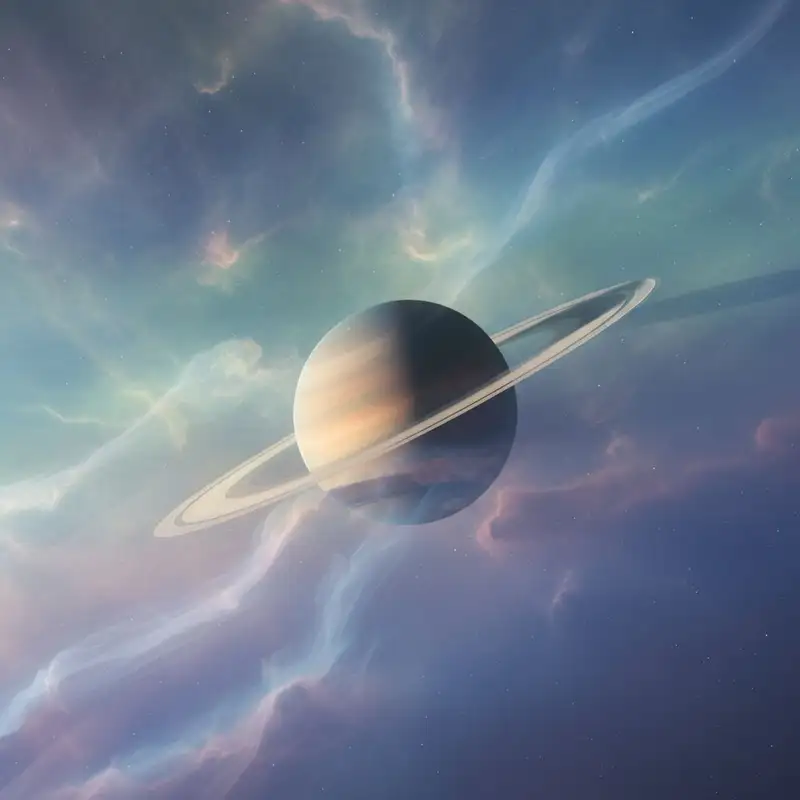
From afar, the rings appear as luminous bands, softly glowing in reflected sunlight.
As we draw closer, the complexity increases.
The broad, sweeping arcs of brightness are revealed to be made of countless smaller structures: ringlets, gaps, waves, and textures that shift over time.
Each particle follows its own orbit, influenced not only by Saturn’s massive gravity but also by the gravitational nudges of nearby moons.
Before we explore the present-day scientific understanding, let’s gradually move back in time, to the earliest human encounters with Saturn and its rings.
Not physical encounters, of course, but encounters through observation — through the earliest telescopes, and the earliest hints that Saturn was unlike any other planet visible from Earth.
The first known telescopic observations of Saturn’s rings occurred in 1610, when Galileo Galilei pointed one of the earliest refracting telescopes at the planet.
Galileo expected a bright, round world similar to what he had seen with Jupiter, but instead he observed a shape that defied the instruments and knowledge of his time.
What he saw appeared almost like three spheres: a central disk flanked by two smaller bodies.
He described the structure as Saturn “having ears,” because he could not fully discern the shape as rings.
The magnification and optical quality of early telescopes simply did not allow a clear view.
But Galileo’s observations did not stop at the first glimpse.
Two years later, the “ears” mysteriously disappeared.
He wrote in confusion about Saturn “swallowing” these strange appendages.
For Galileo, this disappearance was inexplicable, because the true explanation — the tilt of Saturn’s ring plane relative to Earth — was not yet understood.
When the rings rotate edge-on to our perspective, they become nearly invisible because of their thinness.
A more decisive understanding came in 1655, when Christiaan Huygens used a more advanced telescope of his own design.
He observed Saturn with enough clarity to deduce that the planet was encircled by a thin, flat, ring-shaped structure that did not touch the planet.
This was the first correct interpretation of the rings as a separate structure.
A few decades later, astronomer Giovanni Cassini discovered the large gap between what we now call the A and B rings.
This gap, now named the Cassini Division, is one of the most prominent features in the entire ring system.
Cassini’s observations began to reveal the rings not as a single structure, but as a layered, subdivided arrangement with distinct zones.
From these early observations, humanity gradually began to piece together the story of Saturn’s rings, though mysteries remained for centuries.
The nature of the rings — what they were made of, how they formed, and how they maintained their shape — remained unresolved until the 19th century.
In the mid-1800s, physicist James Clerk Maxwell addressed the problem mathematically.
He demonstrated that the rings could not be solid or liquid, as some earlier scientists had proposed.
A solid ring would be gravitationally unstable, inevitably breaking apart under Saturn’s pull.
Maxwell concluded that the rings must be composed of countless small particles, each orbiting Saturn independently.
Modern observations confirm Maxwell’s insight.
The rings are made primarily of water ice, with a small fraction of rock, dust, and other material.
They span more than 270,000 kilometers from the innermost to the outermost visible regions, yet they are extraordinarily thin — often no more than about 10 meters thick.
The broad sections we see with telescopes are labeled in alphabetical order based on their discovery: the D, C, B, A, F, G, and E rings.
The B and A rings are the brightest and densest, while others like the F ring are narrow and dynamic, shaped by small shepherd moons.
To better understand these rings, we must consider the environment around Saturn — an environment shaped by gravity, magnetism, and the presence of more than 140 known moons.
These moons range in size from small fragments only a few kilometers across, to large worlds like Titan, which is bigger than the planet Mercury.
Some moons, such as Prometheus and Pandora, orbit near the F ring and help maintain its narrow, braided structure.
Other moons embedded within the rings, such as Daphnis in the Keeler Gap, create waves and disturbances in the surrounding material through gravitational interactions.
These interactions reveal the rings not as a static structure, but as a dynamic, constantly shifting system shaped by the continuous interplay of forces.
As humanity entered the age of planetary exploration, new tools became available to study Saturn up close.
In 1980 and 1981, the Voyager 1 and Voyager 2 spacecraft performed flybys of Saturn.
For the first time, detailed images of the rings were captured, revealing thousands of ringlets and unexpected features.
One of the most intriguing Voyager discoveries was the presence of spokes — faint radial markings that can stretch for thousands of kilometers across the rings.
These features appear and disappear over hours or days and are believed to be related to interactions between electrically charged dust particles and Saturn’s magnetic field.
Voyager’s observations expanded our understanding, but the picture became far clearer with the Cassini spacecraft.
Launched in 1997 and arriving at Saturn in 2004, Cassini spent more than 13 years studying the planet, its rings, and its moons.
Cassini provided the highest-resolution images ever captured of the ring system, revealing textures, patterns, and wave structures that were previously unknown.
One discovery was the diversity in particle composition and size across different regions.
Some areas contain larger chunks of ice, while others consist mostly of fine grains.
Cassini also observed propeller-shaped disturbances caused by moonlets too small to be directly seen.
The spacecraft also revealed how moons interact with the rings in subtle ways.
For example, the moon Enceladus emits plumes of water vapor and ice particles through geysers at its south pole.
This material feeds the outer E ring, linking the geology of a moon directly to the orbiting ring structure.
The question of how old the rings are became a major focus of Cassini’s science mission.
One line of evidence suggested that the rings are relatively young — perhaps 10 to 100 million years old — because they appear too bright to be ancient.
Micrometeoroid impacts should darken the ice over billions of years, yet the rings remain highly reflective.
However, more recent studies propose that impacts might remove material in ways that maintain the brightness, potentially allowing the rings to be much older than previously thought.
It remains possible that the rings are nearly as old as Saturn itself, having formed around 4.5 billion years ago.
Cassini’s final orbits — known as the Grand Finale — brought the spacecraft between Saturn and its innermost rings.
These close passes allowed scientists to precisely measure the gravitational pull of the rings, refining estimates of their mass.
This information helps constrain theories of their age.
Beyond age, another question concerns the future of the rings.
Cassini measurements detected ring material falling inward toward Saturn’s atmosphere.
This phenomenon, sometimes called ring rain, suggests that the rings are gradually eroding.
Over tens to hundreds of millions of years, they may diminish significantly or even disappear entirely.
Despite their eventual fate, Saturn’s rings remain an extraordinary example of natural orbital engineering.
They demonstrate how particles can organize into stable structures under the influence of gravity, collisions, and magnetism.
As we continue to explore space, the rings provide a model for understanding other disk systems in the universe.
Circumstellar disks around young stars, for example, contain the building blocks of planets.
Accretion disks around massive bodies show similar patterns of density waves and gravitational shaping.
Saturn’s rings, therefore, serve as a nearby laboratory for studying wide-ranging astrophysical processes.
Now, imagine drifting above the rings themselves.
From this vantage, the icy particles below might look like snowy grains shimmering in sunlight, forming patterns of brightness and shadow across the curved arc of the planet’s equator.
The particles do not collide violently; instead, they gently nudge and settle, aligning themselves into thin layers.
Even within the brightness, there is variation — dense regions where particles cluster tightly, and gaps where gravitational interactions have cleared paths.
The Cassini Division, though they appear empty from afar, contains fine dust and subtle structures that only high-resolution measurements can detect.
Every region tells a different part of the story, shaped by millions of years of motion.
As the rings circle Saturn, they maintain a delicate balance.
Each particle follows an orbit defined by physics, yet influenced by events large and small: a passing moon, a collision, a charge from sunlight, or the faint pull of the planet’s magnetic field.
When we view the rings from Earth, we see them as symmetrical arcs.
But up close, they are far more textured — rippled waves, narrow gaps, and twisting structures shaped by resonances.
These patterns also change with seasons.
As Saturn orbits the Sun once every 29.5 years, the angle of sunlight shifts, altering the appearance of the rings.
In 2009, the rings passed edge-on relative to Earth, causing them to nearly vanish from view.
Their thinness becomes striking during these moments, revealing how delicate they truly are.
All of these details reinforce the idea that Saturn’s rings are more than a simple structure.
They are an evolving environment, a system of countless components moving together in quiet choreography.
As we let this picture settle in, we can appreciate the scale of what we are observing.
Each particle in the rings follows an orbit at high speed, yet from a distance the system appears perfectly still.
This harmony of motion is one of the most remarkable features of Saturn’s environment.
Let’s continue deeper, expanding our view of the ring system and the surrounding moons.
Among Saturn’s many moons, Titan is the largest, with a dense atmosphere rich in nitrogen and methane.
Though it does not interact directly with the rings, Titan’s gravitational influence plays a role in the broader orbital structure.
Enceladus, with its icy plumes, stands out as one of the most interesting moons in the solar system.
Its contributions to the E ring connect geology, chemistry, and orbital mechanics.
Other moons, such as Rhea, Dione, Tethys, and Mimas, each hold their own histories, marked by cratering, fractures, and variations in density.
These moons and rings are part of a shared environment, each influencing the other across immense stretches of time.
Let’s pause for a moment.
Imagine the gentle hum of space, the faint reflection of sunlight through drifting particles.
Slow orbital paths weaving their way around a giant planet.
A vast network of moons and rings, each moving through silent gravitational interactions.
This is the setting that surrounds Saturn — a quiet, majestic environment shaped by steady forces over ages.
The origin of the rings themselves remains one of the most compelling mysteries.
One theory suggests that a large icy moon ventured too close to Saturn and was torn apart by tidal forces.
Another theory proposes that the rings formed from leftover material that never coalesced into a moon during the early formation of the solar system.
Some evidence supports the idea of a catastrophic event, while other evidence points toward gradual processes.
The question of whether the rings are ancient or relatively young continues to inspire debate.
As we look ahead, the future of Saturn’s rings will be shaped by many of the same forces that shaped their past.
Micrometeoroid impacts will continue to grind particles into smaller pieces.
Ring rain will draw material toward Saturn.
Moons will maintain or alter ring edges.
And sunlight will charge particles, affecting their positions within the magnetic field.
Over millions of years, these processes will gradually reshape the rings.
The story of Saturn’s rings is not a static one.
It is a living chapter within the larger narrative of the solar system.
As we move toward the end of this exploration, feel free to let your breath slow, allowing the imagery and facts to settle into a calm, drifting perspective.
Imagine the rings once again from afar.
Delicate, thin, and luminous.
Orbiting a world of storms, magnetism, and deep history.
A structure formed from ice and motion, shaped by time and quiet forces.
The rings continue to orbit, silent and steady, beneath the vastness of space.
They endure as symbols of cosmic harmony, reflecting sunlight across unimaginable distances.
And as we step back from this journey, we return with a deeper appreciation for the structure and beauty woven into the physics of the universe.
Let your thoughts soften, like particles settling gently into orbit…
and allow your mind to drift where it wishes…
into the quiet expanse of space.
As we continue our quiet journey through this remarkable part of the solar system, let’s shift our perspective slightly.
Instead of focusing solely on the rings themselves, we’ll consider Saturn as a whole — its structure, composition, atmosphere, and the ways these elements influence the rings and surrounding space.
Saturn is a gas giant, composed primarily of hydrogen and helium.
Its average density is so low that, if a bathtub large enough existed, Saturn would float.
The outer layers of Saturn consist of thick clouds and atmospheric bands, similar in appearance to Jupiter’s but more subtle and muted.
Beneath these clouds, the atmosphere gradually transitions into layers of metallic hydrogen and deeper regions where pressures and temperatures rise dramatically.
The planet rotates quickly, completing a full rotation in just about 10.5 hours.
This rapid rotation causes Saturn to bulge noticeably at the equator.
The equatorial diameter is significantly larger than the polar diameter, resulting in a shape known as an oblate spheroid.
This equatorial bulge plays an important role in the dynamics of Saturn’s gravitational field, which in turn affects the rings and moons.
The gravitational variations help maintain certain ring structures and contribute to the precession of moon orbits.
Saturn’s magnetic field is another key factor.
It is aligned closely with the planet’s rotational axis and extends far into space, forming a magnetosphere that interacts with charged particles in the rings.
The magnetic field influences phenomena like spokes and particle charging, adding to the complexity of ring behavior.
When sunlight strikes the ring particles, it can cause electrons to escape from their surfaces, generating a slight electric charge.
This charge affects how the particles respond to magnetic forces, altering their vertical position above the ring plane.
Under certain seasonal conditions, these charged particles can levitate briefly, creating the ghostlike spokes first observed by Voyager and later studied by Cassini.
Saturn’s seasons are long, lasting over seven Earth years each, because the planet's orbit around the Sun takes nearly thirty Earth years.
As seasons change, the angle of sunlight shifts across the rings.
This affects not only how the rings look from Earth but also how particles within them behave.
During equinox, when the Sun shines edge-on across the ring plane, shadows cast by ring structures become extremely long.
Cassini captured remarkable images during the 2009 equinox, showing fine details such as vertical structures at ring edges and intricate shadows stretching across the system.
These observations helped scientists measure the thickness of ring features with precision not possible before.
Understanding these changes helps us appreciate how even small variations in sunlight and angle can produce large visual effects at the scale of Saturn's rings.
Let’s now shift our attention to one of the most important aspects of the system: resonances.
A resonance occurs when orbiting bodies, such as moons and ring particles, exert regular gravitational influences on one another.
These interactions can maintain gaps, create waves, or destabilize certain regions.
The Cassini Division, for example, owes part of its structure to a resonance with the moon Mimas.
Particles within the division would orbit Saturn twice for every orbit of Mimas.
This repeated gravitational tug gradually clears particles from the region, creating the prominent gap that we observe.
Similarly, many waves and disturbances found within the rings correspond to resonances with other moons.
Some waves spiral outward, while others spiral inward.
These wave structures act like fingerprints identifying which moon is influencing that region.
Resonances not only sculpt the rings but also help scientists determine the masses and orbits of moons.
By studying these patterns, Cassini provided new insights into the internal structure of certain moons and the composition of ring regions.
Moving further outward in the Saturnian environment, we encounter the E ring.
This is a broad, diffuse ring extending far beyond the bright A and B rings.
The E ring is composed mainly of fine ice particles ejected from the south polar geysers of Enceladus.
Enceladus has become one of the most scientifically intriguing moons in the solar system.
Beneath its icy crust lies a global subsurface ocean in contact with a rocky core.
The interaction between water and rock likely produces hydrothermal activity, which contributes to the geysers.
Cassini flew through these plumes multiple times, detecting organic molecules, salts, silica particles, and water vapor.
The connection between Enceladus and the E ring illustrates how geological activity on a moon can shape the ring system.
It is a rare and beautiful example of a world influencing a ring through ongoing processes rather than ancient history.
Another unique ring is the Phoebe ring.
It is enormous, extending far beyond the E ring, and is composed of dark dust believed to originate from the moon Phoebe.
This ring is so faint that it cannot be seen with visible light; it was detected using infrared imaging.
Some of the dust drifts inward until it reaches the moon Iapetus, coating its leading hemisphere and contributing to Iapetus’s stark two-tone appearance.
These outward rings remind us that Saturn’s influence extends much farther than its bright, familiar bands.
Now, let's return to the internal structure of the rings.
The densest region is the B ring.
It contains the greatest mass of material and reflects sunlight intensely.
Yet, even within this bright band, the internal composition varies.
Some parts of the B ring are nearly opaque, while others contain windows of relative transparency.
Cassini’s instruments measured the ring particles' distribution and showed that their density and arrangement can differ significantly from one region to another.
Even within a single ring, conditions vary enough to produce different optical depths and textures.
The A ring, located just outside the Cassini Division, features its own complex structures.
Near the outer edge of the A ring lies the Encke Gap.
Within this gap orbits the small moon Pan, whose gravitational influence maintains the gap and creates wave patterns in the surrounding ring material.
Pan has a distinctive shape, resembling a rounded body with a raised equatorial ridge — almost like a ravioli.
This unusual shape may have formed as the moon accreted material from the rings.
A similar moon, Daphnis, orbits within the Keeler Gap.
Its influence creates vertical waves at the edges of the gap, some rising hundreds of meters above the ring plane.
These waves cast long shadows during equinox, revealing the three-dimensional nature of the ring system.
Even though the rings appear flat from a distance, they contain structures with surprising vertical complexity.
The F ring, narrow and dynamic, is influenced by the shepherd moons Prometheus and Pandora.
Prometheus periodically steals material from the ring, creating channels and streamers.
Pandora helps confine the ring’s outer boundary.
The interactions between these moons and the F ring produce chaotic, ever-changing patterns.
Cassini observed bright clumps, knots, and braided segments within the F ring.
These features evolve quickly, sometimes changing over hours or days.
The F ring demonstrates that ring systems can be highly dynamic and not simply ordered or static.
As we shift our focus again, imagine drifting above the rings, observing the fine interplay between gravity, light, and motion.
The particles, though small, collectively form patterns that stretch across thousands of kilometers.
These patterns shift quietly, subtly, influenced by moons that orbit nearby and by forces that act continuously, shaping the system's appearance.
Saturn’s rings have been the subject of countless scientific studies, yet many questions endure.
One lingering question concerns the total mass of the rings.
Mass estimates vary, but most suggest that the rings contain only a small fraction of the mass of Saturn's smallest moons.
Cassini’s gravity measurements indicated that the rings may be less massive than previously thought.
A lower mass suggests they could be younger, because they would more easily accumulate dust and debris over time, darkening and degrading their appearance.
However, the rings remain bright, raising questions about how they stay clean.
If ring particles are continually ground down into smaller sizes, and if impacts vaporize contaminants rather than embedding them, the rings could stay bright even over long timescales.
This interplay between contamination and cleansing remains an active area of research.
Another question concerns how ring particles interact with Saturn’s atmosphere.
Ring rain — the slow migration of particles into the planet’s upper atmosphere — has been observed directly through Cassini measurements.
Charged particles spiral along magnetic field lines until they enter the atmosphere and dissipate.
This process likely occurs continuously.
Although it is slow, over millions of years it could significantly alter the rings.
Saturn’s rings, therefore, are not permanent fixtures.
They represent a phase in the planet’s long history.
Whether they formed billions of years ago or more recently, their evolution is ongoing.
Let’s broaden our view once more, to the role ring systems play in the wider solar system.
Saturn is not the only planet with rings.
Jupiter, Uranus, and Neptune also have ring systems, though they are much fainter and more simplistic.
Jupiter’s rings are primarily composed of dust and are fed by micrometeoroid impacts on its moons.
Uranus has a system of narrow, dark rings maintained by gravitational interactions with small moons.
Neptune’s rings are thin and contain arc-shaped clumps that resist dispersal due to resonant interactions.
These other ring systems help us understand Saturn’s rings by comparison.
Saturn’s rings are unique because of their brightness, mass, and structural diversity.
But all ring systems provide insights into how particles behave in orbit and how gravitational influences shape celestial structures.
Understanding rings also helps researchers interpret protoplanetary disks around young stars.
These disks contain gas and dust that eventually form planets.
Spiral waves, gaps, and resonances observed in Saturn’s rings offer analogies to the processes occurring on much larger scales in these early planetary nurseries.
Thus, Saturn’s rings act as a nearby laboratory for understanding far more distant and complex systems.
As we reflect on these facts, imagine now that we are floating just above the edge of the B ring.
The light scattering from the particles creates a soft, shimmering effect.
Depending on the angle of the Sun, the rings may appear brighter or darker.
From some angles, they reflect sunlight almost like a mirror.
From others, they appear translucent.
If you were able to reach down, the particles would not feel like a solid surface.
Instead, you would encounter countless pieces of ice drifting past one another.
An individual particle might be cool to the touch, its temperature influenced by the Sun and the shadow of Saturn.
But together, these particles behave like a fluid, creating waves and patterns that ripple outward.
As we drift further, the rings become denser or more sparse depending on the region.
Moving across the Cassini Division, we enter the A ring, with its distinctive density waves and resonance patterns.
The sound, if it could be heard, would not resemble anything familiar.
Space is silent, and the motion of ice particles produces no audible noise.
Yet the visual motion of particles would tell its own story — a story of celestial harmony, shaped by physics and time.
Now imagine descending closer, moving between ring particles themselves.
Each particle follows its path, maintaining speed and direction unless perturbed by a collision or gravitational influence.
Collisions, when they occur, are gentle.
Particles may bounce lightly, exchange momentum, and drift apart again.
This environment is peaceful, steady, and governed by laws that apply throughout the universe.
With this perspective, we begin to appreciate how structure emerges from simplicity — how countless small objects, each following basic physical rules, can collectively form a vast and intricate system.
Let’s now shift toward the region inside the D ring, closest to Saturn.
This region contains sparse particles and is influenced strongly by Saturn's atmosphere and magnetic field.
Particles here experience drag from faint atmospheric gases, causing them to gradually spiral inward.
This process contributes to ring rain, the gradual loss of material toward Saturn.
The interplay between atmospheric drag, electromagnetic forces, and gravitational pull makes the inner ring regions particularly dynamic.
If we extend our view outward again, beyond the A ring and the F ring, we reach the region of the G and E rings.
The G ring contains arcs of material maintained by the gravitational influence of the small moon Aegaeon.
The E ring, as discussed earlier, is maintained by the plumes of Enceladus.
At the farthest reaches lies the Phoebe ring, composed primarily of dark dust.
The particles orbit retrograde — the opposite direction of Saturn’s rotation — because they originate from the irregular moon Phoebe.
This ring demonstrates how even distant moons can contribute to Saturn’s extended environment.
As we continue to drift along this orbit of thought, let your breathing slow.
Allow your attention to soften, and imagine the vastness of Saturn’s system extending around you.
The rings encircle the planet like a cosmic gateway.
The moons dance in their paths.
And forces that operate quietly — gravity, magnetism, collisions, sunlight — shape everything over enormous timescales.
In the context of the solar system, Saturn’s rings represent a unique balance between chaos and order.
Their formation may have been violent or gradual, but their present state is one of harmony.
Now imagine the rings once more from afar, stretching outward in thin, delicate arcs.
The particles that make up the rings each follow a journey determined by physics, yet collectively form one of the most beautiful structures in the solar system.
As we conclude this section of our journey, feel free to let your attention ease into the background of your experience.
We will continue our exploration shortly, expanding the narrative into the broader cosmic implications of Saturn’s rings and their enduring mystery.
For now, simply remain present with the sense of quiet motion, drifting gently across the rings of an ancient and enigmatic world.
As we continue floating gently within the Saturnian system, it becomes clear that every component — every moon, every particle, every gap within the rings — plays a role in shaping the overall environment.
The rings are not isolated structures but are deeply intertwined with the planet’s moons, atmosphere, magnetic field, and even the history of the solar system.
Let’s gradually shift our attention toward the interior of Saturn itself, so we can understand how its internal structure influences everything around it.
Saturn’s internal composition is layered.
At the surface, or more accurately, at the uppermost visible cloud tops, the atmosphere consists mostly of hydrogen, with helium and trace amounts of methane, ammonia, and water vapor.
These gases form bands that encircle the planet, shaped by winds that can reach speeds of more than 1,800 kilometers per hour.
Beneath the atmosphere lies a transition region where hydrogen becomes denser and more compressed.
Further down, at extreme pressures, hydrogen becomes metallic — a fluid in which electrons move freely.
This region helps generate Saturn’s magnetic field.
Although Saturn’s magnetic field is less intense than Jupiter’s, it is still far stronger than Earth’s.
The magnetic field rotates with the planet, sweeping through space and interacting with particles in the rings.
Charged particles respond to this field, altering their paths and occasionally forming structures such as spokes.
The magnetic field also traps charged particles in radiation belts surrounding the planet.
These belts interact with ring particles in complex ways, contributing to the slow drift of material inward.
Each component — atmospheric winds, magnetic forces, gravitational variations — adds subtle influences that ripple across the rings.
Let’s now expand outward once more, examining the broader dynamics of Saturn’s ring system.
The rings contain a wide range of particle sizes.
Smaller particles are more affected by sunlight and magnetic interactions.
Larger particles, being heavier, respond primarily to gravity and collisions.
When particles collide, their interactions depend on speed, angle, and surface properties.
In most regions, collisions are gentle, resulting in energy being lost as heat and particles settling into thin layers.
Some collisions, however, can lead to particles sticking together, forming aggregates.
These aggregates may survive for long periods or be broken apart by subsequent impacts.
Cassini’s observations revealed regions where aggregates appeared to be growing, forming temporary clumps that moved cohesively through the ring system.
These structures could be early stages of moonlet formation, though they rarely grow large enough to become stable moons.
This interplay between aggregation and disruption demonstrates the dynamic balance within the rings — a constant process of creation and dissolution.
Let’s also consider how Saturn’s rings cast shadows onto the planet.
During certain seasons, the rings project narrow, dark lines across Saturn’s cloud tops.
These shadows slowly drift as Saturn rotates, creating subtle variations in light and temperature.
Cassini captured images of these shadows stretching across Saturn’s atmosphere, revealing how the rings influence the planet even from afar.
The shadows help scientists measure the thickness of ring structures and understand how sunlight interacts with the particles.
If we shift our perspective now to the outer edge of the A ring, we encounter a region affected by resonances with several moons.
These resonances create spiral density waves — patterns where ring particles cluster in regular intervals.
The spacing and intensity of these waves reveal information about the mass and composition of the rings.
Density waves occur when a ring particle’s orbital period has a simple ratio with that of a moon.
For example, if a particle completes two orbits for every single orbit of a particular moon, it experiences repeated gravitational nudges.
These periodic nudges create patterns that propagate through the ring system.
Some waves move inward, others outward.
Their shape depends on the mass of the moon, the distribution of ring particles, and the physical properties of the ring material.
By studying density waves, scientists have been able to determine properties such as Saturn’s internal oscillations.
These oscillations can create subtle gravitational variations that influence ring structure.
This field of research, known as ring seismology, allows scientists to probe Saturn’s interior using the rings as a giant seismograph.
The idea that ripples in the rings can reveal information about the deep interior of a gas giant demonstrates the interconnected nature of planetary systems.
Now, let’s shift our attention to the outer moons.
Some of Saturn’s moons, such as Iapetus and Rhea, exhibit unusual features that reveal their complex histories.
Iapetus, for example, has a striking two-tone surface.
One hemisphere is dark, coated in material from the Phoebe ring, while the other is bright.
Its equatorial ridge creates a distinctive shape, almost as if a ridge wraps around the entire moon.
Rhea, another large moon, has a thin atmosphere composed of oxygen and carbon dioxide.
Its surface is heavily cratered, providing clues about ancient impacts.
Tethys and Dione contain bright ice cliffs and fractures, evidence of tectonic activity in their distant past.
These moons, though not as active as Enceladus, still contribute to the broader environment through gravitational interactions.
The diversity of Saturn’s moons enriches the complexity of the ring system.
Each moon carries its own geological story, shaped by internal processes and external influences.
Moving further outward, Titan stands out as Saturn’s largest moon and one of the most intriguing bodies in the solar system.
Titan possesses a thick atmosphere — even denser than Earth’s — composed primarily of nitrogen, with methane playing a major role.
Titan has lakes and seas of liquid methane and ethane, forming a hydrological cycle parallel to Earth’s water cycle.
Rain falls from methane clouds, flows into rivers, and collects in lakes.
This methane cycle influences Titan’s surface and atmosphere in ways that scientists are still exploring.
Although Titan does not interact directly with the rings, its presence exerts gravitational influence on the system.
Titan also contributes to the broader Saturnian environment through its atmospheric chemistry.
The study of Titan helps scientists understand how organic chemistry operates in cold environments, offering clues about the conditions under which life might arise elsewhere.
Now let’s return again to the rings and consider how sunlight interacts with them.
Ring particles absorb and reflect sunlight differently depending on their composition, size, and surface texture.
Small particles scatter light efficiently, creating a bright appearance.
Larger particles absorb more light and may appear darker.
As particles rotate, they expose different surfaces to sunlight, causing subtle variations in temperature.
During Saturn’s long seasons, the angle and intensity of sunlight change, affecting the thermal properties of the rings.
Thermal observations made by Cassini’s instruments helped scientists determine particle sizes in various regions.
These measurements also revealed that some ring particles have rough or porous surfaces, affecting how they retain heat.
The seasonal variations in temperature provide additional insight into how ring structures respond to environmental changes.
Let’s now consider how the rings influence Saturn’s atmosphere.
Particles falling into Saturn contribute to atmospheric chemistry and may leave detectable signatures.
Spectroscopic observations have identified material consistent with ring-derived compounds in Saturn’s upper atmosphere.
The interaction between ring rain and atmospheric gases creates a complex cycle, further demonstrating that the rings are not isolated but actively coupled with the planet.
As we expand our perspective beyond Saturn, the question arises: why are ring systems more common around gas giants than rocky planets?
One factor is the strong gravitational influence of large planets.
Gas giants have deep gravitational wells that can capture and maintain debris in orbit.
Their large masses allow ring systems to remain stable over long periods.
Rocky planets, being smaller, lack the gravitational capacity to maintain extensive ring systems.
Earth may once have had a ring after a major impact billions of years ago, but such structures dissipate quickly without the stabilizing influence of a massive planet.
Gas giants also have multiple moons, creating conditions for resonances and gravitational shaping.
These interactions can maintain ring structures or create new ones through collisions or tidal disruption.
Saturn’s rings are therefore part of a broader pattern, reflecting the role that size, mass, and environment play in shaping planetary systems.
Now, imagine drifting again above the broad expanse of the B ring.
The brightness reflects toward you, shimmering in gentle patterns.
Each particle beneath seems small, yet collectively they form a structure of immense beauty and complexity.
Below the rings, Saturn’s vast atmosphere swirls with storms and bands.
The planet’s rotation creates jet streams that shape cloud patterns, and storms occasionally form bright, long-lasting features.
The contrast between Saturn’s turbulent atmosphere and the quiet, orderly motion of the rings reinforces the diversity of processes operating within this single planetary system.
As we continue exploring, we can consider how ring systems evolve over time.
Initially, particles may form from a catastrophic event such as the breakup of a moon or comet.
Over time, collisions grind larger fragments into smaller pieces.
Micrometeoroids add dark material, altering the composition.
Electromagnetic forces influence small particles, while gravitational forces influence larger ones.
Over millions of years, these processes create the structures observed today: gaps, ringlets, and waves.
Eventually, ring material may drift inward or outward, or coalesce into new moonlets.
The system continually reshapes itself, moving through cycles of aggregation and erosion.
The fact that Saturn’s rings appear bright and structured today suggests that they are in a relatively active or youthful phase, though the true age remains uncertain.
Now let’s consider what it would be like to descend below the rings toward Saturn’s atmosphere.
As you approach the planet, the bright structure of the rings begins to fade behind you.
The sky grows darker as you enter Saturn’s shadow.
The planet’s atmosphere appears as a layered gradient of soft colors — yellows, golds, greys, and faint blues.
Descending further, the winds intensify, though there is no surface to touch.
Cloud layers become denser, pressure increases, and sunlight becomes diffuse.
This journey helps frame the rings within the larger environment of the gas giant.
Each part of Saturn’s system — the rings, the moons, the magnetosphere, and the atmosphere — exists in a balance shaped by billions of years of physics.
As we drift back toward the rings, consider once more the harmony of their motion.
Even though each particle follows its own path, the collective behavior forms stable, repeating patterns.
It is this harmony that allows scientists to study oscillations, resonances, and density waves.
It is this harmony that enables predictions about how the rings will change over time.
Now imagine moving outward again from Saturn, slowly drifting past the rings and into the region where moons orbit more widely.
Each moon has its own orbit, its own history, its own geology.
Some are cratered.
Some are smooth.
Some contain subsurface oceans or icy cliffs.
Together, the moons form a complex gravitational network that influences the rings and helps maintain their structure.
As we drift across this network, the motions of moons and ring particles form a silent cosmic dance, choreographed by gravity and shaped by time.
From this vantage point, Saturn’s rings look like a luminous halo.
Their thinness becomes more apparent.
Their elegant arcs reflect the faint sunlight, casting soft glows across the planet.
The system extends far beyond what the eye can see.
The faint outer rings blend into the darkness, and beyond that, the gravitational influence of Saturn reaches even farther.
Pausing here for a moment, imagine floating in the quiet of space.
No sound.
No wind.
Just motion — slow, steady, and continuous.
Now let your attention shift back to the story of how the rings came to be.
Some scientists propose that the rings could have formed from a moon that ventured too close, torn apart by tidal forces.
Others propose that the rings are remnants of the early solar system, never fully aggregated into moons.
Still others suggest that multiple events may have shaped the rings — periods of growth, decline, and restructuring.
Each of these theories carries evidence.
None fully resolves the mystery.
This ambiguity is part of what makes Saturn’s rings so captivating.
Their beauty is matched by the questions they evoke.
The more deeply scientists study them, the more subtle complexities emerge.
The rings reveal clues about Saturn’s magnetic field, its interior, its history, and the forces that operate across the solar system.
As we explore these possibilities, imagine drifting slowly along the outer A ring once more.
The sunlight glints off the ice particles.
The waves and patterns ripple ever so slightly.
The moons in the distance move along their paths, their gravitational influences reaching across space.
All of this occurs over immense timescales, far beyond human lifetimes.
Yet in this moment, we can appreciate the scale and elegance of these processes.
Saturn’s rings remind us of the interconnectedness of cosmic structures — how small particles contribute to large patterns, and how large forces shape the behavior of small objects.
As we drift further outward, leaving the rings behind in our thoughts, imagine Saturn shrinking gradually into the distance.
The rings now appear as thin lines encircling the planet, delicate and luminous against the backdrop of space.
The moons become points of light, each carrying its own secrets.
The planet’s atmosphere blends into soft shades, and the magnetic field extends unseen.
And as we drift into this quiet, expansive perspective, the story of Saturn’s rings continues to unfold — a story written in ice, gravity, and time.
Let your breathing soften here.
Let your mind drift lightly across the ideas we’ve explored.
There is no need to hold onto each detail.
Just allow them to settle gently, like particles arranging themselves in orbit.
This moment is simply a pause in a vast celestial story — a story we are free to return to whenever curiosity or calmness invites us back.
As we drift deeper into contemplation of Saturn's place in the solar system, it becomes clear that the rings are only one chapter in a much larger story. To understand Saturn fully, we must consider not only the rings and moons, but the role Saturn plays within the architecture of our celestial neighborhood.
Saturn orbits the Sun at an average distance of about 1.4 billion kilometers. At this distance, sunlight is only a tiny fraction of the intensity we experience on Earth. The planet receives just enough light to illuminate its cloud tops and ring particles with a soft, distant glow. The reduced sunlight contributes to the slow pace of chemical and atmospheric processes on Saturn, shaping everything from cloud formation to seasonal cycles.
The length of Saturn's orbit — nearly 30 Earth years — means its seasons are extraordinarily long. Each season persists for more than seven Earth years. During these extended periods, the angle of sunlight gradually shifts, altering the appearance of the rings, the shadows they cast, and the temperatures of the atmosphere.
These seasonal cycles reveal patterns that allow scientists to refine models of atmospheric circulation. When Cassini observed Saturn through different seasons, it documented how cloud structures evolved, how storms dissipated, and how haze layers formed and changed with time.
In the northern hemisphere, for example, a massive storm erupted in 2010 during the northern spring. The storm wrapped around the planet, creating complex cloud features that persisted for months. Events like these demonstrate the dynamic nature of Saturn’s atmosphere, even as the rings move in comparatively steady orbits.
Understanding Saturn’s atmosphere helps put the rings into context. The rings are not isolated ornaments; they interact with sunlight, reflect heat, and even contribute material to the planet’s atmosphere. In return, Saturn’s gravitational field and magnetic forces shape the rings, creating subtle variations across their vast expanse.
This mutual influence between the rings and the planet itself is one of the more elegant aspects of the Saturnian system. Everything is connected, quietly influencing everything else.
Now, as we drift outward once again in our imagination, let's reflect on the role Saturn plays in the stability of the solar system.
Saturn, with its significant mass, acts as a gravitational anchor. Its presence affects the orbits of other bodies, including comets and asteroids. Along with Jupiter, Saturn helps shape the pathways of objects in the outer solar system, influencing how material moves and clusters.
Without gas giants like Jupiter and Saturn, the distribution of debris in the solar system would likely be very different. Their gravitational influence helps clear regions of excess material, while also capturing or redirecting objects that might otherwise move inward.
These interactions stretch across vast timescales, shaping the long-term evolution of the solar system. Saturn’s rings may appear small compared to the scale of the entire solar system, but they exist within this broader gravitational framework.
Let’s now consider the concept of angular momentum — one of the most fundamental principles governing celestial motion. Saturn, like all rotating bodies, possesses angular momentum that affects how matter moves around it. The rings align themselves with Saturn's equator because this is the most stable configuration within its rotating gravitational field.
Similarly, moons orbit in patterns influenced by Saturn’s rotation, internal structure, and mass distribution. The rings and moons reflect the broader dynamics of motion that govern the entire cosmos.
Taking a deeper look at the moons, each one acts as a record of the environment in which it formed or was captured. Some moons have surfaces marked by craters and fractures. Others show evidence of internal processes, such as tectonic activity or subsurface oceans.
Let’s revisit Enceladus, which continues to fascinate scientists. The geysers at its south pole eject material into space, which forms the E ring. These geysers originate from a subsurface ocean warmed by tidal forces. The interaction between the ocean and Enceladus's rocky core likely produces hydrothermal activity.
Cassini detected silica nanoparticles and organic compounds in the plumes, suggesting complex chemical processes occur beneath the icy surface. While our focus remains on Saturn and its rings, the activity on Enceladus illustrates how interconnected the system is — a small moon influencing the structure of a massive ring.
Titan, Saturn’s largest moon, offers a different kind of complexity. Its thick atmosphere, composed mainly of nitrogen, contains methane clouds and weather systems. Rivers and lakes of liquid methane and ethane carve channels across the surface. These features reflect a world that, while cold and distant, undergoes processes strikingly similar to those on Earth.
The presence of organic molecules and complex atmospheric chemistry adds layers of interest to Titan. Although Titan does not contribute directly to the rings, its gravitational presence helps shape the orbital dynamics of moons and contributes to the overall balance of the Saturnian system.
As we expand our perspective, let’s consider how Saturn withstands external influences, such as solar wind. The planet's magnetic field shields its atmosphere and the rings from charged particles streaming from the Sun. The interaction between the magnetic field and solar wind generates auroras near Saturn’s poles. These auroras are similar to those on Earth but are shaped by the unique properties of Saturn’s magnetosphere.
Auroras on Saturn were observed by Cassini in ultraviolet and infrared wavelengths. They appear as glowing rings of light near the poles, shifting in response to solar activity. These displays, though invisible to the naked eye from a distance, contribute to the dynamic energy environment surrounding the planet.
The magnetosphere also influences the rings by affecting how charged particles behave. During periods of heightened solar activity, particle charging can increase, potentially altering the behavior of small particles in the rings and influencing phenomena such as spokes.
Now, let us shift our focus toward Saturn's gravitational interactions with the outer solar system. Saturn’s mass is second only to Jupiter’s among the planets, and its gravitational field helps stabilize the region beyond Mars. Some models suggest that without gas giants like Saturn and Jupiter, the inner solar system might have experienced more frequent bombardment from asteroids and comet-like objects.
This protective role is subtle but significant. Over billions of years, Saturn and Jupiter have shaped not only their own environments but also the broader architecture of the planetary system.
Reflecting upon this, we can appreciate that the rings are a visual representation of Saturn’s capacity to organize and influence matter. The delicate arcs we observe are shaped by forces that also operate on cosmic scales.
Let’s imagine once more drifting above the rings. Each particle, orbiting quietly, represents a piece of history. Some may come from ancient ice that has existed since the formation of the solar system. Others may be fragments from collisions between moons or comets. Collectively, they form patterns that speak to the passage of time and the power of natural forces.
As we float here, the contrast between the seeming stillness of the rings and the actual motion occurring within them becomes more evident. Each particle orbits at high speed, yet from afar, the system appears calm and stationary.
This perception reflects how many cosmic phenomena appear. Stars move, galaxies rotate, and cosmic structures evolve, yet the timescales are so vast that the motion seems imperceptible.
Now, let’s extend our view to consider how Saturn compares to Jupiter, the largest planet in the solar system. Saturn is smaller and less massive but has similarities in composition and atmospheric structure. Both planets are primarily hydrogen and helium, with layered atmospheres and internal cores.
Jupiter has a more powerful magnetic field and a more intense radiation environment. Its rings are faint and composed of dust. Saturn’s rings, in contrast, are bright, massive, and structured.
Studying the differences between Saturn and Jupiter helps scientists understand the range of possible outcomes in planetary formation. Even planets that form from similar materials can develop very different appearances and environments, shaped by conditions such as mass, distance from the Sun, and interactions with surrounding material.
Reflecting again on Saturn's rings, consider the subtle but constant influence of micrometeoroids — tiny dust particles that strike the rings from all directions. These impacts contribute to the gradual erosion of ring particles, breaking larger chunks into smaller pieces. Over time, accumulated impacts may darken or alter the composition of the rings, unless processes such as sputtering or material replenishment counteract these effects.
The balance between contamination and cleansing continues to be studied. New missions may refine our understanding of whether the rings are ancient or comparatively young.
Considering future exploration, scientists hope to send new missions to Saturn that may include orbiters, atmospheric probes, or landers on moons like Enceladus or Titan. These missions would offer fresh perspectives and allow new measurements of Saturn’s environment, rings, and moons.
Although the Cassini mission answered many questions, it also raised new ones. The precise age of the rings, the structure of Saturn’s interior, and the long-term evolution of the system remain areas of active research.
As we move toward a broader cosmic perspective, it becomes clear that Saturn and its rings are part of a continuum of structures found throughout the universe. Rings are not unique to planets. They appear around stars, around black holes, and around newly forming planetary systems.
The processes that shape Saturn’s rings — accretion, collisions, gravitational resonances — also shape galaxies and star systems on vastly larger scales.
By studying Saturn, we gain insights into the universal laws that govern motion and structure. The rings, though local in scale, reflect principles that operate throughout the cosmos.
Returning now to our drifting perspective, imagine the vast darkness surrounding Saturn. Stars distant and faint fill the background. The rings shimmer in a thin arc, reflecting gentle light. The planet rotates quietly below, its cloud bands wrapping around its surface like a soft tapestry.
From this vantage, the system appears timeless, suspended within the stillness of space. Yet we know that every particle moves, every moon travels a long orbit, and the system is engaged in a slow but persistent evolution.
As we reflect on the scale of Saturn’s system, we might consider how small our own position in the universe is. Earth and the inner planets orbit close to the Sun compared to the outer giants. The solar system stretches far beyond Saturn, past Uranus and Neptune, into the Kuiper Belt and beyond.
Yet here, at Saturn, we find a place where the intricate balance of forces creates one of the most beautiful and scientifically rich environments in the solar system.
Allow yourself to drift gently through this imagery.
The rings form a soft halo.
The moons move in steady paths.
The planet rotates silently.
The stars in the distance serve as a backdrop, steady and faint.
In this quiet place, we can appreciate the harmony of natural forces.
We can appreciate the beauty of systems shaped over billions of years.
And we can reflect on how Saturn’s rings connect us to the wider cosmos.
As we reach the end of this segment, imagine slowly drifting away from Saturn once more. The rings become thinner. The planet becomes smaller. The moons become points of light. The system recedes, becoming a distant jewel in the vastness of space.
In this distance, Saturn remains an object of wonder — a world of clouds, rings, and moons, shaped by time and physics, existing in harmony with the universe.
Allow your breath to settle.
Allow your thoughts to quiet.
Let Saturn drift gently in the background of your imagination, a reminder of the peaceful, ordered beauty of the cosmos.