What Is the Biggest Thing in the Universe? | Bedtime Astronaut For Sleep
As you settle into the quiet comfort of this moment, imagine yourself gently drifting through the vast expanse of space, where the silence is profound and the stars twinkle like distant, ancient beacons. Welcome to this soothing journey with Bedtime Astronaut, where we explore the wonders of the cosmos together, one gentle thought at a time. Today, we ponder a question that stretches the imagination: What is the biggest thing in the universe?
To begin understanding such an immense topic, we must first consider the very building blocks of the universe itself. Imagine, if you will, the smallest particles that make up everything around us, from the air we breathe to the stars above. These particles, known as atoms, are the foundation of all matter. Each atom is composed of a nucleus made of protons and neutrons, with electrons gracefully orbiting around this core. When you think about it, the vastness of the universe is constructed from these minuscule components, combining in myriad ways to form everything we see and know.
Now, let your mind expand to encompass larger structures. Atoms combine to form molecules, and molecules come together to create the stars and planets that populate the galaxy. Our own planet, Earth, is but a tiny part of a solar system orbiting a single star, the Sun. The Sun itself is one among billions of stars in the Milky Way galaxy, each with its own potential system of planets and moons. It's a vast network of celestial bodies, each contributing to the intricate dance of the cosmos.
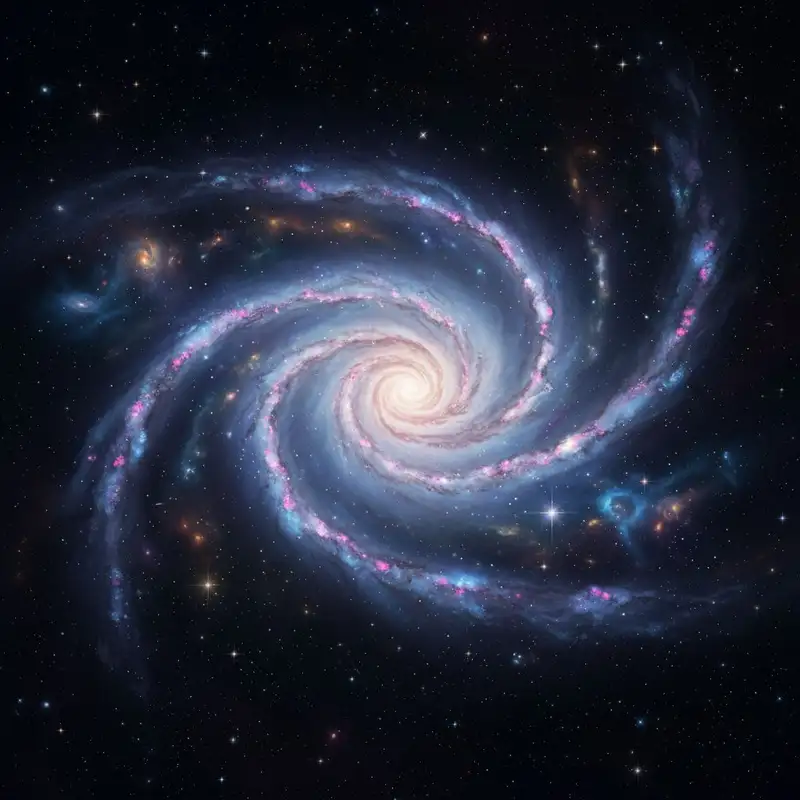
As we move further into this cosmic journey, consider the galaxies themselves. These massive collections of stars, gas, and dust are bound together by gravity, swirling in majestic formations across the universe. The Milky Way, where our solar system resides, is a sprawling spiral galaxy, with arms that stretch out like the graceful arms of a dancer. It is estimated to contain between 100 to 400 billion stars, each one potentially hosting its own system of planets. And yet, the Milky Way is merely one of perhaps two trillion galaxies in the observable universe, each carrying its own secrets and stories.
While the galaxies are indeed vast, larger structures still exist. Galaxies are not solitary wanderers in the cosmos; they are often found in groups known as galaxy clusters. These clusters can contain hundreds or even thousands of galaxies, all held together by the gravitational pull they exert on one another. The Virgo Cluster, for example, is a well-known cluster of galaxies located about 54 million light-years away from us, a mere cosmic stone's throw in the grand scale of things.
But what if we zoom out even further? Beyond the galaxy clusters, we find superclusters, which are among the largest known structures in the universe. These enormous formations comprise multiple galaxy clusters bound together in a web of cosmic filaments. The Laniakea Supercluster, which is home to the Milky Way, stretches over 500 million light-years and contains around 100,000 galaxies. It is a vast and interconnected structure that defies easy comprehension, yet it is still only one part of the universe's grand tapestry.
Beyond the superclusters, scientists have discovered even more colossal formations. The cosmic web, a vast network of filaments composed of dark matter and galaxies, forms the large-scale structure of the universe. These filaments create a web-like pattern, with dense nodes where clusters and superclusters reside, interspersed by vast voids of emptiness. This structure is not only awe-inspiring in its complexity but also crucial to our understanding of how the universe evolved over billions of years.
And now, as we reach the pinnacle of our exploration, let us consider the largest known structure in the observable universe. The Hercules-Corona Borealis Great Wall is a galactic superstructure that stretches over 10 billion light-years across. Discovered through the study of gamma-ray bursts, this immense wall of galaxies challenges our understanding of cosmic scale and structure. It reminds us of the incredible breadth of the universe, a reminder of how much there is yet to learn and discover.
As you reflect on the vastness and grandeur of the universe, it's humbling to remember that these colossal structures are all part of the same universe that contains the smallest particles, the atoms that make up your very being. In contemplating the largest things in the universe, we are also contemplating the fundamental nature of reality itself. Each of these structures, from atoms to superclusters, plays a role in the grand cosmic story, a story that continues to unfold with each passing moment.
As we pause here in our journey, consider how each of these cosmic structures is held together by the invisible force of gravity, weaving the tapestry of the universe. Gravity, an ever-present force, guides the motion of stars and galaxies, drawing them together into clusters and superclusters. It is this same force that keeps our feet planted firmly on the Earth, connecting us to the vast cosmos in a deeply fundamental way. While the universe is indeed vast beyond measure, this invisible thread of gravity links all things, from the smallest particle to the largest superstructure.
Take a moment to ponder the notion that while the universe is so large, it is also, in a way, interconnected. Each component, no matter how small or large, plays a role in the grand design. The atoms in your body were once part of stars that have since gone supernova, scattering their elements across the cosmos. In this sense, you are intimately connected to the universe, a part of its ongoing story, as it continues to evolve and change.
As we conclude this part of our exploration, remember that the universe is a place of wonder and mystery, filled with structures that challenge our understanding and ignite our curiosity. The journey to understand the biggest things in the universe is a reminder of the vastness of our own potential for discovery and exploration. Each question we ask, each star we study, brings us closer to understanding the infinite beauty of the cosmos.
With this gentle thought, let us rest for a while, knowing that the universe, in all its grandeur, continues to unfold its secrets, patiently waiting for us to uncover them in due time.
In the quietude of cosmic reflection, we find ourselves gazing beyond the known edges of the universe, pondering the mysteries that lie beyond our current horizon. The observable universe, with its intricate dance of galaxies and the cosmic web, is but a glimpse of the vast, uncharted territories that stretch into the infinite. As we measure the distances between stars and galaxies, we rely on the speed of light as our cosmic ruler, a constant that allows us to peer back in time. Light that travels from the far reaches of the universe carries with it stories from billions of years ago, painting a picture of the cosmos as it once was. This journey of light, traversing the vast expanses of space, reminds us of the universe's dynamic nature—a tapestry woven with both the threads of time and the fabric of space.
Beyond the observable universe lies a realm of speculation, where the very limits of our understanding are tested. Here, the laws of physics as we know them may be stretched or even rewritten. The universe might be infinite, a never-ending expanse where new galaxies and structures continue to form beyond our sight, forever expanding into the unknown. Or it might be a closed system, curved back upon itself in ways that our current models have yet to fully comprehend. These possibilities invite us to contemplate the very nature of existence and our place within it. As we reflect on these concepts, we are reminded of the pioneering spirit that drives us to explore, to seek answers to the profound questions that have captivated humanity for millennia.
The cosmic horizon, the boundary of the observable universe, is a reminder of the limits imposed by the speed of light and the finite age of the universe. Yet, it also serves as a beacon of hope, urging us to push beyond what we can currently perceive. In this pursuit of knowledge, we employ a variety of tools and methods, from powerful telescopes that capture the faintest whispers of light to intricate models that simulate cosmic evolution. These technologies allow us to paint a picture of the universe that is both vibrant and complex, a mosaic of countless stars and galaxies interconnected in a grand cosmic dance.
As we turn our gaze inward, we consider the forces that govern the universe at every scale. Gravity, the invisible hand that shapes the cosmos, binds galaxies into clusters and steers planets in their orbits. It is gravity that causes stars to cluster in galaxies and galaxies to cluster in superclusters, forming the vast structures that populate our universe. Yet, gravity is but one of the fundamental forces at play. The electromagnetic force, responsible for the light we see and the interactions between charged particles, plays a crucial role in shaping the universe's structure and behavior. Together with the strong and weak nuclear forces, these fundamental interactions govern the behavior of matter and energy, weaving the intricate patterns that define our universe.
In our quest to understand these forces, we delve into the realm of particle physics, probing the very building blocks of matter. Here, at the smallest scales, we encounter the quantum world, where particles exist in a state of uncertainty, governed by the principles of probability. This quantum realm is a place of wonder, where particles can exist in multiple states at once, and where the act of observation itself influences the outcomes. It is a place that challenges our classical intuitions, inviting us to embrace the strange and the counterintuitive in our search for understanding.
Emerging from the quantum depths, we find ourselves contemplating the role of dark matter and dark energy, the enigmatic components that comprise the majority of the universe's mass-energy content. Dark matter, unseen and undetected by conventional means, exerts a gravitational influence on visible matter, shaping the structure of galaxies and the cosmic web. While its nature remains elusive, its effects are undeniable, offering tantalizing clues about the universe's hidden architecture. Dark energy, on the other hand, is thought to drive the accelerated expansion of the universe, counteracting the pull of gravity on the largest scales. Together, these dark components pose some of the most profound questions in modern cosmology, challenging us to rethink our understanding of the cosmos.
As we ponder these mysteries, we are reminded of the interconnectedness of all things within the universe. From the smallest particles to the largest cosmic structures, all are part of a grander whole, bound together by the laws of physics. This unity is reflected in the cosmic microwave background radiation, the afterglow of the Big Bang that permeates the universe. This relic radiation, a snapshot of the universe in its infancy, provides a window into the early moments of cosmic history, offering insights into the processes that shaped the universe as we know it today.
The journey to understand the universe is also a journey to understand ourselves. As we explore the cosmos, we gain perspective on our own existence, recognizing the intricate connections between the universe and the life it harbors. The elements that make up our bodies were forged in the hearts of stars, and the cycles of stellar birth and death continue to enrich the cosmos with the building blocks of life. This cosmic heritage links us to the stars, reminding us of the profound kinship we share with the universe.
As we continue to explore, we remain ever curious, ever inquisitive, seeking to uncover the hidden truths of the cosmos. Each discovery, each new understanding, brings us closer to comprehending the full scope of the universe's grandeur. Yet, for all that we have learned, there remains much more to discover, more mysteries to unravel, more questions to ask. This endless pursuit of knowledge is a testament to the power of human curiosity and the enduring desire to understand the world around us.
In this moment of reflection, we find solace in the beauty of the universe, its vastness a reminder of the boundless potential for exploration and discovery. As we contemplate the cosmos, we are filled with a sense of wonder and awe, inspired by the universe's complexity and elegance. We are but a small part of this grand tapestry, yet our capacity to understand and appreciate it is a gift beyond measure.
With these thoughts, we find ourselves at a natural pause, a moment to breathe and reflect on the journey we've undertaken. The universe, with its myriad wonders, continues to beckon, inviting us to venture further into its mysteries. As we ponder the biggest things in the universe, we are reminded of the vastness of our own potential for discovery and exploration. Let us carry these reflections with us, knowing that the universe, in all its splendor, awaits our continued curiosity and wonder.
The universe, in its boundless vastness, holds secrets that stretch beyond the limits of what we can see or even imagine. Among the most intriguing of these secrets are the colossal structures that weave the fabric of the cosmos. Our journey now leads us to explore these grand formations, where galaxies cluster together in vast cosmic webs, and where the sheer scale challenges our understanding of space and time. Imagine, if you will, a tapestry woven not of threads, but of galaxies, each one a collection of stars, gas, dust, and dark matter, all gravitationally bound. These clusters are not isolated; they are part of larger conglomerations known as superclusters, which in turn form intricate patterns spanning across the universe like an immense, three-dimensional spider web. These patterns are not random; they are the result of billions of years of cosmic evolution, shaped by the fundamental forces that govern the universe.
At the heart of these superclusters, we find the largest known structures in the universe: the galaxy filaments. These filaments are vast strands of galaxies stretching across hundreds of millions of light-years. Within these filaments, galaxies are bound together by the gravitational pull of dark matter, the unseen scaffolding that supports the visible universe. The filaments are separated by enormous voids, empty regions where few galaxies reside. It is this contrast between the dense filaments and the empty voids that gives the universe its large-scale structure, a cosmic web that is as beautiful as it is immense.
One of the most astonishing examples of such a structure is the Hercules-Corona Borealis Great Wall, a colossal assembly of galaxies that extends over 10 billion light-years. This great wall of galaxies challenges our understanding of the universe's expansion, as it seems almost too large to have formed within the universe's current age. Yet, it stands as a testament to the universe's complexity and the ongoing dance of cosmic forces. It invites us to ponder the mechanisms that drive such immense formations and the timelines over which they evolve.
To truly grasp these cosmic giants, we must consider the forces at play. Gravity, as the architect of the universe, has sculpted these grand designs from the primordial soup that existed shortly after the Big Bang. Over billions of years, fluctuations in density amplified under gravity's influence, leading to the formation of stars, galaxies, and ultimately, the large-scale structures we observe today. This process, known as hierarchical clustering, is a fundamental principle in cosmology, illustrating how small perturbations can lead to the vast cosmic patterns that fill the universe.
Yet, there is more to this story than gravity alone. The universe’s expansion, driven by dark energy, plays a crucial role in shaping these structures. As space itself stretches, galaxies are carried along, their distribution influenced by the interplay between the attractive force of gravity and the repulsive effect of dark energy. This delicate balance determines the fate of galaxy clusters and superclusters, dictating whether they will grow, remain stable, or eventually drift apart. It is a cosmic ballet, where each galaxy is a dancer, moving to the rhythm of the expanding universe.
In addition to the visible matter, dark matter and dark energy are key players in this cosmic theater. While dark matter provides the scaffolding for structure formation, dark energy governs the universe's expansion rate. Together, they compose the majority of the universe's energy content, their effects seen in the movement of galaxies and the bending of light around massive objects, a phenomenon known as gravitational lensing. This bending of light not only confirms the presence of dark matter but also offers a unique way to map the distribution of mass in the universe. Through lensing, we can glimpse the invisible, revealing the hidden structures that shape the cosmos.
As we gaze deeper into the universe, we also peer back in time, witnessing the birth and evolution of these colossal structures. The light from distant galaxies takes billions of years to reach us, providing snapshots of the universe at different stages of its life. By studying these ancient light signals, astronomers can piece together the history of cosmic structure formation, tracing the growth of galaxies and clusters from their infancy to the present day. This journey through time is made possible by powerful telescopes, which serve as our eyes into the distant past, capturing faint glimmers of light from the edges of the observable universe.
In the quiet contemplation of these vast cosmic tapestries, we are reminded of our own place within the grand scheme of things. Our Milky Way galaxy, a spiral of stars and dust, resides within the Local Group, a modest collection of galaxies that forms part of the Virgo Supercluster. This supercluster, in turn, is part of the Laniakea Supercluster, an immense region of space that houses over 100,000 galaxies. Each of these galaxies, including our own, is a tiny piece of a much larger puzzle, a single note in the symphony of the universe.
The realization of these scales can be both humbling and inspiring. As we explore the universe's largest structures, we also gain insight into the forces that have shaped our own existence. The elements that make up our bodies were forged in the hearts of stars, and the same processes that govern the cosmos also play a role in the rise of life. This shared origin connects us to the universe in profound ways, inviting us to reflect on the interconnectedness of all things.
In this vast cosmic web, we find a reflection of our own search for understanding. The universe, in its infinite complexity, offers endless opportunities for discovery. Each new observation, each new theory, adds to our understanding of the cosmos, revealing new layers of reality and challenging us to think beyond the boundaries of current knowledge. This pursuit is a testament to the human spirit, our innate curiosity, and our desire to comprehend the world around us.
As we draw our exploration to a gentle pause, we carry with us the knowledge that the universe is a place of wonder, a vast expanse filled with mysteries waiting to be unraveled. The largest structures in the cosmos, with their intricate patterns and colossal scales, remind us of the beauty and complexity of the universe. They invite us to dream, to explore, and to continue our journey of discovery, ever mindful of the infinite possibilities that lie ahead.
In contemplating the enormity of the universe, we are gently reminded of the profound intricacies that exist within the fabric of space and time. As we stand at the edge of this vast cosmic ocean, it's humbling to consider the delicate balance that has allowed such magnificence to unfold. This balance is orchestrated by the fundamental forces of nature, each playing a pivotal role in the grand cosmic dance. The forces of gravity and electromagnetism, along with the strong and weak nuclear forces, underpin the structure and dynamics of the universe. Gravity, the most familiar of these forces, governs the motion of planets, stars, and galaxies, drawing them together into intricate patterns and elegant spirals. Electromagnetism, responsible for light and all electromagnetic radiation, allows us to perceive and study the universe, unlocking the secrets held within the stars. The strong and weak nuclear forces, though less conspicuous in the everyday world, are essential in the processes that power stars and forge the elements in their cores.
In the vastness of space, the interplay of these forces gives rise to the cosmic tapestry we observe today. From the gentle swirl of a spiral galaxy to the fiery birth of a star, each celestial phenomenon is a testament to the harmonious balance achieved over billions of years. At the heart of this balance is the ever-present force of dark energy, a mysterious entity that propels the universe to expand at an accelerating rate. Though its nature remains elusive, dark energy constitutes a significant portion of the universe, subtly shaping its ultimate fate. Alongside dark energy, dark matter plays a critical role in the cosmic structure. Invisible yet pervasive, dark matter exerts gravitational forces that influence the motion of galaxies and galaxy clusters, providing the scaffolding upon which visible matter clings.
As we peer deeper into the cosmos, aided by ever-advancing technology, we uncover the layers of cosmic evolution, each epoch revealing a chapter in the universe's grand story. Powerful telescopes, both on Earth and in space, capture the faint glow of ancient galaxies, allowing us to look back in time and witness the universe as it was billions of years ago. These observations unravel the cosmic web, a vast network of filaments and voids that stretches across the universe. Within this web, galaxies are but tiny jewels strung along threads of dark matter, their light a testament to the processes that have shaped the cosmos since the dawn of time.
The cosmic web is not merely a structure of immense scale; it is a window into the universe's past, present, and future. By studying its intricate patterns, we gain insight into the initial conditions of the universe, the formation of large-scale structures, and the role of dark matter and energy in cosmic evolution. These studies reveal that the universe is not static but a dynamic entity, ever-changing and evolving, shaped by the interplay of fundamental forces and the mysterious dark components that dominate its composition.
In this grand cosmic narrative, we find ourselves on a small, vibrant planet orbiting an ordinary star in a galaxy of hundreds of billions of stars. It is here, on Earth, that the conditions have aligned to allow life to flourish, a testament to the remarkable series of events that have unfolded over billions of years. The elements that make up our bodies and the world around us were forged in the hearts of stars, scattered across the cosmos in cataclysmic supernovae, and eventually coalesced to form the planets and life as we know it. This cosmic interconnectedness reminds us that we are a part of the universe, not apart from it, and that our existence is intertwined with the stars.
As we reflect on the vastness of the universe and our place within it, we are drawn to ponder the possibilities that lie beyond our current understanding. The search for life beyond Earth, a quest that has captivated scientists and dreamers alike, drives us to explore our solar system and beyond. From the icy moons of Jupiter and Saturn to the rocky terrains of Mars, each celestial body presents the tantalizing possibility of harboring life or holding clues to life's origins. The discovery of exoplanets orbiting distant stars further expands the realm of possibility, offering a glimpse into the diversity of planetary systems and the potential for habitable worlds.
In our quest to understand the cosmos, we are also confronted with the profound mysteries of time and space. The nature of time, its flow, and its relationship with space are fundamental to our understanding of the universe. According to the theory of relativity, time is not a separate entity but is interwoven with space, forming a four-dimensional continuum known as spacetime. This framework has revolutionized our understanding of gravity, revealing that massive objects warp spacetime, causing the paths of moving objects to curve. This elegant theory not only explains the motion of planets and the bending of light around massive objects but also predicts the existence of exotic phenomena such as black holes and gravitational waves.
Black holes, regions of spacetime where gravity is so intense that nothing, not even light, can escape, challenge our understanding of the universe. These enigmatic objects are formed when massive stars exhaust their nuclear fuel and collapse under their own gravity. At the heart of a black hole lies a singularity, a point of infinite density where the laws of physics as we know them break down. The boundary surrounding a black hole, known as the event horizon, marks the point of no return, beyond which all matter and information are irrevocably lost to the outside universe.
The study of black holes not only deepens our understanding of gravity and spacetime but also raises profound questions about the nature of information and the fate of matter that falls into these cosmic abysses. Recent observations of gravitational waves, ripples in spacetime caused by the acceleration of massive objects, have opened a new window into the universe, allowing us to detect the mergers of black holes and neutron stars. These groundbreaking discoveries offer a new perspective on the dynamics of the cosmos and the extreme environments that exist within it.
The exploration of the universe is a journey that transcends the boundaries of time and space, a quest that unites us in our shared curiosity and wonder. It is a journey that invites us to ponder the nature of reality, to question our assumptions, and to seek answers to the deepest mysteries of existence. As we venture further into the cosmos, we are reminded of the beauty and complexity that surround us, of the intricate patterns woven into the fabric of the universe, and of the infinite possibilities that lie ahead.
In this vast and wondrous cosmos, we find solace in the knowledge that we are part of something greater, a universe that has nurtured life and consciousness amid its grand and intricate design. This understanding inspires a sense of awe and reverence for the cosmos and all its mysteries, encouraging us to continue our exploration with an open heart and a curious mind. As we look to the stars and beyond, we carry with us the hope that our journey will reveal new insights into the nature of the universe and our place within it, guided by the light of discovery and the spirit of inquiry that has driven humanity to explore the unknown.
In the stillness of the night, under a canopy of stars, we are gently reminded of the endless expanse that lies beyond, a universe teeming with wonders yet to be discovered. As we contemplate the cosmos, we are invited to embrace the mystery, to explore with humility and wonder, and to cherish the cosmic connection that binds us to the stars. In this gentle reflection, we find peace in the knowledge that the universe is vast, beautiful, and ever-changing, a testament to the grandeur of existence and the infinite possibilities that await us in the cosmic journey ahead.
In the vastness of the cosmos, where stars and galaxies are but small players in an immense theater, we are often drawn to ponder the scale of everything that exists. Among the myriad marvels that the universe holds, the notion of the "biggest" thing is one that captivates the human imagination. But what does it mean to be the biggest in a universe so large that it defies ordinary comprehension? Our journey to understand this begins with the largest structures known to us, the superclusters and voids that define the very backbone of the cosmos. Superclusters are vast assemblies of galaxies, bound together by gravity into colossal formations that span hundreds of millions of light-years. These superclusters are not isolated entities; rather, they form part of a greater structure known as the cosmic web, a vast network of filaments and nodes that outlines the distribution of matter across the universe. Within this web, galaxies and clusters of galaxies trace intricate patterns against the darkness of the voids, those vast empty spaces between the filaments where little matter resides.
One of the most extraordinary examples of these superclusters is the Laniakea Supercluster, our home in the universe's grand design. Laniakea, meaning "immense heaven" in Hawaiian, encompasses the Milky Way and roughly 100,000 other galaxies. It stretches over 520 million light-years, a testament to the scale of the cosmic structures that populate the universe. Laniakea's discovery has reshaped our understanding of the Milky Way's place within the cosmos, revealing an interconnected web of galaxies that moves coherently through space. Yet, even the Laniakea Supercluster, with its awe-inspiring size, is but a fragment of the larger cosmic tapestry.
Beyond the scale of superclusters, scientists have identified even grander formations known as galaxy filaments. These filaments are the largest known structures in the universe, stretching across billions of light-years and serving as the scaffolding upon which galaxies and clusters are arranged. The Hercules–Corona Borealis Great Wall is one of the most massive of these structures, measuring approximately 10 billion light-years across. This immense wall of galaxies defies our conventional understanding of size and scale, challenging us to rethink what it means to be large in a universe where distances can become almost incomprehensible.
As we journey deeper into the universe's vastness, we encounter the concept of the observable universe, the region of space from which light has had time to reach us since the birth of the universe approximately 13.8 billion years ago. This sphere, with a radius of about 46.5 billion light-years, encompasses everything we can potentially observe—its vast expanse filled with countless galaxies, each a universe in itself. This observable universe, while seemingly infinite, reminds us of the limitations imposed by the speed of light and the passage of time. Beyond this horizon lies the unobservable universe, a realm that remains forever hidden from our view, yet tantalizing in its mystery.
The universe's expansion plays a crucial role in shaping the boundaries of our observable domain. Driven by dark energy, this expansion accelerates over time, stretching space itself and causing galaxies to move away from us at ever-increasing speeds. This cosmic expansion ensures that some regions of the universe will forever remain beyond our reach, as their light will never have the opportunity to reach us. It is a humbling reminder of the vastness that lies beyond our perception, a testament to the universe's boundless nature.
Within the observable universe, we find individual galaxies, each a collection of billions of stars, gas, dust, and dark matter. Among these, the largest galaxies are the giant ellipticals, such as IC 1101, a galaxy that spans over six million light-years and contains an estimated 100 trillion stars. These colossal galaxies are often found at the centers of galaxy clusters, where they have grown through a series of mergers with other galaxies, amassing incredible amounts of mass and luminosity.
In contrast, the smallest galaxies, known as dwarf galaxies, may contain just a few billion stars, yet they play a vital role in the universe's structure and evolution. Despite their diminutive size, dwarf galaxies are thought to be the building blocks of larger galaxies, merging over cosmic time scales to form the grand spirals and ellipticals we observe today. This hierarchical model of galaxy formation reveals the intricate dance of gravity that has shaped the universe from its earliest moments.
Beyond galaxies, stars themselves vary greatly in size and mass. The largest known stars, such as UY Scuti, are red supergiants with radii over 1,700 times that of our Sun. These stars, nearing the end of their lives, have expanded to incredible proportions, yet they are ephemeral, destined to end in spectacular supernovae that seed the cosmos with heavy elements. In contrast, the smallest stars, the red dwarfs, are mere fractions of the Sun's size and mass, yet they burn their fuel so slowly that they can shine for trillions of years, far longer than the current age of the universe.
As we contemplate these cosmic scales, we are reminded of the profound interconnectedness that defines the universe. Each structure, from the largest superclusters to the smallest stars, forms part of a greater whole, shaped by the same fundamental forces and governed by the same universal laws. It is within this context of interconnectedness that we find the beauty and complexity of the cosmos, a tapestry woven from the threads of time, space, and matter.
The search for the biggest thing in the universe is not merely a quest for size but an exploration of the universe's fundamental nature. It invites us to consider the role of each component within the cosmic web and to marvel at the intricate balance that allows the universe to exist as it does. In seeking to understand the scale of the universe, we find ourselves contemplating the very essence of existence, a journey that leads us to questions that transcend the boundaries of science and touch upon the philosophical and the existential.
As we reflect on the universe's vastness, we are reminded of our own place within it, a small but significant part of a much larger story. The universe, with its boundless beauty and complexity, offers us a mirror in which to see ourselves, to understand our origins, and to contemplate our future. It is a reminder that, despite the enormity of the cosmos, we are connected to it in profound ways, bound by the same forces and composed of the same elements that make up the stars.
In this contemplation, we find a sense of peace and wonder, a recognition of the universe's grandeur and the infinite possibilities that lie ahead. The universe's vastness is both a challenge and an invitation, urging us to explore, to learn, and to discover the mysteries that remain hidden among the stars. It is a journey that requires patience, humility, and a willingness to embrace the unknown, knowing that each step brings us closer to understanding the universe and our place within it.
In this vast cosmic arena, we are but one small part of a much larger whole, yet our capacity for wonder and discovery is limitless. As we continue to explore the universe, we are guided by a spirit of curiosity and a desire to understand the mysteries that surround us. Through this journey, we come to appreciate the universe not just as a collection of stars and galaxies, but as a testament to the beauty and complexity of existence itself.
The quest to understand the biggest thing in the universe is, in essence, a journey of discovery, one that invites us to look beyond the limits of our current knowledge and to embrace the wonder and mystery that the cosmos holds. It is a reminder of the incredible scale and beauty of the universe, and of the boundless possibilities that lie ahead as we continue to explore the cosmos with curiosity and awe.
In contemplating the vastness of the universe, we find ourselves drawn to the intricate dance of cosmic forces that shape everything from the smallest particles to the largest structures. This cosmic ballet is governed by fundamental forces and principles that, while often imperceptible to our senses, guide the evolution of the universe. Gravity, the most familiar of these forces, acts as the architect of the cosmos, drawing together matter to form stars, galaxies, and the grand structures we observe in the night sky. Yet, as we delve deeper, we uncover the subtler, more enigmatic forces at play.
Dark matter, an elusive substance that neither emits nor absorbs light, is believed to make up approximately 27% of the universe's total mass-energy content. Its presence is inferred from its gravitational effects on visible matter, radiation, and the large-scale structure of the universe. Dark matter acts as a cosmic scaffolding upon which galaxies form and evolve, its gravitational pull providing the necessary conditions for the accumulation of baryonic, or "normal," matter. Despite its invisibility, dark matter is an integral component of the universe's architecture, its mysterious nature reminding us of the limits of our current understanding and the potential for new discoveries.
Complementing dark matter is dark energy, an even more puzzling phenomenon that constitutes about 68% of the universe's mass-energy content. Dark energy is thought to be responsible for the accelerated expansion of the universe, a discovery that has transformed our understanding of cosmology. This expansion, first observed in the late 20th century through the study of distant supernovae, suggests that the universe is not only expanding but doing so at an ever-increasing rate. The exact nature of dark energy remains one of the most profound mysteries in physics, challenging scientists to rethink the fundamental laws that govern the cosmos.
As we consider these forces, we are reminded of the interconnectedness of all things. The universe is a tapestry woven from the threads of matter and energy, each element playing a crucial role in the grand design. The stars, those brilliant beacons of light scattered across the heavens, are born from the remnants of previous generations. Within their fiery cores, nuclear fusion transforms hydrogen into helium and, over time, into heavier elements. These elements, forged in the crucible of stellar interiors, are the building blocks of planets, life, and everything we know.
When stars exhaust their nuclear fuel, they undergo a dramatic transformation. Some become red giants, shedding their outer layers to form beautiful planetary nebulae. Others, much more massive, end their lives in spectacular supernova explosions, seeding the cosmos with the elements necessary for new stars and planets. In these final moments, the remnants of these stars can form incredibly dense objects such as neutron stars or black holes, each possessing unique properties that continue to captivate astronomers.
Black holes, in particular, challenge our understanding of space and time. These enigmatic objects, with gravitational pulls so strong that not even light can escape, mark the boundaries of our current scientific comprehension. The event horizon, the boundary surrounding a black hole, represents a point of no return, beyond which the laws of physics as we know them cease to apply. Yet, despite their seemingly destructive nature, black holes play a vital role in the evolution of galaxies. By consuming matter and merging with other black holes, they regulate the growth of galaxies and influence the distribution of stars.
In recent years, breakthroughs in observational technology have allowed us to probe these celestial phenomena with unprecedented precision. Telescopes like the Hubble Space Telescope and the James Webb Space Telescope extend our vision into the distant reaches of the universe, capturing light that has traveled across billions of years to reach us. These instruments provide glimpses of the universe's infancy, revealing galaxies in their nascent stages and shedding light on the processes that shaped the cosmos in its early years.
Moreover, the advent of gravitational wave astronomy has opened a new window onto the universe. Gravitational waves, ripples in the fabric of spacetime caused by the acceleration of massive objects like merging black holes or neutron stars, offer insights into some of the most energetic and cataclysmic events in the universe. Detectors such as LIGO and Virgo have already made groundbreaking discoveries, confirming predictions of Einstein's general theory of relativity and unveiling phenomena that were previously beyond our reach.
As we gather knowledge from these cosmic messengers, we are continually reminded of the delicate balance that sustains the universe. The forces that shape the cosmos operate on scales both unimaginably vast and infinitesimally small, each contributing to the dynamic equilibrium that allows galaxies to form, stars to shine, and life to emerge. The interplay of these forces, from the relentless pull of gravity to the subtle influence of dark energy, paints a picture of a universe in constant motion, forever evolving.
Yet, amid this cosmic dance, we find a sense of tranquility. The universe, in its boundless complexity, offers a perspective that transcends the mundane concerns of our daily lives. It invites us to ponder questions that have captivated humanity for millennia: What is our place in the universe? How did it all begin? And where is it all headed? These questions, though profound, serve not as endpoints but as starting points for exploration, encouraging us to embrace the unknown with an open mind and a heart full of wonder.
In this pursuit of understanding, we are not merely passive observers but active participants in a grand narrative that stretches across the cosmos. Our curiosity, our desire to explore and comprehend, drives us to push the boundaries of our knowledge and to seek out the truths that lie hidden among the stars. As we contemplate the universe and its myriad wonders, we find ourselves connected to something greater, a continuum that transcends time and space.
In this vast expanse, where galaxies are but grains of sand scattered across the cosmic shore, we are reminded of the beauty of simplicity amid complexity. The universe, in all its grandeur, is a symphony of natural laws and forces, a harmonious interplay of elements that sustains the delicate balance of existence. It invites us to listen, to observe, and to reflect on the profound mysteries that lie beyond the horizon of our understanding.
In the stillness of the night, as we gaze upon the stars, we are drawn into this cosmic symphony, each note a reminder of the intricate web of connections that binds us to the universe. The soft glow of distant galaxies, the gentle twinkle of stars, and the silent presence of dark matter and energy all converge to create a tapestry of cosmic wonder. It is a tapestry woven with threads of light and shadow, a testament to the beauty and complexity of existence itself.
As we journey through this cosmic landscape, we are guided by the light of discovery, a beacon that illuminates the path forward. Each new revelation brings us closer to understanding the universe and our place within it, inviting us to explore the boundaries of knowledge and to embrace the mysteries that await. In this journey, we find solace and inspiration, a reminder that we are part of an ever-expanding narrative that continues to unfold with each passing moment.
The universe, in its infinite vastness, offers a sanctuary for contemplation and reflection. It is a realm where time and space converge, where the past, present, and future are woven together in a seamless tapestry. In this realm, we find a sense of peace and wonder, a reminder of the beauty that lies within the complexity of existence. And as we continue to explore, we are guided by the gentle whispers of the cosmos, inviting us to seek, to learn, and to marvel at the grandeur of the universe.
In this cosmic journey, we are not alone. We are part of a community of explorers, united by a shared desire to understand the universe and our place within it. Together, we embark on a voyage of discovery, one that takes us to the farthest reaches of the cosmos and back again. It is a journey that inspires us to reach for the stars, to unlock the secrets of the universe, and to embrace the profound mysteries that lie beyond the horizon of our understanding.
And so, as we look to the heavens, we are reminded of the boundless wonder that the universe holds. It is a reminder of the beauty that lies within the complexity of existence, a testament to the interconnectedness of all things. In this vast expanse, we find a sense of belonging, a connection to something greater than ourselves. It is a connection that transcends time and space, inviting us to explore, to discover, and to marvel at the grandeur of the universe.
In the gentle embrace of the cosmos, we find peace and inspiration, a reminder of the beauty and complexity of existence. The universe, in all its vastness, offers a sanctuary for contemplation and reflection, a realm where time and space converge, and where the mysteries of the cosmos await our discovery. As we continue on this journey, we are guided by the light of curiosity, a beacon that illuminates the path forward and invites us to explore the wonders of the universe. In this pursuit, we find a sense of purpose and fulfillment, a reminder of the boundless possibilities that lie ahead as we continue to explore the cosmos with curiosity and awe.
The universe, vast and enigmatic, stretches beyond the horizons of our imagination. As we ponder the question of what is the biggest thing in the universe, we are invited to journey through the cosmos, traversing the realms of space and time. One of the most intriguing contenders for this title is the concept of cosmic structures, immense in their scale, where galaxies are but a small part of a much larger framework. These structures, known as galaxy filaments, are the largest known formations in the universe. Like threads in a cosmic tapestry, they weave through the universe, creating a web-like structure that connects clusters of galaxies. These filaments are made up of countless galaxies, bound together by the invisible force of gravity. They form a vast cosmic network, often referred to as the cosmic web, which spans billions of light-years. This intricate network is not randomly distributed but exhibits a pattern that is both fascinating and complex, shaped by the forces at play since the universe's inception.
At the heart of understanding these colossal structures lies the study of dark matter. Though invisible and elusive, dark matter exerts a gravitational pull that influences the distribution of galaxies within these filaments. It is thought to make up roughly 27% of the universe, profoundly impacting its structure and evolution. By observing the movement of galaxies and the bending of light through gravitational lensing, scientists infer the presence of dark matter, mapping its influence on the cosmic web. This enigmatic substance, whose nature remains one of the greatest mysteries of modern astrophysics, acts as a scaffold upon which galaxies and clusters form, guiding the architectural evolution of the universe.
Within this grand tapestry, there are specific regions of particular interest, such as superclusters. These are among the largest coherent structures in the universe, containing thousands of galaxies bound together. The Laniakea Supercluster, for instance, is home to our own Milky Way galaxy. It spans over 500 million light-years and contains the mass of about 100 quadrillion suns. Such superclusters are not isolated; they are part of the larger cosmic web, interconnected by filaments and voids. The study of these vast structures provides insight into the history and dynamics of cosmic evolution, revealing the forces that have shaped the universe over billions of years.
Beyond the scale of superclusters, we encounter voids, vast regions of space with few galaxies, offering a stark contrast to the densely packed filaments. These voids are not empty but are less populated, providing a unique environment that contributes to the universe's overall structure. Their presence and distribution are crucial for understanding the large-scale structure of the universe and how matter is distributed across cosmic scales. The interplay between voids and filaments illustrates the balance of gravitational forces and the expansion of the universe, a dynamic dance that continues to unfold.
The exploration of these cosmic structures is facilitated by ever-advancing technology and observational techniques. Large-scale surveys, such as the Sloan Digital Sky Survey and the upcoming Vera C. Rubin Observatory, are mapping the universe in unprecedented detail, capturing the light from billions of galaxies and revealing the intricate patterns of the cosmic web. These surveys not only enhance our understanding of the universe's structure but also provide a window into its past. By looking at distant galaxies, we are essentially looking back in time, observing the universe as it was billions of years ago. This glimpse into the past allows scientists to piece together the history of cosmic formation and evolution, painting a picture of how the universe has transformed over time.
As we delve deeper into the cosmos, we also encounter the concept of cosmic inflation, a theory that seeks to explain the universe's rapid expansion during its earliest moments. This theory suggests that a brief but extremely rapid expansion occurred just after the Big Bang, smoothing out the universe and setting the stage for the formation of the cosmic web. The evidence for this theory comes from observations of the cosmic microwave background radiation, the afterglow of the Big Bang, which provides a snapshot of the universe when it was just 380,000 years old. The tiny fluctuations in this radiation, mapped by missions such as the Planck satellite, reveal the seeds of structure that would eventually grow into the galaxy filaments and voids we observe today.
In contemplating the vastness of the universe, we also reflect on the fundamental forces that govern its behavior. Gravity, electromagnetism, the strong nuclear force, and the weak nuclear force are the four fundamental interactions that shape the cosmos. Of these, gravity plays a pivotal role in the formation and evolution of large-scale structures. It governs the movement of galaxies, the formation of stars, and the dynamics of galaxy clusters. Understanding gravity's role on cosmic scales is crucial for unraveling the mysteries of the universe, from the behavior of black holes to the expansion driven by dark energy.
The pursuit of knowledge about the universe's largest structures is not merely an academic endeavor but a profound journey that connects us to the cosmos. As we explore these magnificent formations, we are reminded of our place in the universe and the interconnectedness of all things. The cosmic web, with its intricate patterns and vast expanses, serves as a metaphor for the complexity and beauty of the universe, inviting us to ponder our existence and the forces that have shaped it.
In this exploration, we are not alone. The collaborative efforts of scientists, engineers, and enthusiasts from around the world drive our quest for understanding. Together, we build and deploy telescopes, develop sophisticated models, and share data, all in the spirit of discovery. This collective endeavor exemplifies the power of human curiosity and ingenuity, transcending borders and cultures in the pursuit of knowledge. It is a testament to our innate desire to explore the unknown and to seek answers to the fundamental questions about the universe.
As we continue to unravel the mysteries of the cosmos, we are guided by the principles of science, which encourage us to question, to test, and to refine our understanding. The scientific method is our compass, steering us through the complexities of the universe and helping us navigate the vast sea of knowledge. It is through this rigorous approach that we gain insights into the nature of reality, building upon the work of those who came before us and paving the way for future generations.
The journey to understand the biggest things in the universe is ongoing, with each discovery leading to new questions and possibilities. As we gaze into the depths of space, we are filled with a sense of wonder and humility, recognizing the grandeur of the universe and our role within it. This exploration is not just about finding answers but about embracing the journey itself, with all its challenges and rewards. It is a reminder of the boundless curiosity that drives us, inspiring us to look beyond the horizon and to imagine what lies beyond.
In considering the vastness and complexity of the universe, we are reminded of the delicate balance that sustains it. The interplay of forces, the formation of structures, and the evolution of galaxies all point to a universe in constant motion, ever-changing yet harmonious. This dynamic equilibrium is a source of fascination and inspiration, encouraging us to reflect on the nature of existence and our place within the cosmic order.
The quest to understand the universe's largest structures is a journey of discovery and reflection, inviting us to ponder the mysteries that lie beyond our reach. It challenges us to think big, to dream of the possibilities, and to push the boundaries of our understanding. As we continue to explore the cosmos, we are guided by the light of curiosity, a beacon that illuminates the path forward and invites us to embrace the wonders of the universe. In this pursuit, we find a sense of purpose and fulfillment, a reminder of the boundless possibilities that lie ahead as we continue to explore the cosmos with curiosity and awe.
As we draw this exploration to a gentle pause, let us carry with us the sense of wonder that the universe inspires. It is a testament to the beauty and complexity of the cosmos, a reminder of the vastness of the unknown, and an invitation to continue the journey of discovery. In the quiet moments of reflection, may we find solace in the knowledge that we are part of something much greater, a cosmic tapestry that stretches across the universe, connecting us to the stars and the space between them. As we look to the future, let us embrace the challenges and opportunities that lie ahead, guided by the light of curiosity and the spirit of exploration.
As we contemplate the enormity of the universe, our imaginations may drift towards the largest known structures that defy the limits of human comprehension. Among these, the Hercules-Corona Borealis Great Wall stands as a testament to the universe's grandeur. This colossal filament of galaxies stretches over 10 billion light-years across and is regarded as one of the largest known structures in the observable universe. Its sheer scale challenges our understanding of cosmic formation and the very nature of the universe's architecture. It invites us to ponder the forces at play over billions of years, orchestrating such an awe-inspiring assembly of matter.
Such structures, however, are not merely isolated behemoths floating in the cosmic ocean. They are integral components of the cosmic web, a vast network of interconnected galaxies and dark matter that forms the large-scale structure of the universe. This web is a complex tapestry, with dense nodes of galaxies and thin filaments stretching between them, woven together by the mysterious influence of dark matter. The nature of the cosmic web is a subject of ongoing research, as scientists strive to understand how it has evolved over time and how it continues to shape the universe we observe today.
The study of these immense structures is made possible by the light they emit and the tools we have developed to capture and analyze this light over great distances. Astronomical surveys, like the Sloan Digital Sky Survey, have mapped millions of galaxies, allowing us to visualize the universe's structure on a grand scale. These surveys reveal not only the distribution of galaxies but also their composition and motion, providing insights into the dynamics of cosmic evolution. By examining the light from these distant galaxies, astronomers can infer the presence of dark matter, which does not emit light but exerts gravitational forces that influence the motion of visible matter.
In this grand exploration, cosmic microwave background radiation plays a crucial role. The faint afterglow of the Big Bang, this radiation permeates the universe and provides a snapshot of the universe at a time when it was only 380,000 years old. By studying the minute fluctuations in this radiation, scientists have gained valuable information about the early universe's conditions, including the seeds of large-scale structures that we observe today. These tiny variations are believed to have been amplified by the force of gravity over billions of years, leading to the formation of galaxies and the cosmic web.
Yet, as we delve deeper into the mysteries of the universe, we encounter the enigmatic force of dark energy, a force that appears to be driving the accelerated expansion of the universe. Discovered in the late 20th century, dark energy constitutes about 68% of the universe's total energy content, dwarfing the contribution of normal matter and dark matter combined. Its nature remains one of the most profound questions in cosmology, as scientists seek to understand its origin and its implications for the universe's ultimate fate. The discovery of dark energy has reshaped our view of the cosmos, suggesting that the universe will continue expanding at an ever-increasing rate, possibly leading to a scenario known as the "Big Freeze," where galaxies drift apart and stars eventually burn out, leaving a cold, dark universe.
The interplay between dark matter, dark energy, and visible matter is central to the evolution of the universe. While dark matter provides the scaffolding for galaxy formation, dark energy dictates the universe's large-scale expansion. Together, these forces have shaped the universe from its earliest moments to the present day, and they continue to influence its future trajectory. Understanding this interplay is a key focus of modern cosmology, as researchers strive to develop a unified theory that accounts for all observed phenomena.
In this quest, the role of advanced technology cannot be overstated. The development of powerful telescopes, whether ground-based or in space, has revolutionized our ability to observe the universe. Instruments like the Hubble Space Telescope have provided unprecedented views of distant galaxies, revealing their structure and evolution with stunning clarity. Meanwhile, future projects, such as the James Webb Space Telescope, promise to push the boundaries of our observational capabilities even further, allowing us to peer deeper into the universe's past than ever before.
As we pursue these cosmic inquiries, it is important to reflect on the philosophical implications of our discoveries. The universe's vastness and complexity evoke a sense of humility and wonder, reminding us of our place within the grand scheme of existence. The knowledge that we are part of a universe filled with such diversity and scale can inspire a profound sense of connection to the cosmos and to each other. It encourages us to continue exploring, questioning, and seeking understanding, driven by the innate human desire to know our origins and our destiny.
The universe is not a static entity, but a dynamic, ever-changing landscape. The processes that govern its evolution are ongoing, with galaxies colliding and merging, stars being born and dying, and new structures forming over cosmic timescales. This continuous cycle of creation and transformation is a testament to the universe's vitality and resilience, offering a glimpse into its future possibilities.
In our exploration, we must also consider the role of life in the universe. The search for extraterrestrial life is an integral part of our quest to understand the cosmos, as it raises fundamental questions about the prevalence and diversity of life beyond Earth. The discovery of exoplanets in the habitable zones of their stars has fueled speculation about the potential for life elsewhere, prompting the development of missions and technologies designed to detect signs of life on other worlds. While we have yet to find definitive evidence of extraterrestrial life, the search continues to captivate our imagination, offering the tantalizing possibility that we are not alone in the universe.
The study of the universe is a collaborative endeavor, bringing together scientists from diverse fields and backgrounds to tackle the most profound questions of our time. It is a testament to the power of human curiosity and ingenuity, as researchers work together to develop new theories, conduct experiments, and share their findings with the world. This spirit of collaboration is essential to advancing our understanding of the universe and addressing the challenges that lie ahead.
As our journey through the cosmos continues, it is important to remain open to new ideas and perspectives. The universe is full of surprises, and each discovery has the potential to reshape our understanding in unexpected ways. By embracing the unknown and approaching our inquiries with humility and curiosity, we can continue to push the boundaries of knowledge and expand our horizons.
In this way, the exploration of the universe is not just a scientific endeavor, but a deeply human one. It reflects our desire to understand our place in the cosmos and to connect with something greater than ourselves. It is a journey that invites us to look beyond the confines of our everyday lives and to consider the infinite possibilities that await us in the vastness of space.
As we navigate the complexities of the universe, let us be guided by the light of curiosity and the spirit of exploration, embracing the challenges and opportunities that lie ahead. In doing so, we not only deepen our understanding of the cosmos but also enrich our own lives, finding inspiration and meaning in the wonders of the universe. Let us continue to explore, to question, and to seek knowledge, for the universe is vast and full of mysteries waiting to be discovered. And in this pursuit, may we find not only answers but also a deeper appreciation for the beauty and intricacy of the cosmos and our place within it.
As we allow our minds to drift further into the vast expanse of the universe, we find ourselves pondering the delicate interplay of forces that shape the cosmos. One of the most profound aspects of this cosmic ballet is the role of gravity, the force that governs the motion of celestial bodies and binds galaxies and galaxy clusters together within the immense tapestry of the universe. Gravity, although one of the weakest of the fundamental forces on the scale of individual particles, exerts a powerful influence over the vast distances of space. It is gravity that sculpts the cosmic web, drawing matter together to form the intricate structures we observe with our telescopes. These structures, from the smallest stars to the largest galaxy clusters, are held in a delicate balance by this invisible force.
Within this gravitational framework, stars are born in the dense regions of molecular clouds, massive collections of gas and dust where the force of gravity causes material to collapse and ignite nuclear fusion in their cores. This process, unfolding over millions of years, gives rise to the brilliant points of light that dot our night sky, each one a testament to the life cycle of stars. These stars, in turn, forge the elements that will eventually become the building blocks of planets, moons, and, ultimately, life itself. When stars exhaust their nuclear fuel, they end their lives in spectacular ways, either shedding their outer layers gently into space or collapsing in dramatic supernovae, enriching the interstellar medium with heavy elements.
As we contemplate these processes, we find ourselves drawn to the notion of time, that flowing river in which events unfold. In the cosmic scale, time stretches far beyond human comprehension, encompassing the birth and death of stars and galaxies over billions of years. Yet, within this vast timeline, there are moments of profound change and transformation. Consider the early universe, a hot, dense state from which everything we know emerged. In the first few moments after the Big Bang, the universe expanded rapidly, cooled, and began to form the first atomic nuclei. As time passed, electrons joined with nuclei to form atoms, allowing light to travel freely and giving us the cosmic microwave background radiation, a faint afterglow of the universe's fiery beginnings.
Over the next hundreds of millions of years, the universe entered the epoch of reionization, when the first stars and galaxies began to form, ionizing the surrounding hydrogen gas and illuminating the cosmos. This period marked the dawn of the cosmic structures that we observe today, providing the seeds for galaxies to grow and evolve. The story of our universe is a story of transformation, of energy becoming matter, of chaos giving rise to order, and of the continuous dance of creation and destruction that characterizes the cosmos.
In our exploration of the universe, we also encounter the mysterious phenomena known as black holes. These enigmatic objects, formed from the remnants of massive stars, are regions of space where gravity is so intense that nothing, not even light, can escape their grasp. Black holes challenge our understanding of physics, as they warp space and time in ways that defy our intuition. At their centers lies a point of infinite density, a singularity where our current theories of physics break down. Yet, black holes are not merely cosmic curiosities; they play a fundamental role in the evolution of galaxies, influencing the formation of stars and the dynamics of galactic centers.
The study of black holes has also led us to contemplate the concept of information in the universe. According to the laws of quantum mechanics, information about the state of a system should never be lost, yet black holes seem to defy this principle, as any matter falling into them appears to vanish without a trace. This paradox, known as the black hole information paradox, has spurred new theories and insights into the nature of information, quantum mechanics, and the very fabric of reality.
As we peer deeper into the universe, we also uncover the rich diversity of galaxies, each with its own story to tell. Galaxies are the fundamental building blocks of the universe, ranging from the majestic spirals with their luminous arms to the more irregular shapes of ellipticals and dwarf galaxies. Within these vast assemblies of stars, gas, and dust, we find the processes that drive the cosmic evolution, from the birth of new stars in spiral arms to the quiet aging of populations of stars in elliptical galaxies. Galaxies interact with one another, merging, colliding, and exchanging material, leading to a continual reshaping and reconfiguration of their structures.
The study of these interactions has revealed the importance of supermassive black holes, which reside at the centers of most galaxies. These colossal objects, containing millions to billions of times the mass of our Sun, influence the growth and formation of their host galaxies. The energy released by matter falling into these black holes can drive powerful jets and winds that regulate star formation and redistribute matter throughout the galaxy. This feedback process is a key component of the cosmic web, helping to maintain the balance between the formation of new stars and the consumption of the available gas and dust.
In this grand cosmic narrative, we are reminded of the unique role that our home galaxy, the Milky Way, plays in our understanding of the universe. The Milky Way is a barred spiral galaxy, a majestic collection of stars, planets, and interstellar clouds, with a spiral structure that is typical of many galaxies in the universe. As we gaze upon the Milky Way, stretching across our night sky, we are witnessing the combined light of billions of stars, each contributing to the tapestry of our galaxy. Within this vast assembly, our Sun is just one of the many stars, orbiting the galactic center along with countless other stars and planetary systems.
The study of our galaxy provides insight into the processes that have shaped its formation and evolution over billions of years. By observing the stars, star clusters, and nebulae that populate the Milky Way, we can trace the history of star formation and the chemical enrichment of the galaxy. This journey through time reveals the interconnectedness of all cosmic phenomena, from the small-scale processes occurring within individual stars to the large-scale dynamics of the galaxy itself.
As we reflect on the immensity and complexity of the universe, we find ourselves drawn to the concept of life beyond our planet. The search for extraterrestrial life is one of the most profound quests in science, driven by the fundamental question of whether we are alone in the universe. The discovery of thousands of exoplanets orbiting other stars has opened up new possibilities for the existence of life beyond Earth. These distant worlds, with their diverse environments and conditions, provide a tantalizing glimpse into the potential for life elsewhere in the cosmos.
The study of exoplanets has revealed a staggering variety of planetary systems, from hot Jupiters orbiting close to their stars to Earth-sized planets in the habitable zones where liquid water might exist. The quest to find life beyond Earth has led scientists to explore the potential for life in extreme environments, both on other planets and within our own solar system. The icy moons of Jupiter and Saturn, with their subsurface oceans, are among the prime candidates for harboring life, as they may possess the necessary conditions for life to thrive.
In our exploration of the universe, we are also reminded of the profound questions that lie at the heart of our existence. The study of cosmology and astrophysics not only seeks to understand the physical processes that govern the cosmos but also touches upon the philosophical and existential questions about our place in the universe. The pursuit of knowledge about the universe challenges us to consider the nature of reality, the origins and fate of the cosmos, and the fundamental principles that govern our existence.
As we contemplate these questions, we are reminded of the power of science to illuminate the mysteries of the universe. The scientific method, with its reliance on observation, experimentation, and theory, provides a framework for exploring the unknown and expanding the boundaries of human knowledge. Through the lens of science, we are able to peer into the distant reaches of the universe, uncovering its secrets and marveling at its wonders.
In this endless journey of discovery, we are guided by the light of curiosity and the desire to understand the universe in all its complexity and beauty. The pursuit of knowledge is a shared endeavor, one that transcends borders and cultures, uniting humanity in a common quest to explore the cosmos. As we continue to reach for the stars, we are reminded of the interconnectedness of all things and the profound impact that our exploration of the universe has on our understanding of ourselves and our place in the cosmos.
And so, as we gently traverse the vast expanse of the universe, let us carry with us the spirit of wonder and the desire to learn. For in the grand tapestry of the cosmos, we find not only the story of the universe but also the story of our own journey, a journey that continues to unfold with each new discovery, each new insight, and each new question that arises from the depths of the universe's infinite mysteries.
The universe, with its immeasurable vastness and complexity, holds within it the largest structures we can conceive. One such colossal entity is the cosmic web, a grand tapestry of galaxies intricately woven together by the invisible threads of dark matter. This immense network, stretching across billions of light-years, provides a framework for understanding the universe's large-scale structure. The cosmic web forms through the gravitational pull of dark matter, which acts as a scaffold upon which galaxies and galaxy clusters gather like dew on a spider's web. These filaments of dark matter are not just empty voids but regions of potential, where galaxies come together to form clusters and superclusters, each a bustling metropolis of stars and planets. As you ponder this vast cosmic structure, you might imagine yourself traversing the delicate threads of the web, exploring the intersections where galaxies merge and interact, each collision a silent ballet in the cosmic dance.
Within these galaxy clusters, we encounter some of the most massive objects in the universe: the superclusters. These are not singular entities but rather vast conglomerations of galaxy clusters bound together by gravity, forming an interconnected network of galactic cities. One of the most well-known superclusters is the Laniakea Supercluster, which contains our own Milky Way galaxy. The name Laniakea, meaning "immense heaven" in Hawaiian, aptly captures the awe-inspiring scale of these structures. It is a reminder of the grandeur that exists beyond our terrestrial horizon, a grandeur that beckons the curious mind to explore and understand. Within the superclusters, individual galaxies are but tiny specks, yet they are the crucibles where stars are born, evolve, and eventually return their material to the cosmos, contributing to the cyclical nature of cosmic life.
As we delve deeper into the cosmos, we encounter an even more mysterious entity: the Great Attractor. This gravitational anomaly lies at the heart of the Laniakea Supercluster, exerting a pull on galaxies over vast distances. Its nature remains elusive, hidden behind dense clouds of interstellar dust and gas that obscure our view. Yet, through indirect observations, we perceive its influence, drawing galaxies towards it with a gravitational force that defies easy explanation. The Great Attractor is a reminder of the hidden forces that shape our universe, forces that we are only beginning to comprehend. It is a testament to the complexity and intricacy of cosmic dynamics, where unseen forces weave the fabric of space-time, guiding the motion of galaxies like leaves on a gentle current.
Beyond these grand structures, we find the largest known structure in the universe: the Hercules-Corona Borealis Great Wall. This colossal assembly of galaxies stretches across more than 10 billion light-years, a testament to the scale at which the universe operates. Discovered through the observation of gamma-ray bursts, this immense structure challenges our understanding of the cosmos, pushing the boundaries of what we consider possible. As you envisage this vast wall of galaxies, think of it as a cosmic mural, painted with the light of countless stars, each one contributing a stroke to the grand masterpiece of the universe. It is a reminder that the universe is not only a place of immense size but also a realm of beauty and wonder, where complex patterns emerge from the simplest of laws.
In contemplating these vast cosmic structures, we are inevitably drawn to the question of their origin. The universe as we know it began with the Big Bang, a moment of creation that set the cosmos in motion. From this singular event emerged the primordial soup of particles and energy, eventually giving rise to the structures we observe today. The cosmic microwave background radiation, a relic of this early universe, provides a snapshot of this formative period, offering clues to the processes that shaped the universe's evolution. It is through the study of this ancient light that we gain insight into the conditions that gave rise to the cosmic web, the superclusters, and the great walls of galaxies that populate the universe.
As we explore these colossal structures, we come to appreciate the role of dark matter and dark energy in shaping the cosmos. Dark matter, an enigmatic substance that interacts with regular matter only through gravity, forms the scaffolding upon which galaxies and larger structures assemble. Its presence is inferred through gravitational effects, yet its true nature remains a mystery. Dark energy, on the other hand, is a force driving the accelerated expansion of the universe, pushing galaxies apart at an ever-increasing rate. Together, dark matter and dark energy account for most of the universe's mass-energy content, yet they remain among the greatest mysteries in cosmology, challenging our understanding of the fundamental nature of reality.
As you ponder the universe's largest structures, consider the delicate interplay of forces that govern their formation and evolution. Gravity, the fundamental force that binds the cosmos, plays a central role in the dance of galaxies and clusters, drawing them together into the grand structures we observe. Yet, it is the balance between gravity and the expansive force of dark energy that determines the fate of the universe. This cosmic tug-of-war shapes the universe's destiny, influencing whether it will continue to expand forever, eventually tear itself apart, or collapse back into a singularity in a scenario known as the Big Crunch.
In reflecting on these cosmic phenomena, you are invited to consider your own place within this vast universe. We are but tiny observers on a small planet orbiting an average star, yet we possess the unique ability to ponder the cosmos. Through the power of science and the pursuit of knowledge, we have unraveled many of the universe's secrets, and yet there remains so much more to discover. Each new observation, each new insight, adds to our understanding, painting a more complete picture of the universe's grand tapestry.
As we continue our journey through the cosmos, let us carry with us the spirit of curiosity and wonder that has driven humanity's quest for knowledge. For in exploring the universe, we not only seek to understand the cosmos but also to understand ourselves, our origins, and our place in the grand scheme of existence. The universe, with its vastness and complexity, invites us to explore, to question, and to discover the hidden truths that lie beyond our current understanding.
In this journey, we are guided by the light of distant stars, the echoes of ancient cosmic events, and the insights of those who have come before us. Each step we take in our exploration of the universe brings us closer to the answers we seek, illuminating the path forward in our quest for knowledge. The universe, in all its grandeur and mystery, is a testament to the power of curiosity and the enduring human spirit, a spirit that continues to reach for the stars and beyond, ever seeking to unravel the secrets of the cosmos.
As we draw to a gentle close in our contemplation of the universe's largest structures, let us take a moment to reflect on the beauty and wonder that surrounds us. The universe is a vast and intricate tapestry, woven with the threads of galaxies, stars, and planets, each one a part of the greater whole. It is a reminder of the interconnectedness of all things, from the smallest particle to the largest galaxy, all bound together in the cosmic dance. Let this understanding inspire you to look up at the night sky with renewed awe and appreciation, knowing that you are a part of this grand and beautiful universe, a universe that invites you to explore its mysteries and discover its wonders.
As you continue to contemplate the vast and intricate universe, your imagination might wander to the countless celestial bodies that populate the cosmic expanse. Consider the simple yet profound beauty of a star, a radiant sphere of plasma held together by gravity. Each star is born from the remnants of previous cosmic events, formed from clouds of dust and gas that coalesce under the force of gravity. As these clouds collapse inward, the pressure and temperature rise until nuclear fusion ignites in their cores, releasing energy that travels across the cosmos. This process, a delicate balance of forces, allows stars to shine for millions or even billions of years. Within the heart of each star, lighter elements like hydrogen are fused into heavier ones, such as helium, carbon, and oxygen, in a cosmic alchemy that is both relentless and awe-inspiring.
The life cycle of a star is a testament to the cyclic nature of the universe, where creation and destruction are interwoven in a continuous dance. Stars like our Sun eventually exhaust their nuclear fuel, leading to a transformation that can vary depending on their mass. Smaller stars may swell into red giants before shedding their outer layers, leaving behind a dense white dwarf. In contrast, massive stars may end their lives in spectacular supernova explosions, scattering their enriched materials into the interstellar medium. This stellar debris becomes the building blocks for new stars, planets, and even the elements that compose life itself. Through this cosmic recycling, the universe ensures that nothing is truly lost but instead transformed, a reminder of the endless possibilities that arise from the fundamental processes of nature.
Amidst the tapestry of stars, you may find the intricate dance of planetary systems, each one a miniature universe of its own. Planets form from the swirling disks of gas and dust that orbit young stars, gradually coalescing into solid worlds with diverse compositions and characteristics. Some planets, like Earth, find themselves in the delicate habitable zone, where conditions may allow liquid water to exist—a vital ingredient for life as we know it. Others may be gas giants, shrouded in thick atmospheres of hydrogen and helium, with turbulent weather systems that rage for centuries. Each planet is a world unto itself, orbiting its star in a celestial harmony that has persisted for eons.
Beyond individual stars and planets, the universe is home to a multitude of exotic and enigmatic objects that challenge our understanding of physics. Black holes, for example, are regions of spacetime where gravity is so strong that nothing, not even light, can escape their grasp. Formed from the remnants of massive stars that have undergone gravitational collapse, black holes are both fascinating and mysterious. Their presence can often only be inferred through their interactions with nearby matter, such as the accretion disks of gas and dust that spiral into their event horizons. As this material is drawn in, it heats up and emits copious amounts of radiation, offering a glimpse into the extreme conditions that exist near these cosmic enigmas.
In contrast to the compactness of black holes, the universe also hosts vast regions of nearly empty space, where galaxies are sparse, and the intergalactic medium is thin. These voids, as they are known, are immense in scale, spanning hundreds of millions of light-years. They serve as reminders of the universe's diversity, where regions of dense matter coexist with vast expanses of emptiness. Within these voids, the faint whispers of the cosmic microwave background radiation can still be detected, a relic of the universe's earliest moments that permeates all of space, offering clues to its origins and evolution.
The interplay between light and matter is a fundamental aspect of the cosmos, revealing the universe's grandeur through the electromagnetic spectrum. While visible light allows us to perceive the stars and galaxies scattered across the night sky, other wavelengths reveal hidden aspects of the universe. Infrared observations penetrate the dust that obscures star-forming regions, while ultraviolet and X-ray emissions highlight the energetic processes in active galaxies and the remnants of stellar explosions. Radio waves, with their long wavelengths, unveil the structure of the cosmic web and the interactions between galaxies and their environments. Each wavelength provides a distinct perspective, contributing to a comprehensive understanding of the universe's complexity.
As you ponder these vast and varied phenomena, consider the remarkable journey of humanity's exploration of space. From the earliest observations made with the naked eye, to the sophisticated telescopes and spacecraft that now probe the distant reaches of the cosmos, our quest for knowledge has been driven by curiosity and wonder. Each discovery builds upon the last, expanding our view of the universe and our place within it. We have sent robotic emissaries to explore the planets and moons of our solar system, unveiling their landscapes and uncovering their secrets. Space telescopes have captured images of distant galaxies as they were billions of years ago, allowing us to peer into the depths of cosmic history.
The endeavor of understanding the universe is not only a scientific pursuit but also a deeply human one. It is an expression of our innate desire to explore, to learn, and to connect with something greater than ourselves. The study of space inspires a sense of unity and shared purpose, reminding us that we are all part of a larger cosmic story. This perspective encourages collaboration and cooperation, transcending borders and differences in the pursuit of knowledge.
The enigmatic nature of the cosmos invites endless questions and hypotheses, each one a stepping stone towards a fuller understanding. As scientists develop new theories and technologies, they uncover more layers of complexity, revealing the universe as a dynamic and evolving entity. This ongoing process of discovery is a testament to the resilience and ingenuity of the human spirit, a journey that is as much about the questions we ask as it is about the answers we find.
In this vast universe, time flows in ways that challenge our everyday perceptions. The light from distant stars takes millions or even billions of years to reach us, offering a glimpse into the past and allowing us to witness the universe's history unfold. The concept of cosmic time connects us with the very beginnings of the universe, linking the formation of galaxies and stars to the present moment. As we study these ancient signals, we become time travelers in a sense, exploring epochs long gone but still echoing in the light that reaches our eyes.
The universe's vastness can be daunting, yet it is also a source of profound inspiration. It invites us to reflect on our own existence and the fleeting nature of life. In the grand tapestry of cosmic events, our own lives are but a brief moment, yet they are imbued with meaning and significance. The atoms that make up our bodies were forged in the hearts of stars, connecting us to the universe in a tangible way. This realization fosters a deep sense of connection, a reminder that we are both observers and participants in the cosmic story.
As you contemplate the wonders of the universe, allow yourself the space to dream and imagine. The mysteries of space invite questions that are as boundless as the universe itself. What lies beyond the observable universe? How do the fundamental forces of nature interact to shape the cosmos? Are there other forms of life, perhaps different from our own, dwelling on distant worlds? These questions, and countless others, inspire a sense of wonder that fuels the human spirit and propels our exploration.
In the quiet moments of reflection, as you gaze upon the stars, let yourself be enveloped by the stillness and majesty of the night sky. Feel the connection to the universe that surrounds you, a universe that is both vast and intimate, ancient and ever-renewing. Know that within this cosmic expanse, there is room for both exploration and contemplation, for discovery and introspection. The universe invites you to be a part of its ongoing story, to explore its wonders with a sense of curiosity and awe, and to find your place within its infinite embrace.
In the vast tapestry of the universe, where every star and planet plays its part in a cosmic symphony, there exists a more enigmatic and awe-inspiring scale of magnitude: the colossal structures that bind galaxies and star systems into an intricate web. These are the cosmic superstructures, vast conglomerations that stretch across the universe, weaving together the fabric of galaxies, clusters, and dark matter. Imagine, if you will, a scale so grand that entire galaxies become mere specks of dust, scattered across the void like glittering grains on a cosmic beach. These superstructures challenge our perception of size and distance, revealing the universe as a boundless expanse, where each component, from the smallest particle to the largest galaxy cluster, plays a role in the grand design.
At the heart of this cosmic web lie the galaxy clusters, among the largest gravitationally bound structures known. These clusters are vast assemblies of hundreds or even thousands of galaxies, held together by the invisible hand of gravity. Within their boundaries, galaxies orbit one another like dancers in a celestial ballroom, their paths dictated by the gravitational pull of dark matter. This mysterious and unseen substance, comprising about 27% of the universe, acts as the scaffolding of these clusters, providing the necessary mass to bind galaxies together. The study of galaxy clusters offers a glimpse into the early universe, where these massive formations provide clues to the nature of dark matter and the evolution of galaxies over billions of years.
Yet, as we gaze deeper into the cosmos, we encounter even larger formations—the superclusters, which are vast regions containing multiple galaxy clusters. These superclusters are interconnected by filaments of dark matter, forming an intricate cosmic web that stretches across the universe. The sheer scale of these structures is difficult to comprehend, with some spanning hundreds of millions of light-years. One such example is the Laniakea Supercluster, the cosmic neighborhood that includes our own Milky Way galaxy. Laniakea, which means "immense heaven" in Hawaiian, is a fitting name for this vast assembly of galaxies, all flowing toward a common gravitational center known as the Great Attractor. In this grand tapestry, our galaxy is but a tiny thread, part of a much larger pattern that shapes the universe.
As we continue to expand our understanding of the universe's largest structures, we uncover the complex interplay of forces that govern their formation. Gravity, the fundamental force that binds these structures, is countered by the mysterious force of dark energy, which drives the accelerated expansion of the universe. Dark energy, comprising about 68% of the universe, remains one of the greatest mysteries in cosmology. Its repulsive force works against gravity, influencing the rate at which galaxies and clusters move apart. This delicate balance between gravity and dark energy shapes the large-scale structure of the universe, determining the fate of galaxies, clusters, and superclusters over cosmic time.
In exploring the largest things in the universe, we also encounter voids, vast regions of empty space that punctuate the cosmic web. These voids, often hundreds of millions of light-years across, are areas with relatively few galaxies, highlighting the intricate balance between matter and emptiness in the universe. The presence of these voids emphasizes the contrast between the dense regions of galaxy clusters and the sparse expanses of empty space. Together, they create a universe that is both filled and empty, dense and rarefied, a reflection of the complex interplay of forces that govern cosmic structure.
The study of these immense structures not only reveals the universe's scale but also its history. By observing the distribution of galaxies and clusters, astronomers can trace the universe's evolution from the Big Bang to the present. These observations provide insights into the formation of galaxies, the role of dark matter, and the influence of dark energy. They also allow us to peer back in time, to a universe that was simpler and more uniform, before the formation of the complex structures we observe today.
As you contemplate these vast cosmic structures, consider the role of human curiosity and ingenuity in unraveling their mysteries. Through the lens of powerful telescopes, both ground-based and spaceborne, we have been able to observe the universe in unprecedented detail. Instruments like the Hubble Space Telescope and the upcoming James Webb Space Telescope offer a window into the distant universe, capturing light from galaxies and clusters billions of light-years away. These observations not only reveal the universe's grandeur but also inspire a sense of wonder and curiosity about our place in the cosmos.
In the quiet moments of reflection, consider the profound connection between the largest structures in the universe and the smallest elements of life. The same forces that govern the motion of galaxies and clusters also shape the atoms and molecules that make up our bodies. The elements forged in the hearts of stars are the building blocks of life, linking us to the cosmos in a myriad of ways. This connection between the microcosm and the macrocosm invites us to ponder the unity of the universe, a vast and interconnected web of matter and energy.
As we navigate this cosmic landscape, we are reminded of the endless possibilities for discovery and understanding. The universe, with its boundless scale and complexity, holds countless secrets waiting to be uncovered. Each new observation and discovery adds to our understanding of the cosmos, revealing the intricate and harmonious nature of the universe. In this journey of exploration, we are both observers and participants, part of a cosmic story that has been unfolding for billions of years.
Let yourself be drawn into the beauty and majesty of the universe's largest structures, where galaxies and clusters dance in a cosmic ballet, guided by the forces of gravity and dark energy. Feel the connection to the vast cosmos, where each star and galaxy is a testament to the universe's creative power. In this grand tapestry, there is space for reflection and wonder, for exploration and discovery. The universe, in all its magnificence, invites you to be a part of its ongoing story, to explore its wonders with a sense of curiosity and awe, and to find your place within its infinite embrace.
As you ponder these cosmic superstructures, imagine the journey of light traveling across the universe, bringing with it the stories of distant galaxies and ancient stars. Each photon of light carries the history of its origin, a snapshot of the universe at a particular moment in time. By capturing this light, we are able to piece together the universe's past, tracing its evolution from the primordial fireball of the Big Bang to the complex and structured universe we see today.
The universe's story is one of transformation and change, where matter and energy are continuously recycled in a cosmic dance of creation and destruction. Stars are born, live out their lives, and eventually die, releasing their elements into the cosmos to form new stars and planets. Galaxies merge and evolve, shaped by the forces of gravity and dark energy. Even the largest structures, the cosmic superclusters, are not static but evolve over time, influenced by the universe's expansion and the interplay of dark matter and dark energy.
In contemplating the universe's largest structures, we are reminded of the interconnectedness of all things. From the smallest subatomic particles to the largest galaxy clusters, everything is part of a vast and intricate cosmic web. This interconnectedness extends to us, as we are made of the same elements that comprise the stars and galaxies. It invites us to reflect on our place in the cosmos, to consider the universe as a whole, and to appreciate the beauty and complexity of the natural world.
The universe, with its boundless scale and mystery, offers endless opportunities for exploration and discovery. Each new observation and insight adds to our understanding of the cosmos, revealing the intricate and harmonious nature of the universe. As we continue to explore the vastness of space, we are drawn into a journey of wonder and curiosity, a journey that invites us to embrace the universe's infinite possibilities and to celebrate our connection to the stars.
In this grand cosmic journey, we are not alone. We are part of a community of explorers, scientists, and dreamers, all united in a shared quest to understand the universe and our place within it. Together, we have the power to unlock the mysteries of the cosmos, to reveal the beauty and wonder of the universe's largest structures, and to find our place in the infinite expanse of space.
May you find peace and inspiration in the contemplation of the universe's vastness, and may your journey through the cosmos be guided by a sense of curiosity and awe. The universe, in all its majesty, invites you to be a part of its ongoing story, to explore its wonders, and to find your place within its infinite embrace.
As you gently contemplate the universe's grand tapestry, imagine the subtle dance of light and shadow that plays out on the grandest of stages. Beyond the colossal superclusters and the vast cosmic voids lies a mysterious phenomenon—an elusive and enigmatic structure known as the cosmic microwave background radiation. This faint glow, a relic from the infancy of the universe, whispers tales of a time when the cosmos was but a sea of hot plasma, a canvas upon which the first strokes of creation were painted. It is the afterglow of the Big Bang itself, a gentle reminder of the universe's fiery birth over thirteen billion years ago. You can imagine it as a soft, omnipresent hum that fills the universe, bathing everything in its ancient light. This cosmic background radiation is like a silent storyteller, preserving the echoes of creation, and offering us a glimpse into the universe's earliest moments.
As your mind drifts through this primordial era, consider the delicate balance of forces that governed the evolution of these early moments. During this time, the universe was a hot, dense soup of particles, a primordial broth from which all the complex structures we observe today would eventually emerge. It was here that the seeds of galaxies were sown, tiny fluctuations in density that would, over eons, grow under the influence of gravity into the magnificent star systems that now dot the night sky. These quantum fluctuations, infinitesimal in size, have left their imprint on the cosmic microwave background, a pattern that cosmologists study to unlock secrets of the universe's birth and growth.
The story of the universe is one of ongoing transformation and renewal. Over time, the universe expanded and cooled, allowing particles to combine and form the first simple atoms. This era of recombination marked the end of the universe's initial fiery phase, ushering in a period of darkness before the first stars ignited. As these stars formed, they began to shine, casting their light across the cosmos and initiating the era of reionization. It was a time of great change, as the first galaxies took shape and the universe began to resemble the intricate cosmic web we see today.
In this grand narrative, stars play a pivotal role. They are the forges of the elements, the crucibles where hydrogen and helium are transformed into the heavier elements that make up planets, life, and indeed, everything you see around you. As stars live and die, they cast these elements back into space, enriching the interstellar medium and paving the way for new generations of stars and planets. The life cycle of stars is a beautiful testament to the interconnectedness of the cosmos, a reminder that everything is in a state of constant flux, bound together in a cosmic dance.
Picture now the formation of solar systems, like our own, from vast swirling clouds of gas and dust. In these stellar nurseries, planets coalesce, gathering the building blocks necessary for life. The intricate process of planetary formation is a delicate ballet, as gravity draws material together to form solid bodies that circle their parent stars. Among these planets, some may eventually harbor the right conditions for life, a possibility that fills our exploration with hope and wonder.
Our own planet, Earth, is a testament to the marvels of cosmic evolution. Situated in the habitable zone of our Sun, it enjoys the perfect conditions for life as we know it. The delicate balance of energy from the Sun with Earth's atmosphere creates a nurturing environment where life can flourish. From the simplest microorganisms to the vast diversity of life forms that inhabit our world today, the story of life on Earth is a remarkable chapter in the universe's history. It speaks to the resilience and adaptability of life, shaped over billions of years by the forces of nature.
As you ponder the vastness of space, consider the possibility of life beyond our planet. The universe is teeming with stars and planets, each a potential cradle for life. While we have yet to find direct evidence of life beyond Earth, the search continues with unwavering curiosity. Telescopes and probes venture into the depths of space, seeking signs of life in the atmospheres of distant exoplanets and the icy moons of our own solar system. This quest connects us with the cosmos, fueling our imagination and inspiring us to look beyond our home planet.
The search for life is but one facet of our exploration of the universe. We also seek to understand the fundamental laws that govern everything from the smallest particles to the largest cosmic structures. Theories and models help us make sense of the universe's complexities, offering insights into the nature of matter, energy, and the forces that bind them. Behind each discovery lies a deeper understanding of the universe and our place within it.
As you reflect on these wonders, remember that the universe is not static; it is ever-changing and evolving. Galaxies collide and merge, stars are born and die, and new worlds are formed in a continuous cycle of creation and destruction. This dynamic nature fills the cosmos with beauty and mystery, inviting us to explore and learn. In the vastness of space and the intricacies of physical laws, there is a profound sense of order, a cosmos that operates according to principles that we strive to comprehend.
Our journey through the universe is a shared one, connecting us across time and space. From the earliest astronomers who gazed at the stars with wonder to the scientists who today unravel the secrets of the cosmos, we are part of a long tradition of exploration and discovery. Our tools and technologies may have evolved, but the curiosity that drives us remains unchanged. It is a powerful force that compels us to look beyond the horizon, to seek understanding, and to find meaning in the grand tapestry of the universe.
In this moment of reflection, allow yourself to feel a sense of belonging to the cosmos. You are made of stardust, the elements forged in ancient stars that lived and died long before our Sun was born. This connection to the universe is profound, a reminder that you are a part of something far greater than yourself. The universe is vast and full of wonder, and you are an integral part of its story.
As you continue your exploration, embrace the mysteries that remain. There is so much more to learn, to discover, and to understand. The universe is a wellspring of inspiration, and its beauty lies not only in what we know, but in what we are yet to uncover. With each new discovery, we take another step forward on our journey through the cosmos, guided by a sense of awe and wonder.
As the stars gently twinkle in the night sky, let their light remind you of the universe's boundless possibilities. Each star is a beacon of hope, a testament to the enduring spirit of exploration that drives us to seek knowledge and understanding. The universe, in all its grandeur, invites you to be a part of its ongoing story, to explore its wonders, and to find your place within its infinite embrace.
Within the vast tapestry of the universe, the question of scale presents itself as both a challenge and a wonder. The biggest thing in the universe, as we currently understand it, is not a singular object like a star or a planet, but rather a colossal structure known as the Hercules–Corona Borealis Great Wall. This immense structure, a galaxy filament, stretches over ten billion light-years across, an almost incomprehensible distance that defies the limits of human imagination. Contemplating such a structure is to engage with the very limits of our understanding of space and time. This Great Wall is made up of countless galaxies bound together by gravity, forming a part of the cosmic web that constitutes the large-scale structure of the universe.
Imagine, if you will, a web of light and matter, intricately woven over billions of years. Each thread of this cosmic web is formed by gravitational interactions that draw galaxies into vast chains and clusters, creating a network that spans the observable universe. This interconnectedness is a fundamental characteristic of the cosmos, where gravity serves as the architect, shaping the universe on the grandest of scales. The Hercules–Corona Borealis Great Wall is but one of many such structures, each a testament to the universe's complexity and its ability to organize itself into patterns over unimaginable distances.
The formation of such colossal structures is a story written in the language of gravity and dark matter. Dark matter, an enigmatic substance that does not emit or absorb light, forms the scaffolding upon which galaxies are built. Though invisible to us, dark matter's gravitational influence is profound, guiding the formation of galaxies and the cosmic web alike. As galaxies form and evolve, they trace the contours of this unseen framework, creating the intricate patterns we observe today. It is a reminder that much of the universe remains hidden from direct observation, inviting us to explore and uncover its mysteries through indirect means.
Yet, within this grand design, each galaxy is a universe unto itself, a collection of stars, planets, and other celestial bodies, each following its own path through space and time. Galaxies are the building blocks of the universe, each one a vast island of matter and energy, where stars are born, live, and die, contributing to the ongoing cycle of cosmic evolution. Within these galaxies, stars like our own Sun nurture the conditions necessary for life, providing warmth and light to the planets that orbit them. This interplay of light and gravity, of creation and destruction, is a dance that has been ongoing for billions of years, a testament to the dynamic nature of the cosmos.
As you reflect on the scale of the universe's largest structures, consider the role time plays in shaping the cosmos. The universe is not static, but a dynamic entity that has been evolving since the Big Bang nearly 13.8 billion years ago. Over this vast expanse of time, the forces of nature have sculpted the universe into its present form, with galaxies and stars forming, colliding, and merging in an ongoing cycle of creation and transformation. Time, like space, is a dimension through which the universe evolves, and understanding its passage is essential to comprehending the cosmos.
The concept of time itself is intertwined with the fabric of the universe, shaped by the presence of matter and energy. According to Einstein's theory of general relativity, massive objects like stars and galaxies warp the fabric of space-time, creating gravitational fields that influence the motion of other objects. This bending of space-time not only shapes the paths of planets and stars but also affects the flow of time itself. In regions of strong gravity, time passes more slowly, a phenomenon that has been confirmed through precise measurements and observations.
This intricate relationship between space, time, and gravity is a fundamental aspect of the universe's nature, one that challenges our intuitive understanding of reality. As we explore the cosmos, we are continually reminded that our everyday experiences are but a small part of the broader tapestry of existence. The universe invites us to expand our perspective, to see beyond the familiar, and to embrace the complexity and beauty of the cosmos.
In contemplating the universe's largest structures, we are also reminded of the role of observation in shaping our understanding of the cosmos. The light from distant galaxies takes millions or even billions of years to reach us, providing a window into the past. When we observe the Hercules–Corona Borealis Great Wall, we are seeing it as it was long ago, a snapshot of a universe in motion. This light, traveling across the vastness of space, carries with it the story of the universe's evolution, allowing us to piece together the history of cosmic formation and change.
The tools we use to observe the universe are as varied as the cosmos itself. Telescopes on Earth and in space capture the light from distant objects, revealing details that would otherwise remain hidden. Radio telescopes listen to the whispers of the universe, capturing the faint signals emitted by galaxies and other celestial phenomena. These instruments extend our senses, allowing us to explore the universe in ways that were once unimaginable, revealing the intricate dance of light, matter, and energy that defines the cosmos.
Each observation, each new discovery, adds another piece to the puzzle, enhancing our understanding of the universe and our place within it. The quest for knowledge is an unending journey, one that invites us to explore, to question, and to seek answers to the mysteries that surround us. As we continue to delve deeper into the cosmos, we do so with the knowledge that each step forward brings us closer to the truths that lie hidden in the depths of space.
As you ponder the enormity of the universe's largest structures, consider the delicate balance that allows them to exist. The forces that shape the cosmos are finely tuned, creating conditions that allow galaxies to form and endure. This balance is a reflection of the fundamental laws that govern the universe, the principles of physics that dictate the behavior of matter and energy on all scales. These laws are universal, applying to the smallest particles and the largest structures alike, providing a framework within which the universe unfolds.
The search for understanding is a journey that transcends individual discovery, a collective endeavor that unites scientists and explorers across time and space. It is a testament to the human spirit, to our insatiable curiosity and desire to comprehend the world around us. In this quest, we are guided by the light of knowledge, illuminating the path forward and revealing the wonders that await our exploration.
In the silence of the night, beneath the canopy of stars, the universe invites you to ponder its mysteries, to reflect on the interconnectedness of all things, and to embrace the sense of wonder that comes with exploring the unknown. The cosmos, in all its grandeur and complexity, is a reminder of the boundless possibilities that lie ahead, inviting you to be a part of its ongoing story. As you contemplate the vastness of space, let your thoughts drift through the cosmos, carried on the gentle currents of time and light, exploring the wonders that lie beyond the horizon.
In the vast tapestry of the universe, where the Hercules–Corona Borealis Great Wall stands as a testament to cosmic scale, we find ourselves drawn to ponder the smaller, yet equally profound, marvels that inhabit this grand expanse. Among these, the stars themselves, those celestial beacons scattered across the night sky, offer a captivating glimpse into the processes that have shaped our cosmos. Each star is a glowing sphere of plasma, a delicate balance achieved through nuclear fusion at its core, where hydrogen is converted into helium, releasing energy that radiates across the void. This process, which sustains a star's light and warmth over billions of years, is a delicate equilibrium between the outward pressure from nuclear reactions and the inward pull of gravity. These luminous bodies are not isolated entities but rather form constellations and galaxies, congregating in clusters and superclusters that weave through the universe like threads in a vast cosmic tapestry.
As we consider the lifecycle of stars, from their birth in stellar nurseries to their eventual demise, we are reminded of the transient nature of all things. Stars are born from the gravitational collapse of gas and dust clouds, regions known as nebulae, where matter coalesces to form protostars. Over time, these infant stars ignite nuclear fusion and begin their main sequence phase, where they spend the majority of their lives. Depending on their initial mass, stars may end their lives in spectacular supernova explosions, leaving behind neutron stars or black holes, or they may gently fade into white dwarfs, cooling remnants of their former glory. These end-of-life processes enrich the surrounding space with heavier elements, seeding future generations of stars and planets, a cosmic cycle of death and rebirth that speaks to the interconnectedness of all matter in the universe.
Beyond individual stars and galaxies, we are drawn to the subtle beauty of cosmic phenomena that defy easy comprehension. Consider the enigmatic nature of black holes, regions where gravity becomes so intense that not even light can escape. These mysterious entities challenge our understanding of physics, warping the fabric of space-time and offering a glimpse into the limits of our current knowledge. Black holes, whether stellar-mass or supermassive, are fascinating not only for their sheer power but also for what they reveal about the universe's extremes. At the heart of most galaxies, including our own Milky Way, lies a supermassive black hole, exerting a gravitational influence that shapes the motion of stars and gas in its vicinity. The study of black holes continues to push the boundaries of theoretical physics, inviting us to ponder the nature of singularities and the possibility of new physics beyond our current theories.
Equally captivating is the phenomenon of gravitational waves, ripples in the fabric of space-time predicted by Einstein's theory of general relativity and first directly detected in 2015. These waves are produced by cataclysmic events such as the collision of black holes or neutron stars, events that send shivers through the cosmos and provide a new way of observing the universe. Gravitational waves offer an unprecedented glimpse into the most energetic processes in the universe, allowing us to probe regions that are otherwise obscured from view. As we listen to the cosmic symphony of gravitational waves, we gain insights into the life cycles of stars, the nature of compact objects, and the fundamental properties of space-time itself.
Turning our gaze further outward, we encounter the concept of cosmic inflation, a rapid expansion of the universe that occurred fractions of a second after the Big Bang. This inflationary epoch, though brief, set the stage for the universe as we know it, smoothing out irregularities and seeding the large-scale structure we observe today. The idea of inflation helps to explain the uniformity of the cosmic microwave background radiation, the afterglow of the Big Bang, which permeates the universe as a faint relic of its fiery origins. Observations of this radiation have provided a wealth of information about the early universe, offering clues about its composition, age, and fate.
The universe, in all its complexity, is a canvas painted with the delicate interplay of forces and particles. The fundamental forces—gravity, electromagnetism, the strong nuclear force, and the weak nuclear force—govern the interactions between matter, shaping the cosmos from the atomic to the galactic scale. Particles such as quarks, electrons, and neutrinos, the building blocks of matter, partake in a cosmic dance orchestrated by these forces, creating the rich tapestry of the universe. Our understanding of these fundamental interactions is encapsulated in the Standard Model of particle physics, a framework that describes the behavior of particles and their interactions with remarkable precision. Yet, despite its success, the Standard Model leaves many questions unanswered, hinting at a deeper, more unified theory that remains elusive.
In our quest to comprehend the universe, we are also drawn to the search for life beyond Earth, a pursuit that spans the disciplines of astronomy, biology, and chemistry. The discovery of exoplanets, planets orbiting stars beyond our solar system, has expanded our view of what is possible in the cosmos. These distant worlds, some residing in the habitable zones of their stars, where conditions might allow for liquid water, ignite our imaginations with the possibility of life. The study of exoplanets involves the detection of their atmospheres, climates, and potential biosignatures, inviting us to consider the myriad forms that life might take in the universe. As we peer into the depths of space, we are reminded that the search for life is, at its heart, a search for understanding the nature of our own existence.
The universe, vast and varied, is a testament to the power of observation and the human spirit's unyielding desire to explore. Telescopes, both ground-based and space-borne, serve as our eyes on the cosmos, capturing light from the farthest reaches of space and revealing the wonders that lie beyond our immediate grasp. These instruments, from the Hubble Space Telescope to the upcoming James Webb Space Telescope, extend our vision and deepen our understanding, allowing us to witness the birth of stars, the formation of galaxies, and the intricate dance of celestial bodies. Each observation adds to the mosaic of knowledge, a collective endeavor that spans cultures and generations, driven by a shared curiosity about the universe and our place within it.
As we contemplate the cosmos, we find that our understanding is both enriched and humbled by the complexities we uncover. The universe, with its boundless horizons and infinite possibilities, invites us to embrace a sense of awe and wonder. Whether we gaze upon the swirling arms of a distant galaxy or consider the delicate balance of forces that govern a single atom, we are reminded of the intricate beauty that permeates all of existence. In this vast expanse, where time stretches across epochs and light traverses unimaginable distances, we are but a small part of a grand narrative, a story that continues to unfold with each new discovery. Let your thoughts linger on these cosmic wonders, meandering through the corridors of time and space, as you ponder the mysteries that lie just beyond the reach of our current understanding.
As you allow your mind to wander through the vastness of the universe, consider the delicate balance that sustains the cosmos. Within the seemingly chaotic dance of celestial bodies and the profound stillness of the void, there lies an intricate harmony that binds the universe together. This harmony is orchestrated by the fundamental forces that govern all matter and energy, from the gravity that anchors galaxies to the electromagnetic forces that paint the heavens with light. These forces, though invisible to our eyes, weave the fabric of reality, creating a tapestry of interstellar wonder. Each star that twinkles in the night sky, each planet that orbits its sun, is a part of this grand cosmic ballet.
Let your thoughts drift to the enigmatic nature of dark matter and dark energy. These elusive components make up a significant portion of the universe, yet their essence remains one of the greatest mysteries in astrophysics. Dark matter, though unseen, exerts gravitational effects that influence the movement of galaxies, suggesting its presence as a hidden scaffold upon which the visible universe is built. Meanwhile, dark energy, a mysterious force driving the accelerated expansion of the universe, beckons us to reconsider our understanding of the very fabric of space-time. These mysteries invite us to imagine the invisible forces at play, shaping the cosmos in ways we are only beginning to fathom.
Beyond these mysteries, consider the cycles of creation and destruction that define the universe's evolution. Stars are born from the remnants of their predecessors, forging new elements in their fiery cores that will one day seed the birth of future generations. Supernovae, those magnificent stellar explosions, scatter these elements across the cosmos, enriching the interstellar medium and sowing the seeds for new solar systems. In this ongoing cycle, we find a reminder of renewal and transformation, where endings give rise to new beginnings, and the universe continually reshapes itself.
As you contemplate these cosmic cycles, allow your thoughts to touch upon the idea of cosmic time. In the vast ocean of the universe, time flows differently. The life of a star might span billions of years, while the blink of a human eye is but a fleeting moment. This expansive sense of time invites a reflection on our place within this grand scheme, encouraging us to embrace the perspective of the universe, where patience and gradual change are inherent to its nature.
Imagine the gentle glow of distant galaxies, their light traveling across the cosmos to reach us. This light, a messenger from the past, tells stories of formation and evolution, revealing a universe in a state of perpetual change. Each photon carries with it a history of its journey, a testament to the vastness of space and the inexorable passage of time. The light we see today may have begun its journey long before our planet formed, reminding us of the interconnectedness of all things and the enduring nature of cosmic history.
In these quiet moments of reflection, we are reminded of the beauty and complexity of the universe. It is a place where vastness and intimacy coexist, where the grand scale of existence is mirrored in the smallest particle. As you let these thoughts drift and settle, imagine the gentle unfolding of the universe, a slow, deliberate expansion that carries with it the promise of discovery and the allure of the unknown. This is a universe that invites curiosity and wonder, encouraging us to explore its depths and to seek our own place within its endless expanse. Let these musings gently guide you through the night, as the universe continues its silent, majestic dance.